Coffee's Hidden Crisis Threatens to Spike Unsustainable Prices
Coffee futures are poised to hit all-time high prices as growers face crises that are largely ignored by mainstream news outlets.
You've reached your free article limit
You've read 0 of 1 free Pro articles.
Coffee is delicious and helps many of us to start the day on the right foot. Yet, we rarely think about what goes on behind the scenes to bring that cup of joe to our desks.
In the case of coffee, its journey is complicated and catastrophe-prone. Like most commodities, coffee trades in a feast-or-famine pattern; yet, due to geographical restrictions to coffee growth, this cycle is often more dramatic in price and human impact than many other products we consume.
You might be surprised to learn that in the last coffee bear market of 2018 and 2019, the prices fell below the cost of production, leaving some small family farm operators to believe that the only solution was suicide. They don't have crop insurance or subsidies, nor do many of them hedge price risk; thus, when the market is weak, lives can easily be ruined. Ironically, just two years later, Arabica coffee prices trading on the ICE Exchange (known as the "C market" because of its contract symbol, "C") had almost tripled in price, from 90 cents to $2.60 per pound.
Coffee is mainly grown in countries without organized and reliable supply and demand data. While we like to complain about the USDA and wonder what their motives might be, our system is superior to that of other countries. If you don't believe me, look at what the cocoa market did, as interested parties exaggerated weather supply disruptions to push prices beyond reason.
Mainstream commodity news outlets are focused on hot and dry weather as the catalyst for coffee prices, but our "boots on the ground" source believes there is something bigger "brewing." There are underground reports of a breakdown of relationships between the coffee producers (often small family farms) and coffee buyers (large corporations) in hopes of negotiating better deals for growers. However, a more significant disruption than the weather and the bullying of farmers by large operations is the overplanting of eucalyptus trees; these trees are believed to harm Arabica coffee production by depleting the soil and water supply.
This is said to be causing a crisis in Ethiopia, the world's fifth-largest exporter of Arabica coffee. A friend of mine hosts a coffee podcast aimed at helping those involved in any part of the coffee supply chain. If you want to dive into the nitty gritty of coffee fundamentals, check out the "Map It Forward" podcast with Lee Safar; she dedicated several episodes to the Ethiopian coffee crisis.
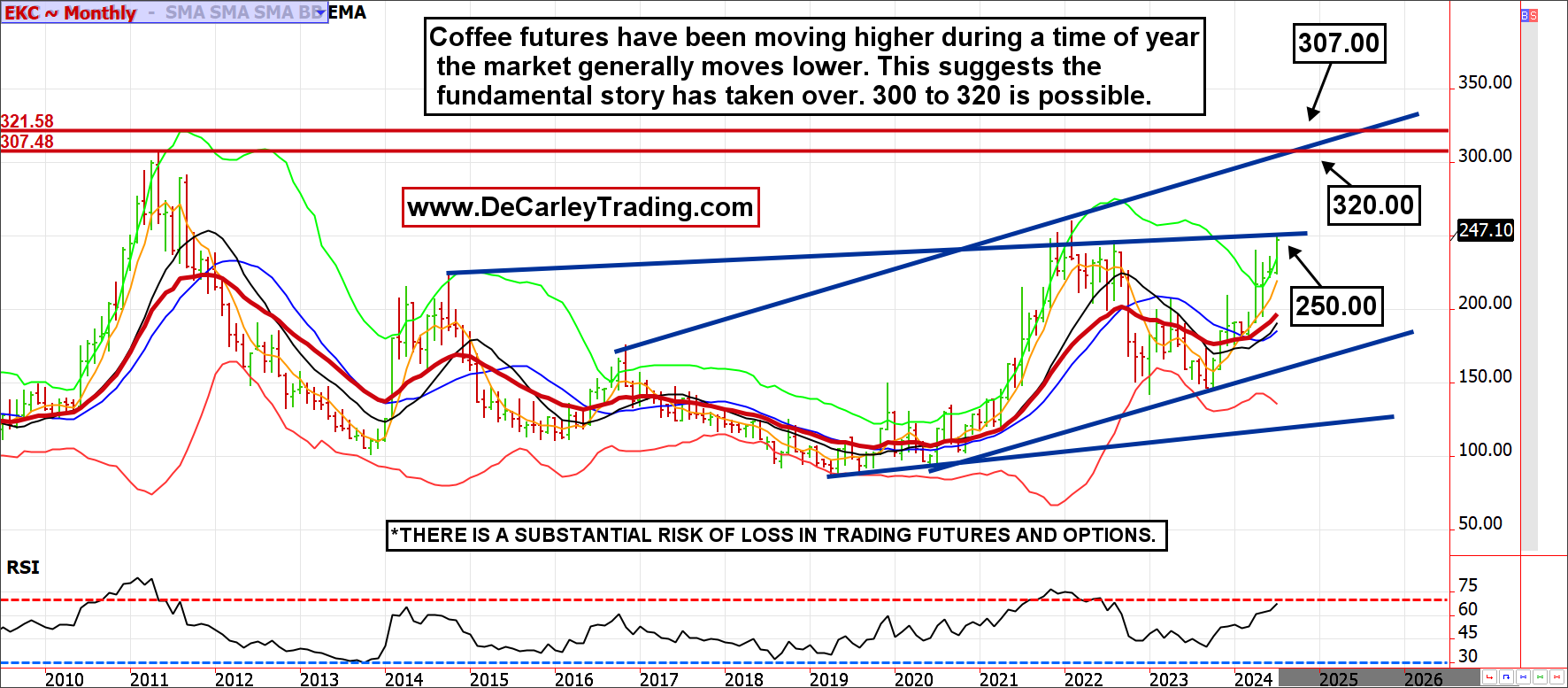
From a charting view, the coffee market appears overheated on most metrics. However, we are coming off three years of out-of-control softs rallies; sugar, cocoa and orange juice all went for a ride, and coffee seems due for its second, and likely last, wave. A break above 250.00 ($2.50 per pound) opens the door to a run into all-time highs at just over 300.00 and probably a little more as the market gets carried away and the shorts get squeezed.
Disclaimer: Coffee futures and options are not for beginning speculators; even experienced speculators must approach this market with kid gloves. As previously mentioned, coffee is grown in areas where the luxury of reliable and timely data doesn't exist. Further, it is traded on a different exchange (ICE) than most commodities (CME Group). The trading hours are limited and cater to non-U.S. market participants, liquidity is sparse, live price data is expensive and daily price fluctuation limits are either outsized or non-existent. Nevertheless, if you are watching from the sidelines, don't panic if and when prices spike to all-time highs. These, too, will eventually prove to be unsustainable.
At the time of publication, Garner had no positions in any securities mentioned.