Careful Where You Step in This Market
Tech is looking stretched, housing is looking weak and SpaceX is blasting past powerhouses like Amazon as other AI companies line up to go public.
You've reached your free article limit
You've read 0 of 1 free Pro articles.

It seems like this time around the Strait of Hormuz is on its way to be reopened soon, despite some details that need to be worked out. The oil markets certainly believe the agreement will hold as Brent crude has plunged to near $75/barrel. This is certainly good news for consumers who have dealt with gasoline over four bucks a gallon for several months now. It is also much needed help on the inflation front.
The U.S. economy certainly will benefit from supply chains getting normalized over the coming quarters. The economy and markets remain historically bifurcated and is being held together by the huge surge in tech and other spending related to the AI infrastructure build out. This activity accounted for roughly 70% of economic activity in Q1.
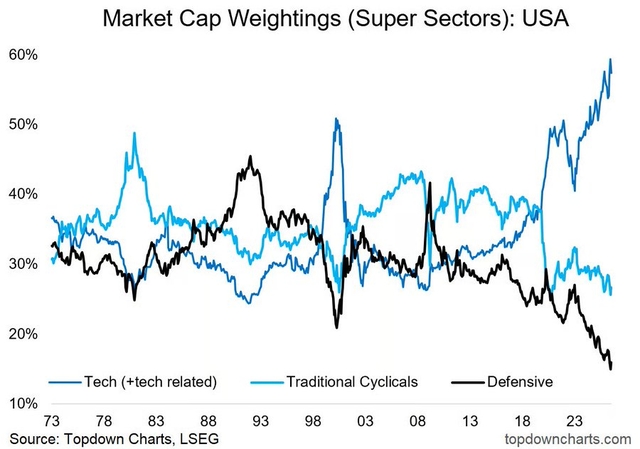
The market is more concentrated than even at the tail end of the Internet Boom. Technology and tech-related stocks now make up nearly 60% of entire market cap in U.S. equities. As Doug Kass noted on the Daily Diary yesterday, the semiconductor index has moved up just over 230% over the past 14 months. Albeit, the Philadelphia Semiconductor Index (SOX) did drop nearly 6% Tuesday.
That sort of move has only happened once before, from December 1998 to February 2000. The Internet Bust commenced the following month and would take 80% off the Nasdaq from peak to trough before bottoming in the summer of 2002. Micron Technology (MU) would drop 98% and would not see its 2000 highs again until 2018.
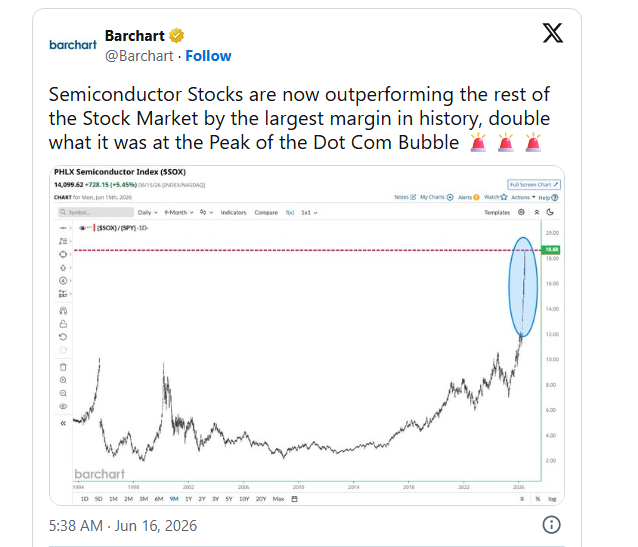
Semiconductors are driving stock market performance to a much greater extent than at any time in market history. It is 1999 redux on steroids. SanDisk (SNDK) is up nearly 4,500% over the past year even after pulling back in trading Thursday. Space Exploration Technologies Corp. (SPCX), which just came public Friday, surpassed Amazon (AMZN) in market cap yesterday. SpaceX lost nearly $5 billion in fiscal 2025 on less than $19 billion in sales. Amazon made over $90 billion and nearly $750 billion in revenue last year. And yes, I know, Elon Musk mused that SpaceX could get to $1 trillion in annual revenue by fiscal 2030. He also said robotaxis would be here years ago, so I would take his pronouncements with a large grain of salt.
Then we have OpenAI, which is hoping to follow SpaceX onto the public markets before the IPO window closes. Ed Zitron is reporting that losses went up nearly 8 times last year as spending rose to $34 billion in 2025. What possibly could go wrong? Meanwhile, Alphabet (GOOG), Oracle (ORCL) and even Nvidia (NVDA) are raising huge sums via debt and equity issuance. Morgan Stanley was out recently noting the hyperscalers have some $1.8 trillion of off-balance sheet liabilities, consisting of $1 trillion in purchase commitments and $800 billion in future lease expenses.
Outside of the buildout of massive AI data centers, construction seems to be declining in the rest of the economy. Housing starts in April and May have plunged and now are at their lowest levels since the Covid lockdowns. Lennar (LEN) incurred nearly 13% of homebuilding sales for incentives (EX, mortgage rate buydowns) in its most recent quarter to move inventory. That took average sales prices at Lennar down 24% from their peaks in 2022 and back all the way to 2017’s levels.
Home sellers now outnumber home buyers by a larger percentage than at any time since Redfin began tracking this metric in 2013. In Miami, home sellers outnumber home buyers by an absurd 160%. The housing market is cracking, the economy outside of AI is sputtering, and stocks are partying like the late innings of the Internet Boom. Not exactly a recipe that gives me much optimism for the overall market even as feelings of 1999 déjà vu increase by the week.
At the time of publication, Jensen was long AMZN.