'Big Short' Michael Burry Buys In and Now There's a Trading Dilemma
A Goldilocks economic narrative is driving strong moves, and the entry points are very difficult. How do I buy this very extended stock?
You've reached your free article limit
You've read 0 of 1 free Pro articles.
The S&P 500 is higher for the sixth day in a row and has completely recovered from a two-week correction period in which worries about economic growth caused panic. Following a weak July jobs report, there were calls for the Fed to deliver an emergency half-point but. There was discussion about how the Fed was behind the curve and should have cut rates long ago.
That narrative didn’t last for long.
After stronger-than-expected retail sales and soft weekly unemployment data, the market has embraced a Goldilocks narrative. The current view is that inflation is low enough that the Fed will cut rates, but the economy is strong enough to avoid a recession.
Market players are now afraid they are going to miss out on another major uptrend driven by big-cap technology. An oversold bounce has morphed into a V-shaped move, and overhead resistance is being ignored.
I’m feeling out of step with the action as the technical resistance has been forgotten, and there are no signs of seasonal weakness. I have little desire to chase right now.
From a trading standpoint, the problem with V-shaped action is that it doesn’t produce good entry points. For example, I want to add to my position in Shift4 Payments FOUR, but it has gone straight up and is up another 3.5% today on news that Michael Burry, who became well known for “The Big Short," had taken a position in the second quarter.
How do you find entry points in a chart that looks like this?
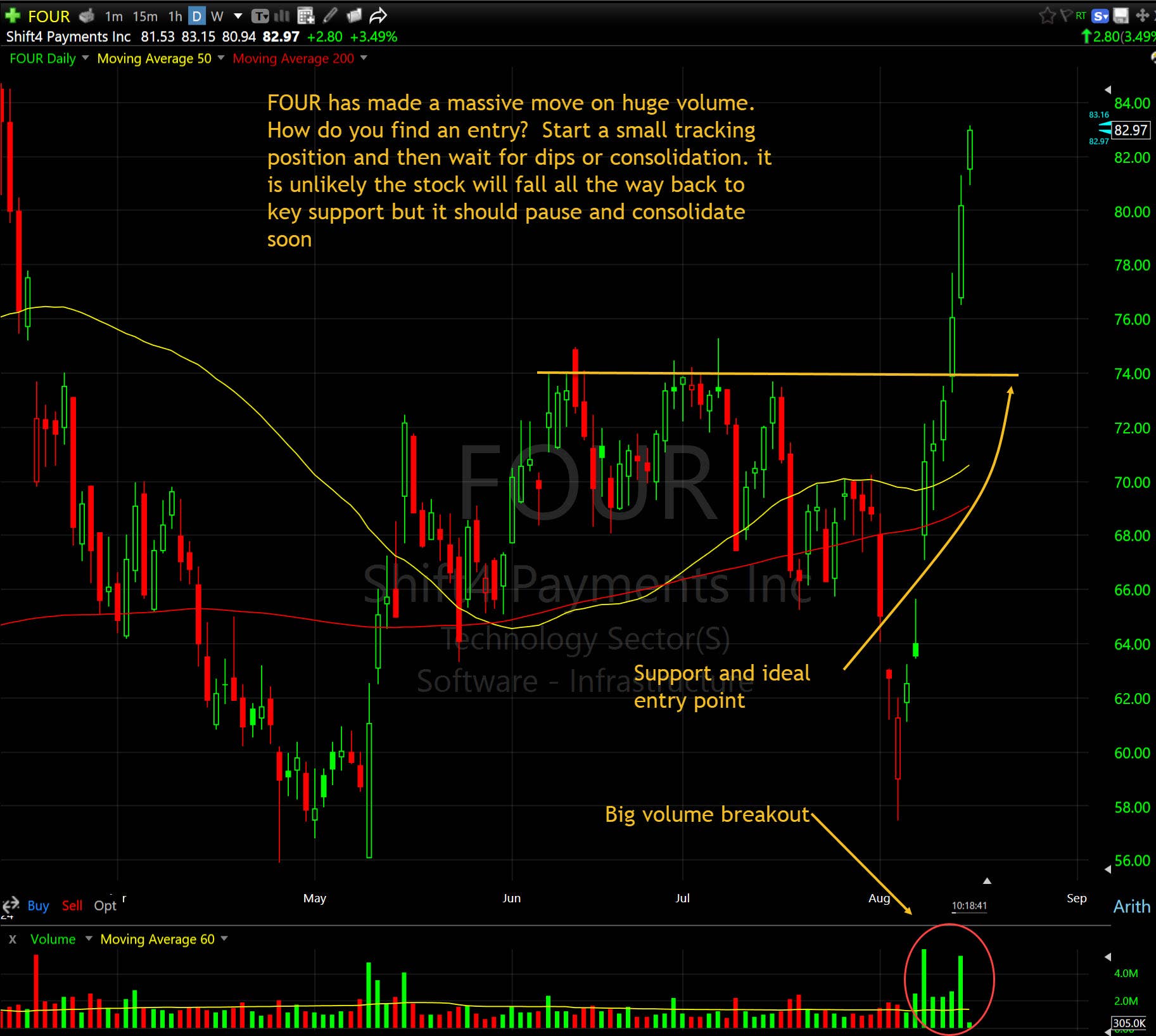
My approach is to take an initial position without any consideration of how extended it is technically. I want to have a position so that I’ll stay focused on the name and have a better feel of its behavior.
Next, I have to remain patient and wait for a pullback before basing my action. I want to make some incremental additions and will do so even if it doesn’t hit an ideal entry. The ideal entry would be in the $74 to $75 area, but when the relative strength is this strong, then it is unlikely to ever pull back that much.
It is a tough pattern to trade, but this level of strength suggests that the stock can move much higher over time.
Other stocks present the same dilemma, and quite a few exhibit no relative strength at all. As a result, I see limited opportunities unless I’m willing to be undisciplined in my trading.
At the time of publication, Rev Shark was long FOUR.