All Clear? Super Bad Margins, A Puzzling VP Pick, Playing the Discount Game
Was the selection of Minnesota Governor Tim Walz by Vice President Kamala Harris a partial cause for Tuesday's rally and overnight strength? Hear me out on this.
You've reached your free article limit
You've read 0 of 1 free Pro articles.
It felt nice seeing green across the screen for most of the Tuesday session. No denying that. Has anyone sounded the "all clear" yet? Haven't heard anything that sounded like an "all clear." Maybe we'll wait a few minutes before we remove our gas masks. Never know what's lingering in the air that we cannot see. Asian markets are higher. Europe is off to a good start as well. The U.S. dollar did spike against the yen last night.
Bank of Japan Deputy Gov. Shinichi Uchida sent global markets a dovish signal as he stated, "I believe that the Bank needs to maintain monetary easing with the current policy interest rate for the time being, with developments in financial and capital markets at home and abroad being extremely volatile." This of course came after the Nikkei 225 had given up almost 13% on Monday and rallied more than 10% on Tuesday.
That Japanese equity index is up little more than 1% on Wednesday as the greenback rallied from roughly 144 yen per dollar to more than 147. One U.S. dollar had been able to purchase more than 161 yen less than a month ago, which was a four-decade high, before the Bank of Japan had increased its policy rate from 0.1% to 0.25%. The BOJ did this while projecting tighter policy going forward and a halving of its quantitative easing program. What makes this situation in Asia unique is that the Japanese economy is currently mired in a state of recession.
So, it's not the end of the era of free or nearly free money in Japan, which would mean that there is still a yen carry trade. For now. I think we all know that the BOJ thinks that the yen has weakened to a far too great extent. That said, how does the Japanese central bank put a bid under the yen without roiling its own markets, much less global markets?
How does the BOJ ever get around to creating an environment capable of generating economic growth? Maybe it cannot, given the nation's demographics. Maybe it cannot, given that decades upon decades of the loosest monetary policy in the developed world already could not get that job done. Those policies did, however, create consumer-level inflation... without the growth to support it.
The BOJ certainly has a problem. Its next move is not clear. There will be pressure on both sides of that football.
Late Selloff
U.S. equity markets did rebound on Tuesday, but to far lesser degree of intensity than was felt up and down Wall Street during Monday's beat-down. Just look at the S&P 500 over the final hour of the regular session on Tuesday:
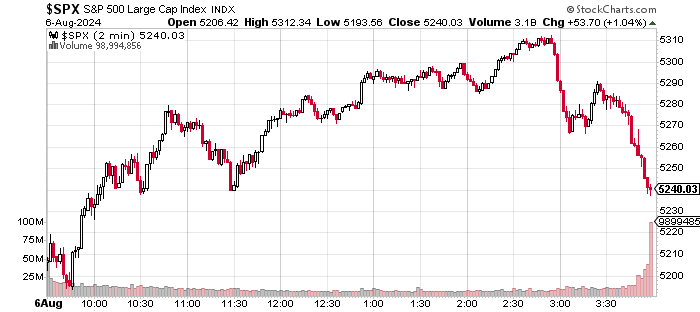
The index surrendered more than half of the gains made from the opening bell until 3 p.m. ET during that final hour. Is it any small wonder? The health of the U.S. economy is still a concern despite the "growthy-looking" July ISM Services PMI. Overall labor markets are still visibly weakening. The national "industrial recession" not only continues on for roughly two and a half years but seems to be accelerating. Credit-card and auto-loan balances are at record highs with delinquencies rising quickly.
On Tuesday, despite the rally, Peter Oppenheimer, who is chief global equity strategist at Goldman Sachs, stated, "My feeling is that this correction, although (it) is stabilizing, is not yet over. We're going to see, I think, some choppy environments in the short term as investors really start to calibrate and get more confident again about the direction of interest rates and the economy."
Not So Graceful
They say that Tuesday's child is full of grace or born with a special refinement about them. The late Tuesday bout of profit-taking or scalping that nearly wrecked the entire day's gains was anything but graceful.
Demand for Treasury debt securities, or safe haven, backed off as well. After a fairly strong auction of $58 billion in Three-Year Notes, the yield for the U.S. Ten-Year Note was pushed up by nine basis points to 3.89% as sellers swamped that market. The Two-Year Note paid 3.99% (+5 bps) by day's end. Overnight, Treasuries across the spectrum have sold off further, despite a strong evening for U.S. equity index futures.
For the regular session on Tuesday, the S&P 500 gained 1.04% as the Nasdaq Composite gained 1.03%. The Russell 2000 moved 1.23%, as the Dow Transports popped for a 1.46% run.
The gains were fairly even across the marketplace. All 11 S&P sector SPDR ETFs closed in the green, which was a reversal from Monday when all 11 closed in the red. The gains made though were not nearly as eye-popping as were Monday's losses. The REITs XLRE led the way, gaining 2.19% as six of these funds moved at least 1% higher. Oddly, a fellow defensive sector, Health Care XLV, finished the day in last (eleventh) place, gaining 0.46%.
Breadth was solid on Tuesday, though not as one-sided as was Monday's action. Winners beat losers by more than 3 to 1 at the NYSE and by almost 2 to 1 at the Nasdaq. Advancing volume took a 75.8% share of composite NYSE-listed trade and a 63.2% share of composite Nasdaq-listed trade. There was a significant drop-off in aggregate trade, however. Trade was lighter for names domiciled at both exchanges and across the memberships of both the S&P 500 and Nasdaq Composite.
This does signal greater institutional participation on Monday than on Tuesday and could be seen as a sign of caution. That said, as I mentioned earlier, equity index futures are trading higher. Perhaps the fear of an extended carry trade is/was a huge concern. Or maybe this sudden strength is something else.
Is it Political?
I write this while trying to do so without expressing personal opinion. Was the selection of Minnesota Governor Tim Walz by Vice President Kamala Harris as her VP running mate on the Democratic Party ticket a partial cause for Tuesday's rally and this overnight strength? I think this could be an algorithmic response to the improved prospects for Republican nominee, former President Donald Trump, to take back his old job.
Hear me out on this. No, algos do not bear political opinion. They are, however, algorithms that are programmed to respond to the possibilities of reduced regulation and lower taxes, which are central to the Trump platform. Markets may have also taken the Walz selection as a sign of capitulation on the part of the Democratic party.
Think about it. You had a moderate who could deliver Pennsylvania, which is a hugely important, t sometimes purple state. You also had a fighter pilot/astronaut who could deliver Arizona, another important but sometimes purple state. Instead, you chose a far-left extremist who can deliver a state already deeply blue. It makes no sense.
Minnesota always votes blue, and this selection likely puts moderates and independents that might have voted blue back into play, while also pushing non-Trump-supporting Republicans back into the red. Very poor selection strategically, unless the other possibilities both turned down the opportunity to play second fiddle with their eyes on the top job down the road. A loss here in 2024 as a VP candidate would likely dash those prospects, and I think we all saw last night just how charismatic Pennsylvania Governor Josh Shapiro is. I don't think that guy needs to play second banana to anyone.
Less Than Super
Super Micro Computer SMCI posted a horrendous fiscal Q4 earnings miss on Tuesday evening. Adjusted EPS of $6.25 fell almost $2 short of expectations, while the GAAP EPS of $5.51 missed by a "mere" $1.30 or so. Revenue landed right on consensus at $5.31 billion, which was good for year-over-year growth of 144%.
The artificial intelligence server company is experiencing a dramatic increase in demand for new AI-related infrastructure, and projected sales for both the current quarter and the full fiscal year just started well above consensus view. That said, the unexpected margin compression being experienced by the company has to be of concern to investors.
Clearly there are questions around this record demand that the pricing power that one might expect does not appear to be developing. The stock is trading 13% lower overnight, with a $536 handle after closing with a $616 handle — despite announcing the authorization of a 10-for-1 stock split that should go into effect on October 1. The stock peaked at $1,229 per share back in early March.
My Thoughts?
Play the game if you like when you see deep discounts for names you believe in.
I added to longs in Nvidia NVDA, Palantir Technologies PLTR and SoFi Technologies SOFI ahead of Monday morning's open. All three of those trades worked out nicely, with Nvidia and Palantir doing so spectacularly. That said, every portfolio needs to be anchored right now. That means that there has to be a more-than-token allocation towards the likes of the Utilities and precious metals or other defensives and/or stores of value until this volatility passes. If it passes.
Carry on, gang.
Economics (All Times Eastern)
07:00 - MBA 30 Year Mortgage Rate (Weekly): Last 6.82%.
07:00 - MBA Mortgage Applications (Weekly): Last -3.9% w/w.
10:30 - Oil Inventories (Weekly): Last -3.436M.
10:30 - Gasoline Stocks (Weekly): Last -3.665M.
13:00 - Ten Year Note Auction: $42B.
15:00 - Consumer Credit (June): Last $11.35B.
The Fed (All Times Eastern)
No public appearances scheduled.
Today's Earnings Highlights (Consensus EPS Expectations)
Before the Open: CVS (1.73), LYFT (0.19), RL (2.47), SHOP (0.20), DIS (1.19)
After the Close: BYND (-0.52), IONQ (-0.11), MCK (7.21), MNST (0.45), OXY (0.77)
At the time of publication, Guilfoyle was long PLTR, NVDA and SOFI equity.