A Violent Ceasefire, Jobs Day, and Is Thai Company Smuggling Tech?
Let's check the latest on the truce, what to expect for jobs numbers, Toyota's predicament, accusations of smuggled semiconductor tech.
You've reached your free article limit
You've read 0 of 1 free Pro articles.

CENTCOM released a statement. U.S. forces had "intercepted unprovoked Iranian attacks and responded with self-defense strikes."
The U.S. had “eliminated inbound threats and targeted Iranian military facilities responsible for attacking U.S. forces including missile and drone launch sites.”
CENTCOM for those unfamiliar, is the U.S. Central Command, one of 11 unified combat commands within the Department of War / Defense. CENTCOM is the area of responsibility that includes all military operations within the Middle East, Central Asia and parts of South Asia.
In a show of force, the U.S. Navy sailed three destroyers, the USS Truxtun, USS Rafale Peralta and the USS Mason through the Strait of Hormuz without any U.S. assets suffering any damage. Iran accused the U.S. of violating the fragile ceasefire between the two nations. The destroyers were, fortunately, more than able to defend themselves.
Pres. Donald Trump made sure that the media understood that the ceasefire was still in effect, referring to the incident as "just a love tap," though financial markets struggled with the news. The president may have made light of that incident, but was clear in what he wants from Iran. He added, "They trifled with us today. We blew them away. I'll let you know when there's no ceasefire. You're not going to have to know, you'll just have to look at one big glow coming out of Iran."
While rhetoric like that may or may not be helpful (we'll find out), the U.S. still waits for an Iranian response to a one-page memo that would or could set the stage for in-depth peace talks, re-open the Strait of Hormuz and lift the U.S. naval blockade. In the meantime, both Saudi Arabia and Kuwait have lifted restrictions on the U.S. military's ability to make use of bases inside those nations for offensive operations within the region.
Related: As Danger of a Reversal Builds, This Is the Most Important Chart to Watch
April Jobs Day
The Bureau of Labor Statistics will release the results from the agency's twin labor market surveys for April this morning. The professional consensus is for non-farm payroll job creation of roughly 62,000 positions across the nation for April, despite that ADP reported 109,000 private sector hires for the month. Very interestingly, the estimates I have seen of late, have trended lower with economists from JP Morgan down around 50,000 on the number and economists from Citigroup projecting job losses rather than job creation.
Readers will see below that my estimate is for 67,000 jobs having been created, putting my number slightly above broader expectations. I also expect that average hourly wages accelerated by 3.7% on a year-over-year basis, up from 3.5% in March, though I do think that we'll see a slight drop-off in participation (to 61.8% from 61.9%) that keeps the unemployment rate at 4.3% and the underemployment rate at an even 8%. Guess we'll know in a few hours, won't we?
A stronger report would reduce growing concerns over the potential for stagflation, which is the coexistence of stagnant economic growth and rising inflation. I don't truly consider this kind of inflationary shock to be anything more than "transitory" until energy prices and its impact upon other parts of the U.S. and global economies outlast the peace process. Then again, I am far from infallible and I have not always been spot-on in regard to the transitory nature of inflation driven in response to a crippled supply-side.
In addition, Federal Reserve officials, who are likely days away from serving under a new Chair, will be watching closely as they consider how to proceed amid these renewed inflationary pressures. Data reflective of a weaker labor market could put the probability for interest-rate cuts back on the table for the second half of this year, while healthier demand for labor would keep monetary policy on hold.
Hmmm....
Bloomberg News is reporting that a company behind Thailand's national effort toward keeping up in the artificial intelligence race is suspected of smuggling billions of dollars' worth of Super Micro Computer (SMCI) servers containing advanced chips designed by Nvidia (NVDA) to clients inside mainland China including Alibaba Group (BABA) . The company is believed to be the Bangkok-based OBON Corp. Allegations were laid out in a March indictment that does not name neither ONON nor Alibaba.
Rock! Rock! (Till You Drop)
Rock, Rock, give it to me
It's what I got going through me
Don't ever stop, whoa, do it to me
Rock, rock, you really move me, yeah
Whoa, yeah
Here we go
Rock, rock 'til you drop
Come on, rock, rock, never stop
Come on and rock, rock 'til you drop
We're gonna rock it 'til you drop, gonna take you to the top
- Lange, Clark, Allen, Savage, Elliott, Willis (Def Leppard), 1983
Toyota Trouble?
Japan's Toyota Motor (TM) reported a 49% drop in fourth-quarter operating profit, making for a fourth consecutive quarter of year-over-year of contracting profitability. Sales were fine. Revenue grew 1.9% year over year. The weaker yen has boosted the competitiveness of exporters such as Toyota by making its products cheaper for foreign buyers. This also increases the value of sales / profits when converted back into the home currency.
That said, Toyota stated that its research and development expenses hit a record high, in part due to certification-related issues and capacity constraints. The company expects to see at least temporarily increased expenses due to the conflict in the Middle East. In addition, Toyota acknowledges its current challenges, such as slowing sales in China, vehicle recalls, intensifying competition in the electric vehicle space, and Trump-related tariffs in the U.S.
Marketplace
Equity markets struggled on Thursday as the U.S. Navy and Iranian forces traded shots. Crude prices rebounded intraday while bond traders were net sellers (not overwhelmingly so) of U.S. Treasuries. The S&P 500 gave up 0.38% for the session, as the Nasdaq Composite surrendered a mere 0.13%. The more severe damage was done away from the major equity indexes. The Philly Semiconductors suffered a 2.72% beating, while the KBW Banks were slapped around for a loss of 1.67%. The small to midcap indices all took losses of between 0.9% and 1.63%.
While Datadog (DDOG) led the S&P 500 with a run of 31.3%, Zoetis (ZTS) led the losers within the index, giving back 21.5%. Perhaps most alarmingly, as Rev James "Shark" DePorre pointed out in his piece last night, 120 members of the S&P 500 hit 52-week lows on Thursday despite that index and others resting close to all-time highs. This clearly illustrates a bifurcated market where there are some mega and super large-cap "haves" as well as an increasing number of "have nots."
Breadth
Losers beat winners at the NYSE by a rough margin of seven to four and at the Nasdaq by about five to three. Advancing volume took a 36.7% share of composite Nasdaq-listed activity and just a 28.6% share of composite NYSE-listed trade. Aggregate trade was mixed. While activity increased 2.9% across Nasdaq-listing, it contracted 5.2% across NYSE-listings. Activity also slowed across the membership of the S&P 500.
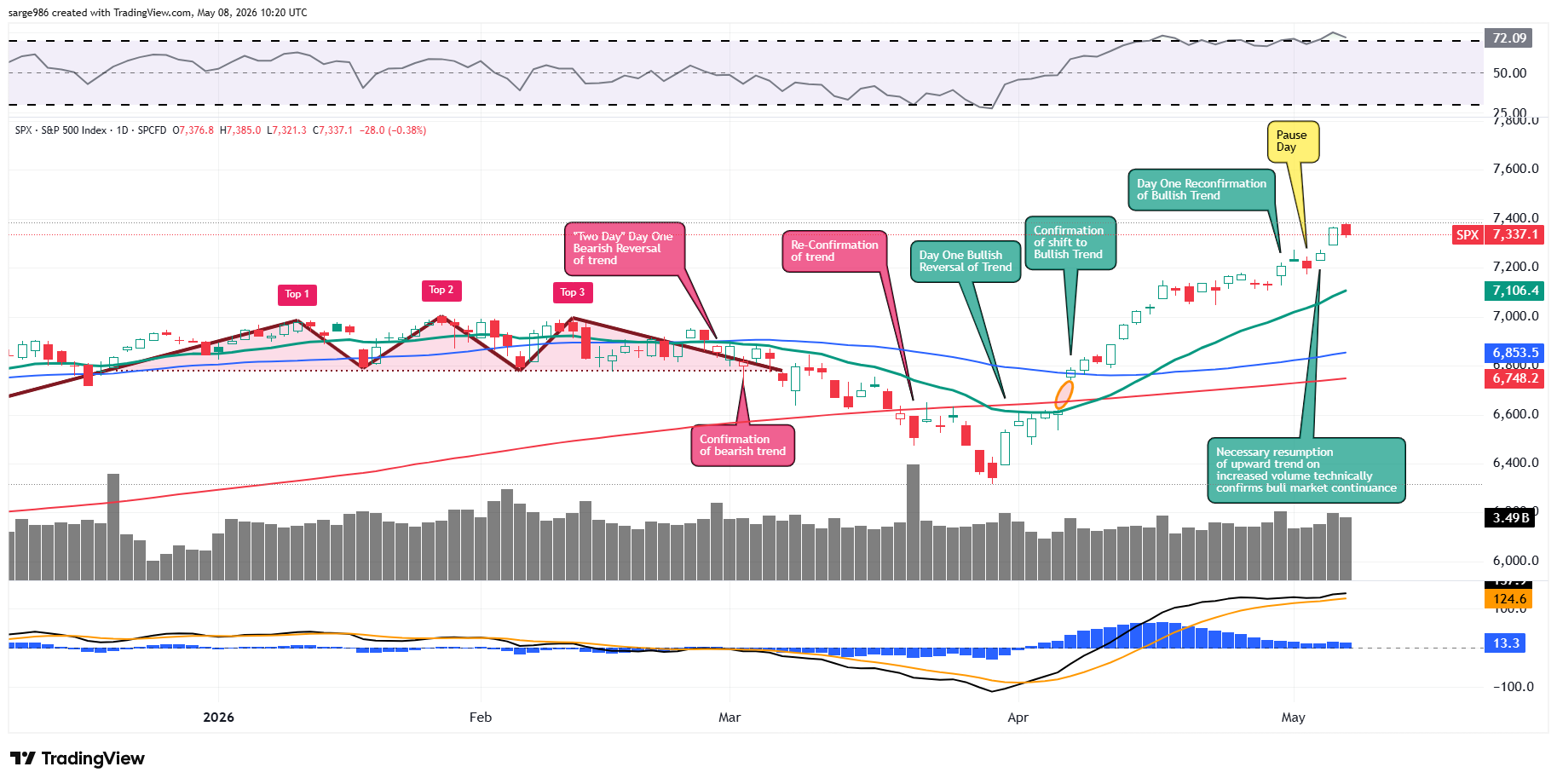
Nine of the 11 S&P sector SPDR ETFs closed out the Thursday session in the red, led by the Materials (XLB) and Energy (XLE) . Only two of these funds closed in the green, but just barely. Back in the glory days when shares traded in "Spanish pieces of eight" and not in decimals, these two funds probably would have closed "unchanged." Growth still outperformed the pack on Thursday. Cyclicals underperformed.
As readers will see, Thursday does not present as a "Day One" bearish reversal of trend die to the lower trading volume and the upward sloping daily range of trade. For the S&P 500, both the relative strength and daily moving average convergence divergence remain postured quite bullishly.
April Employment Situation
(08:30 ET)
Non-Farm Payrolls: Expecting 67,000, Last 178,000.
Unemployment Rate: Expecting 4.3%, Last 4.3%.
Underemployment Rate: Expecting 8.0%, Last 8.0%.
Participation Rate: Expecting 61.8%, Last 61.9%.
Average Hourly Earnings: Expecting 3.7% y/y, Last 3.5% y/y.
Average Weekly Hours: Expecting 34.2, last 34.2 hours.
Other Economics
(All Times Eastern)
10:00 - U of M Consumer Sentiment (May-adv): Expecting 49.4, Last 49.8.
10:00 - U of M One-Year Inflation Expectations (May-adv): Expecting 4.8%, Last 4.7%.
10:00 - U of M Five-Year Inflation Expectations (May-adv): Expecting 3.5%, Last 3.5%.
10:00 - Wholesale Inventories (Mar-F): Flashed 1.4% m/m.
1:00 p.m. - Baker Hughes Total Rig Count (Weekly): Last 547.
1:00 - Baker Hughes Oil Rig Count (Weekly): Last 408.
The Fed
(All Times Eastern)
7:30 p.m. - Speaker: Reserve Board Gov. Michelle Bowman.
7:30 - Speaker: San Francisco Fed Pres. Mary Daly.
7:30 - Speaker: Chicago Fed Pres. Austan Goolsbee.
7:30 - Speaker: Reserve Board Gov. Christopher Waller.
Today's Earnings Highlights (Consensus EPS Expectations)
Before the Open: (ESNT) (1.72), (OSK) (1.04)
At the time of publication, Guilfoyle had no positions in any security mentioned.