A Ceasefire With Lots of Fire; OECD’s Dire Warning, Another Tariff Try
Let’s check the latest from Iran, the OECD’s dire forecast, another round of tariffs … and my Marvell miss.
You've reached your free article limit
You've read 0 of 1 free Pro articles.

One Thing Leads to Another
The deception with tact, just what are you trying to say?
You’ve got a blank face, which irritates
Communicate, pull out your party piece
You see dimensions in two
State your case with black or white
But when one little cross leads to shots, grit your teeth
You run for cover so discreet, why don’t they
Do what they say, say what you mean, and baby
One thing leads to another
You told me something wrong, I know I listen too long but then
One thing leads to another
– Woods, Agius, Curnin, West-Oram, Greenall (The Fixx), 1982
Same as it Ever Was…
This seemingly never ends. Supposedly these peace talks continue. Supposedly there is a ceasefire in place. A ceasefire that America’s enemy in this conflict apparently does not recognize. Equity index futures have waffled close to the unchanged mark throughout the overnight session and into the zero-dark hours of Wednesday morning. Treasury yields have worked their way slightly higher (prices lower). Oil prices and subsequently… prices for gasoline are higher now than they were earlier in the week.
Why? U.S. forces, overnight, intercepted a number of Iranian missiles and drones that had been launched against Kuwait, Bahrain and civilian maritime vessels in the Strait of Hormuz. No, none of these attacks found their targets, but that’s not the point. Iranian military forces clearly do not recognize that someone in their leadership might be negotiating a peace deal. A lack of communication? Disregard for authority? Who knows. One must wonder if there were to be a deal agreed upon that on paper brought peace to the land, if those in Iran who control the missiles and attack drones would even care.
CENTCOM (U.S. Central Command) is reporting that Iranian forces launched two ballistic missiles at Kuwait that fell apart on their own without being shot down and three missiles at Bahrain that were indeed shot down by U.S. and Bahraini forces. Three attack drones were also launched at civilian craft that were shot down by the U.S. Navy. Iranian state media is reporting that these attacks were launched against U.S. military targets in retaliation for the U.S. having destroyed a communications tower on Qeshm Island earlier in the week. That tower was being used to control attack drones over the Strait.
OECD’s Take, Sarge’s Take
The OECD (Organization for Economic Cooperation and Development) has cut its outlook for global economic growth, while warning that unless a peace deal can be reached quickly between the U.S. and Iran, that outlook could weaken dramatically. In its June economic update, the Paris, France-based organization expects that the global economy grew 3.4% in 2025 and will grow 2.8% for 2026 before rebounding to 3.1% in 2027.
That projection assumes a limited disruption to maritime passage through the Strait of Hormuz. In a scenario where this disruption lasts into the second half of 2027, the OECD sees global economic growth of 2.1% for 2026 and just 1.8% for 2027. Of course, such a scenario would also force a number of reliant national and regional economies into a state of recession. In this worst-case scenario, global inflation is seen rising 0.4% for 2026 and 1.3% in 2027.
Under the less severe scenario, the OECD projects U.S.-specific economic growth to print at 2.0% in 2026, down from 2.1% for 2025. In an optimistic shift, the organization now sees U.S. inflation at 3.7% for 2026, which is down from their 4.2% forecast in early March which was just after the start of the war.
Sarge says: “The impacts of the closure of the Strait of Hormuz upon global economies, especially in Asia will force (and is already forcing) those economies to adapt. Going forward, regardless of diplomatic outcome, Asia will be less reliant upon the Strait. Iran has already done permanent harm to that nation’s own economy by forcing several advanced economies to explore other ways to get what they need.”
Another Tariff Try…
On Wednesday morning, both the Wall Street Journal and the Financial Times are reporting that late Tuesday, the Office of the U.S. Trade Representative released a report proposing tariffs of at least 10% on U.S. imports from Canada, Mexico, Taiwan, the E.U. and the U.K. among other nations. A 12.5% tariff would be placed upon imports from China, Japan, India, South Korea and Switzerland. These new proposals are now subject to public comment.
In all, the intention is laid out to impose tariffs on 60 countries for not doing enough to prevent the export of goods to the U.S. using forced labor. This leaves U.S. workers at a competitive disadvantage. This is the first attempt by the Trump administration to resurrect the idea of placing tariffs on trading partners since the concept was defeated at the Supreme Court earlier this year.
Marketplace
The major U.S. equity indexes inched higher on Tuesday to, yes, new record high closing levels. These markets sure did feel tired on Tuesday though, and they have for a couple of days now. While the S&P 500 squeaked out a gain of 0.13%, the Nasdaq Composite gained just seven points or 0.03%. Broder markets were outperformed by the small to mid-cap indexes that added between 0.87% and 0.9% for the session. Among narrower mid-major indices, the Dow Transports and the Nasdaq Biotechs closed in the red, but the KBW Banks and the Philly Semiconductors roared.
Of course, those semis were led by the 32.5% surge made by Marvell Technology (MRVL). Yeah, I’m down around 12% on that short. Most of that loss happened while I was sleeping. Lousy idea. I’ll cover that this morning rather than throw some good money after bad. The tech sector was also helped along by the 9% upward move made by Hewlett Packard Enterprise (HPE). Treasury yields really did not move much on Tuesday, but as mentioned above, have started moving higher overnight.
Breadth
There was not a lot of direction visible in the markets on Tuesday. Winners beat losers at the NYSE by a seven-to-six margin while losers beat winners by a smidgen at the Nasdaq. Advancing volume took a 50.2% share of composite NYSE-listed activity on Tuesday, but just a 43.2% share of composite Nasdaq-listed trade. Aggregate trade contracted on a day over day basis across NYSE-listings, across Nasdaq-listings and across the membership of the S&P 500. This was a second consecutive day of decreased interest by professional managers, which might make early week price discovery less meaningful, at least technically, ahead of the jobs data. It could also be a warning shot as peace talks in the Middle East appear to stall.
Seven of the eleven S&P sector SPDR exchange-traded funds did manage to close in the green on Tuesday, led by the utilities (XLU) and tech (XLK). Communication services (XLC) finished a distant last as Internet stocks sold off and the media agencies took a nasty hit. That group was paced by a 9.1% loss by The Trade Desk (TTD). A bright note? With the exception of those utilities, cyclicals again, in the aggregate, outperformed defensives.
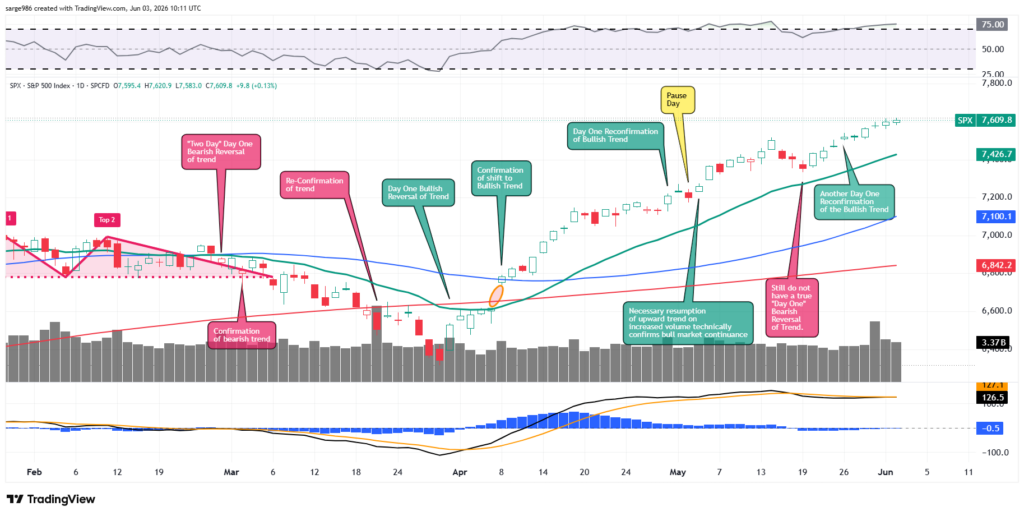
One can easily see that our day-to-day charting of the S&P 500 has been pretty much spot on over several months in predicting shorter-term market behavior. Currently, the bullish trend most recently confirmed or re-confirmed on May 26 remains intact. Relative Strength is still entrenched above the 70 level. It has been there or close to it since mid-April.
Interestingly, as the market has appeared to lose at least some of the wind in its sails over the past two days, the daily moving average convergence divergence appears to be strengthening. The histogram of the 9-day exponential moving average remains slightly negative. A push into positive territory by this component of this indicator would be a short-term bullish signal. Additionally, the 12-day exponential average appears ready to cross above the 26-day EMA with both of those lines residing well above the zero-bound. Such a reality would be a more medium-term bullish signal and likely force a positive algorithmic reaction across the S&P 500.
Economics
(All Times Eastern)
07:00 – MBA 30 Year Mortgage Rate (Weekly): Last 6.65%.
07:00 – MBA Mortgage Applications (Weekly): Last -8.5% w/w.
08:15 – ADP Employment Change (weekly): Last 109K.
09:45 – S&P Global Services PMI (May-F): Flashed 50.9.
10:00 – ISM Non-Manufacturing Index (Dec): Expecting 53.7, Last 53.6.
10:00 – Factory Orders (Apr): Expecting 3.8% m/m, Last 1.5% m/m.
10:30 – Oil Inventories (Weekly): Last -3.327M.
10:30 – Gasoline Stocks (Weekly): Last -2.572M.
The Treasury & The Fed
(All Times Eastern)
10:00 – Speaker: Treasury Secretary Scott Bessent.
2:00 p.m. – Beige Book.
4:00 – Speaker: Dallas Fed Pres. Lorie Logan.
Today’s Earnings Highlights (Consensus EPS Expectations)
Before the Open: M (.03), MDT (1.55)
After the Close: AVGO (2.40), CRWD (1.07), FIVE (1.76), PVH (1.82), VEEV (2.14)
At the time of publication, Guilfoyle was long CRWD equity. Short MRVL equity.