Who Let the Dog Out?
Now that Chewy is off its leash, will it continue to be a good boy?
You've reached your free article limit
You've read 0 of 1 free Pro articles.
After becoming a darling for both pet owners and investors during the pandemic, online pet retailer Chewy CHWY found itself in the doghouse. On the heels of a stunning 210% return in 2020, investors in the Plantation, Florida-based company suffered losses of 34.4% in 2021, 37.1% in 2022, and 36.3% in 2023.
On the weekly chart, a long-term trend line (blue dotted line) kept Chewy at the market’s heel for three years. Then, after a strong earnings report in late May, that trend changed direction.
After three years of rolling over and playing dead, Chewy awoke and started howling at the moon. Chewy broke its bearish trend line, and now the stock is on an absolute tear.
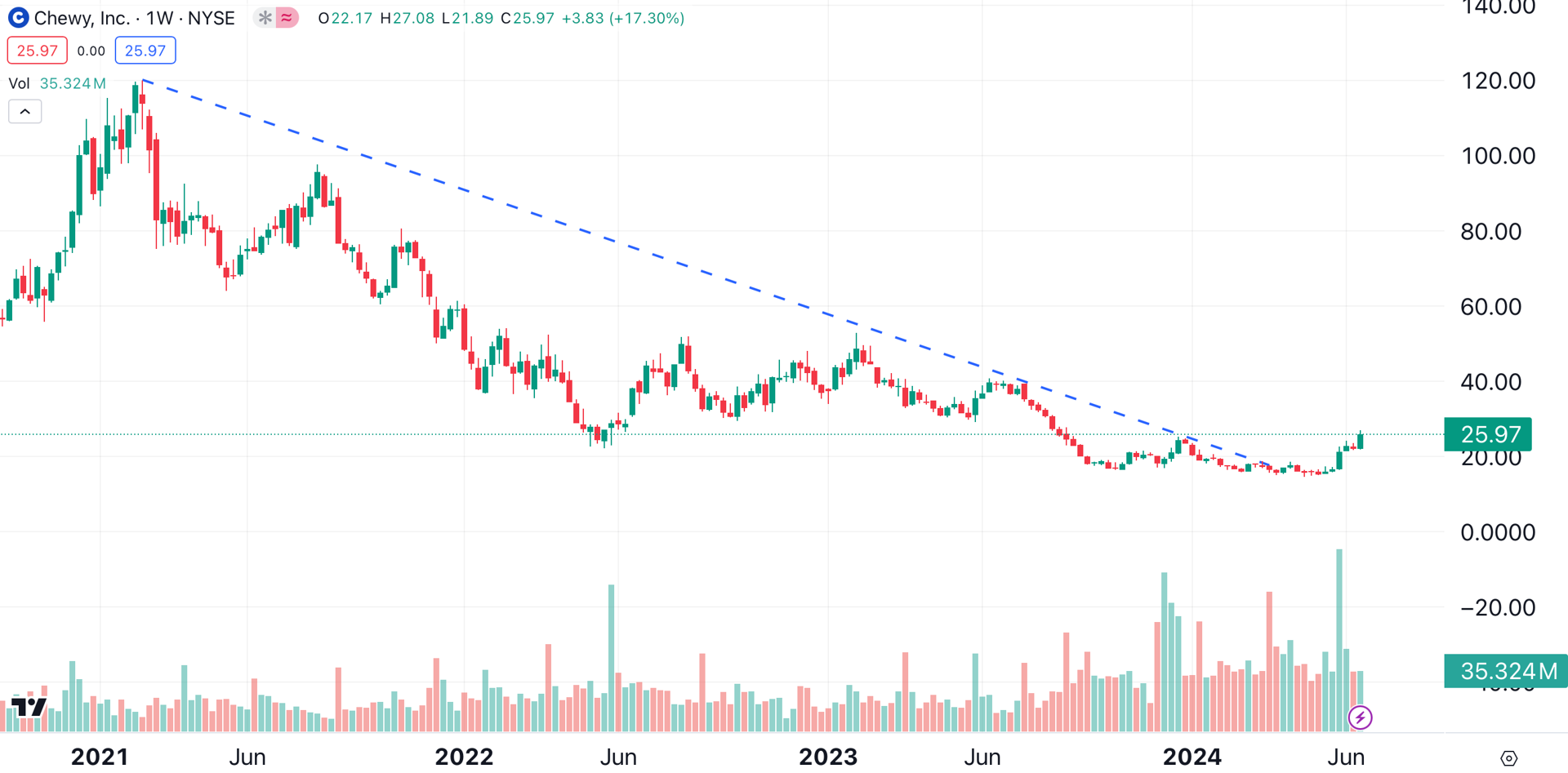
Now let’s zoom in to the daily chart for a closer perspective. Not only has this stock broken out, Chewy is trading well above its 200-day moving average (red, $18.78) and its 50-day moving average (blue, $22.94).
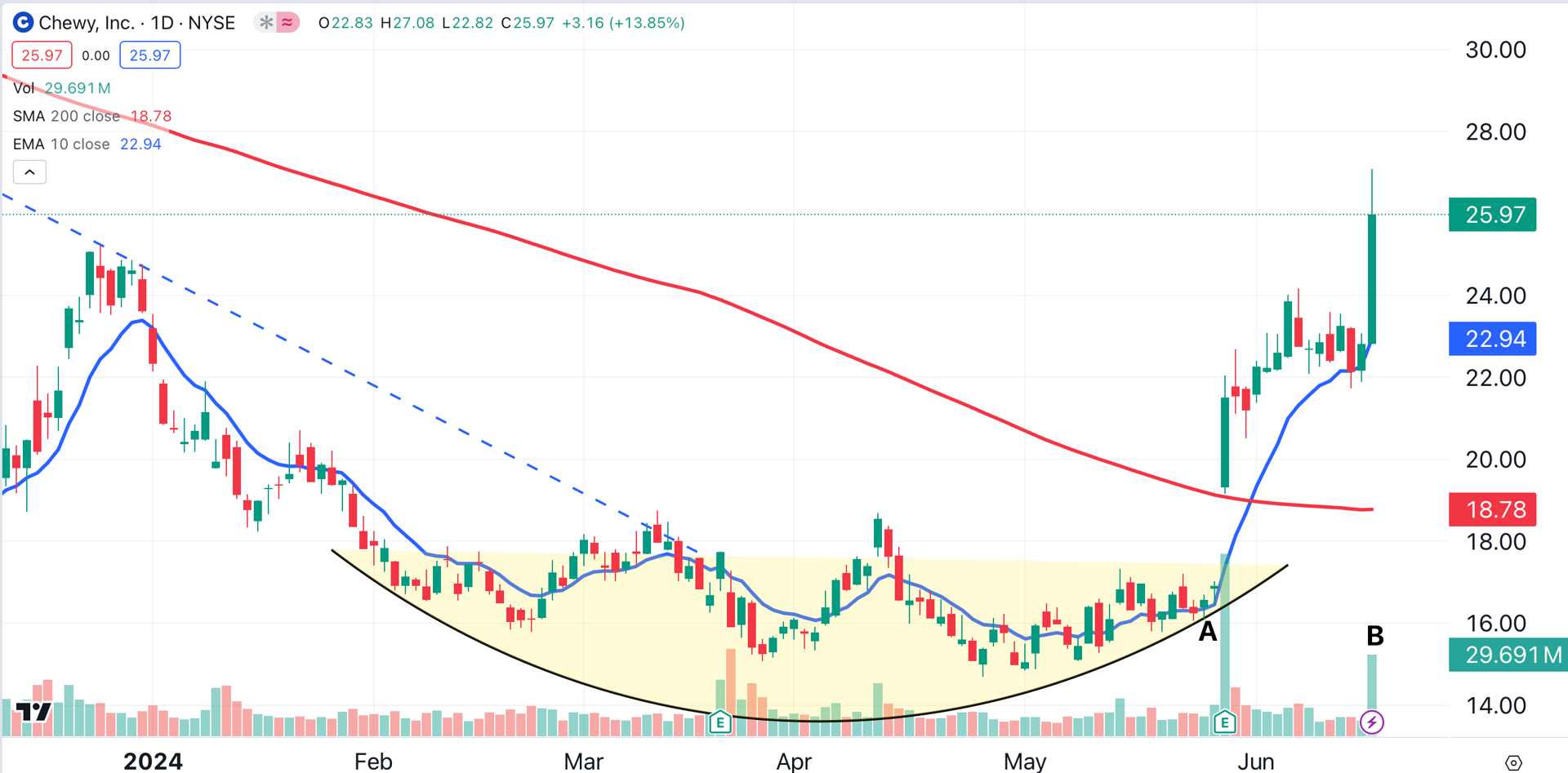
Prior to its breakout, Chewy formed a rounded bottom pattern (shaded yellow). Technically, the target for that pattern has already been reached. Chewy has gained just over 60% since May 28 (point A).
On Tuesday, Chewy jumped 13.85% on heavy turnover (point B) and closed at its highest level since late August. The stock has climbed over 20% since we recommended it on May 30.
Why is Chewy receiving so much affection from investors lately? After the company’s recent earnings report, venerable investment bank Goldman Sachs (GS) placed a buy rating on Chewy, with a target price of $35.
That might not seem like a big deal, but it was appreciated by shareholders. In the investment world, Chewy isn’t widely loved.
The stock’s sky-high valuation has made it a target for short sellers. As of May 31, short interest stood at 18.44 million shares, or 13.79% of the float.
That’s not necessarily bad news for shareholders. It might be helpful to think of every short as a future buyer. Shorts enter a position by selling, and exit that position via buying.
When a heavily shorted stock begins to rise quickly, this can result in panic-buying, known as a short squeeze. No doubt, the 60% gain that Chewy has experienced since late May has forced some shorts to buy, in order to cover their positions and limit their losses.
Chewy shorts have felt tremendous pain over the past three weeks, and are likely to be chastened by their losses. To put it another way, once bitten, twice shy.
At the time of publication Ponsi was long CHWY.