Normalization of Reversals, Bulled Up, Palantir at Pivot, Smart and Dumb Money
This week provided the latest example of why retail traders can no longer be considered the "dumb" money. Plus, what got the crowd bulled up, Taiwan Semi's July sales soar and more!
You've reached your free article limit
You've read 0 of 1 free Pro articles.
The normalization of reversals. That's where financial markets are now.
This week, the S&P 500 and Nasdaq Composite specifically, but almost all major to mid-major U.S. equity indexes, suffered a terrible beat-down on Monday. That had been a third consecutive sharp selloff as that reversal had begun last Thursday.
Tuesday morning, U.S. stocks roared out of the gate, were up huge for most of that day and then gave up more than half of that rally over the final hour of the regular trading session.
They slapped equities around again on Wednesday, making a new closing low for the Nasdaq Composite for the week, but not a new intraday for the week for either index. That turned out to be huge, technically. For, on Thursday, stocks were again strong, so strong as a matter of fact, that they kept on going all day. Both the S&P 500 and Nasdaq Composite closed regular trading hours on Thursday near the top of the day's range.
As I get going on Friday morning, my P/L and where I see U.S. equity futures tell me that equities have had a pretty good overnight session headed into this week's grand finale.
The Catalyst
It didn't take much on Thursday to get the crowd "bulled" up. There has not been a lot of domestic macroeconomic data or "Fed speak" this week, so the algorithms that are set to react to these items and any keywords spoken around them are left grasping at straws. All it took on Thursday was a lower-than-expected print for weekly initial jobless claims less than a week after the poorest monthly BLS employment report since the height of the pandemic shutdowns.
Initial claims for state-level unemployment benefits fell to 233,000 for the week ending August 3 from 250,000 filings for the week prior. There was notable improvement across three states that have been recent hotbeds of unemployment. Those states are Michigan, Missouri and Texas.
This helped alleviate, if not fears for an oncoming economic recession, at least fears that we are headed there in a hurry. Unfortunately, continuing claims increased more than expected from 1.869 million a week earlier to 1.875 million.
Before anyone gets too cozy, continuing claims are not just running at their highest level since the pandemic shutdown spike but are also now running well above the 2018/2019 pre-pandemic norms.
Who's the 'Smart' and 'Dumb' Money Now?
We already know, or at least can make an educated guess, that professional money ran for the hills on Monday due to the intensity of aggregate trading volumes shown for that session. According to data collected by JP Morgan and reported on CNBC's website, individuals (or retail) traders bought $302 million worth of stock on Tuesday and Wednesday after having sold a net $2 billion worth of stock last week.
How interesting is that? I know it's not everyone, I know that there are and were outliers, but it looks like retail traders sold stock ahead of the Japanese yen carry-trade collapse, let the big kids sell stock at the lowest prices, and then bought the dip. Now, maybe we'll find out that this was no dip, but a little sideways wiggle on the way to a worse or even much worse place.
That said, increasingly over recent years, and this is just the latest example, we have found that as large institutions continue to rely more and more on algorithms and less and less on human traders, and as retail traders have more access to higher quality information than ever before, that the pros are no longer the "smart" money and retail traders can no longer be considered the "dumb" money. They may not be able to bring as much weight to the point of sale, but the little guys have certainly figured out how to outwork and out-trade the big kids.
Score one for you folks reading this morning note. Huzzah!
Ignored!
On Wednesday a subpar auction of $24 billion worth of new U.S. 10-Year Notes added fuel to the selloff fire. The U.S. Treasury Department held another high-profile auction on Thursday that did not go quite so well. This time equity traders kept doing what they were doing, and the rally on Thursday didn't skip a beat.
For those that missed it, early Thursday afternoon, Treasury announced the results for its auction of $25 billion worth of new 30-Year Bonds. Bid to cover was in line with last month's auction at 2.308, so that wasn't the issue. However, the high yield award of 4.314%, like Wednesday auction, tailed the "when issued" by more than three basis points. Again, foreign demand was not the issue, as Indirect Bidders took down 65.3% of the issuance.
Direct Bidders, or domestic buyers took down just 15.5% of the auction, well below the recent average for that group of more than 18%. Dealers were stuck with a 19.2% allocation, which was the most they as a group were forced to absorb since the November auction for this series.
Marketplace
For one thing, the VIX dropped to 23.72 on Thursday, a far cry from the high tick of more than 65 on Monday. I think the report by the quants over at JP Morgan that the yen carry trade was probably three quarters done did a lot for sentiment and was certainly picked up by those sometimes pesky keyword-reading algos.
The S&P 500 gained 2.3% for the session, the best one-day performance by our bellwether since November 2022. The Nasdaq Composite tacked on 2.87% for the day. As a matter of fact, among major to mid-major equity indexes, the Dow Transports had the worst day, and that index was up 1.68%.
The Philadelphia Semiconductor Index screamed higher by a whopping 6.86% led by Arm Holdings ARM, Marvell Technology MRVL and On Semiconductor ON. Those three were up 10.6%, 8.9% and 8.8%, respectively.
All 11 S&P sector SPDR ETFs closed in the green for the second time in three days, as Tech XLK ran away with first place for the day with a +3.73% performance. Four more of these funds gained at least 2% for the day, while only three failed to gain 1%. The Utilities XLU, which one might think would trade off on a day like this, still gained 0.11% for a last place finish.
Chips Ahoy!
Early this morning, Taiwan Semiconductor TSM reported July sales. Remember, TSM manufactures high-end chips for the likes of Apple AAPL, Nvidia NVDA and Advanced Micro Devices AMD, among others. Well, revenue for July for the world's most active wafer foundry was up 23.6% month over month from June, and up 44.7% year over year from July 2023.
Keep in mind that Taiwan Semi had posted a strong second quarter and had guided towards a stronger-than-expected third quarter.
Palantir at Pivot
I am sure fellow investors in Palantir Technologies PLTR noticed the news on Thursday that the firm was teaming up with Microsoft MSFT to bring secure cloud, AI and analytic capabilities to the U.S. defense and intelligence community.
The agreement will integrate Microsoft's large language models via the Azure cloud platform with Palantir's AIP (AI Platform) in Microsoft's classified cloud environments. Palantir will deploy Foundry, Gotham, Apollo, and AIP in the Azure Government Secret and Top Secret clouds including DoD Impact Level 6.
Palantir was up 11.25% on Thursday and tested the $30 pivot point that we had discussed earlier this week.
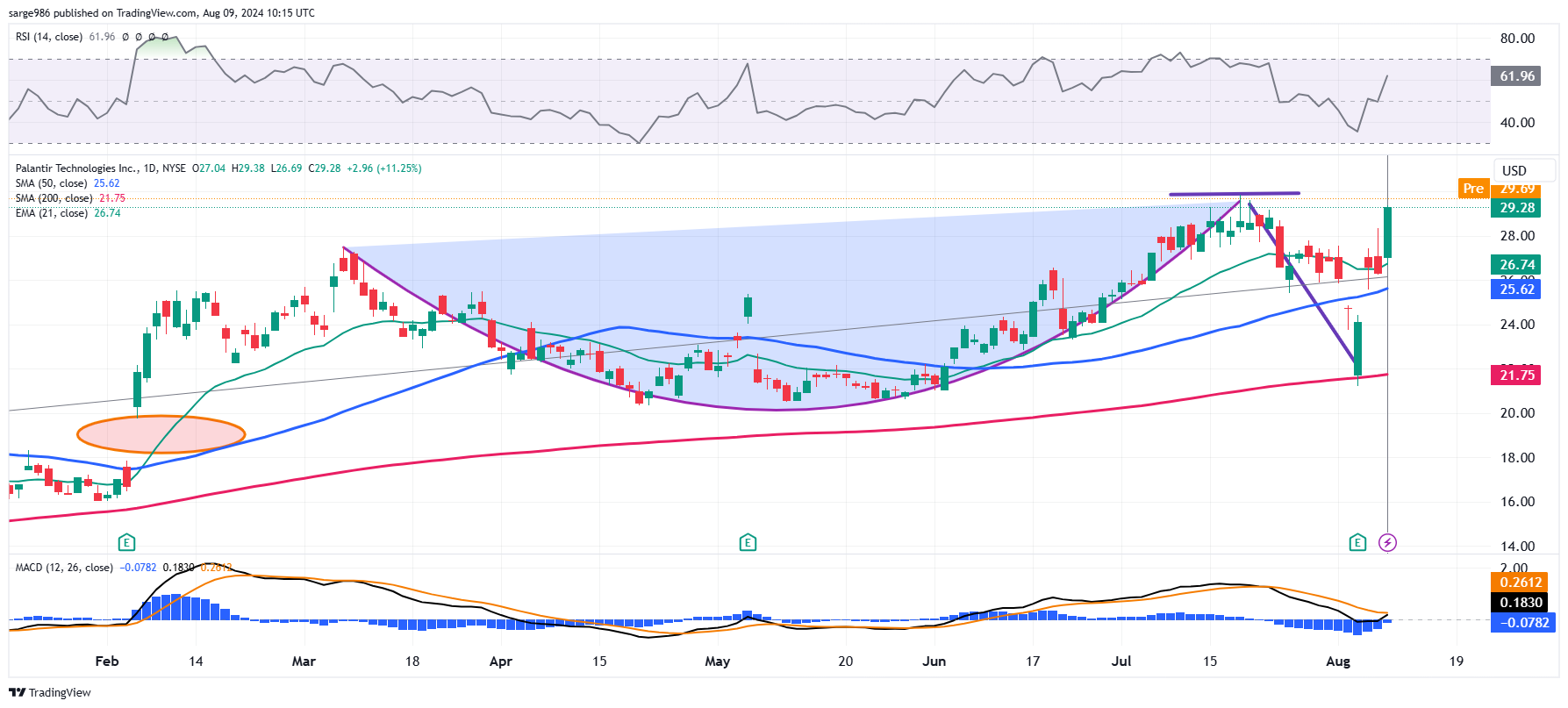
Readers will see that the pivot had indeed been pierced to the upside but not held. The stock closed at $29.28, and I see a last sale of $29.69 while I type through the zero-dark hours. Just to refresh some memories, my levels for PLTR are as such:
Target Price: $36
Pivot: $30
Add: Down to the 200-day SMA
Panic: Loss of the 200-day SMA
Economics (All Times Eastern)
13:00 - Baker Hughes Total Rig Count (Weekly): Last 586.
13:00 - Baker Hughes Oil Rig Count (Weekly): Last 482.
The Fed (All Times Eastern)
No public appearances scheduled.
Today's Earnings Highlights (Consensus EPS Expectations)
Before the Open: ROAD (0.55), SLVM (1.58)
At the time of publication, Guilfoyle was long XLU, NVDA, AMD, PLTR and MSFT.