No Amount of Ketchup Can Make McDonald's Earnings Go Down Easy
Let's see how to handle the fast food giant as its quarter gets pounded.
You've reached your free article limit
You've read 0 of 1 free Pro articles.
I tried to help McDonald's MCD. By that, I mean that I contributed to sales. I guess it wasn't enough. Fast food giant McDonald's Corporation had a rough quarter.
We all (every wall Streeter I talked to) expected a rough quarter, and still somehow almost everything fell short of consensus view. McDonald's posted its second quarter financial results on Monday morning, showing that "Burgers," which was the firm's nickname, earned an adjusted $2.97 per share (unadjusted EPS $2.80) on revenue of $6.49 billion.
These top- and bottom-line results both fell short of Wall Street's expectations as revenue actually contracted small on a year-over-year basis. The adjustments made were made for the pre-tax charges related to the South Korean business and internal efforts to modernize the way individual restaurants do business.
Comp sales were awful. Globally, comparable sales were down 1% from the year-ago period vs. expectations for a gain of 0.8%. U.S. comps printed at -0.7% vs. expectations for 1%. Negative guest counts were the obvious problem here that was only partially offset by growth in average ticket. International Operated Markets suffered a 1.1% decrease in comp sales from the year-ago quarter. Wall Street was looking for growth of 1.9% here, so that's a 3% miss. Performance in France weighed heavily on this segment. Lastly, International Development Licensed Markets suffered a 1.3% decline vs. projections for a decline of "just" 0.4%. Poor performance in China more than offset positive sales growth in both Japan and Latin America.
Operations
While total sales were down small (far less than 1%), revenues from franchised restaurants saw "small growth," while company-owned stores took a 1% hit. The costs of sales and operating expenses combined came to $3.57 billion (+5%), leaving an operating income of $2.92 billion (-6%). After accounting for taxes and interest, net income printed at $2.022 billion, which was down 12% year-over-year. This works out to $2.80 per diluted share, down from $3.15 for the same quarter a year ago.
Outlook
McDonald's expects net restaurant unit expansion to contribute almost 2% to systemwide 2024 sales growth in constant currency. It sees 2024 operating margin in the mid-to-high 40s in percentage terms. McDonald's expects full-year capital spending to reach a range spanning from $2.5 billion to $2.7 billion, of which more than half will be directed toward new restaurant unit expansion. Globally, it expects to open more than 2,100 new restaurants with over 1,600 coming from the International Developmental Licensed Market segment. This is all a re-affirmation of previously given guidance.
Lastly, the McDonald's expects to achieve a free cash flow conversion rate in the 90% range. That reminds me, it did not release balance sheet nor statement of cash flows with the press release. Nor did MCD publish a Form 10-Q under the investor relations section on their website. For the first quarter, McDonald's posted its Form 10-Q to the website eight days after posting the Form 8-K. Therefore, a thorough fundamental analysis of the financials is impossible at this time.
Historically, McDonald's has been a consistent driver of rather robust free cash flow... meaning that most quarters, the print hits in between $1.5 billion and $2 billion, give or take. That said, at least until the completion of the March quarter, MCD has operated with a challenged balance sheet. The current ratio fell below the key 1.0 level back in the first quarter and I would love to see if McDonald's were able to return the balance sheet to a more robust posture this quarter. At that time it had way too much debt on the books in my opinion relative to cash on hand. We'll have to check in in a week plus and update this piece when the 10-Q posts.
The Chart: I'm Not Lovin' It
There's not much here to get excited about. Performance is weaker than expected. Obviously, the concern that through inflation, McDonald's core customers, typically the budget conscious, have to some degree been priced out. The stock was trading higher ahead of the opening bell. Maybe these results, while below consensus, were better than feared. I do not see a reason to buy the shares.
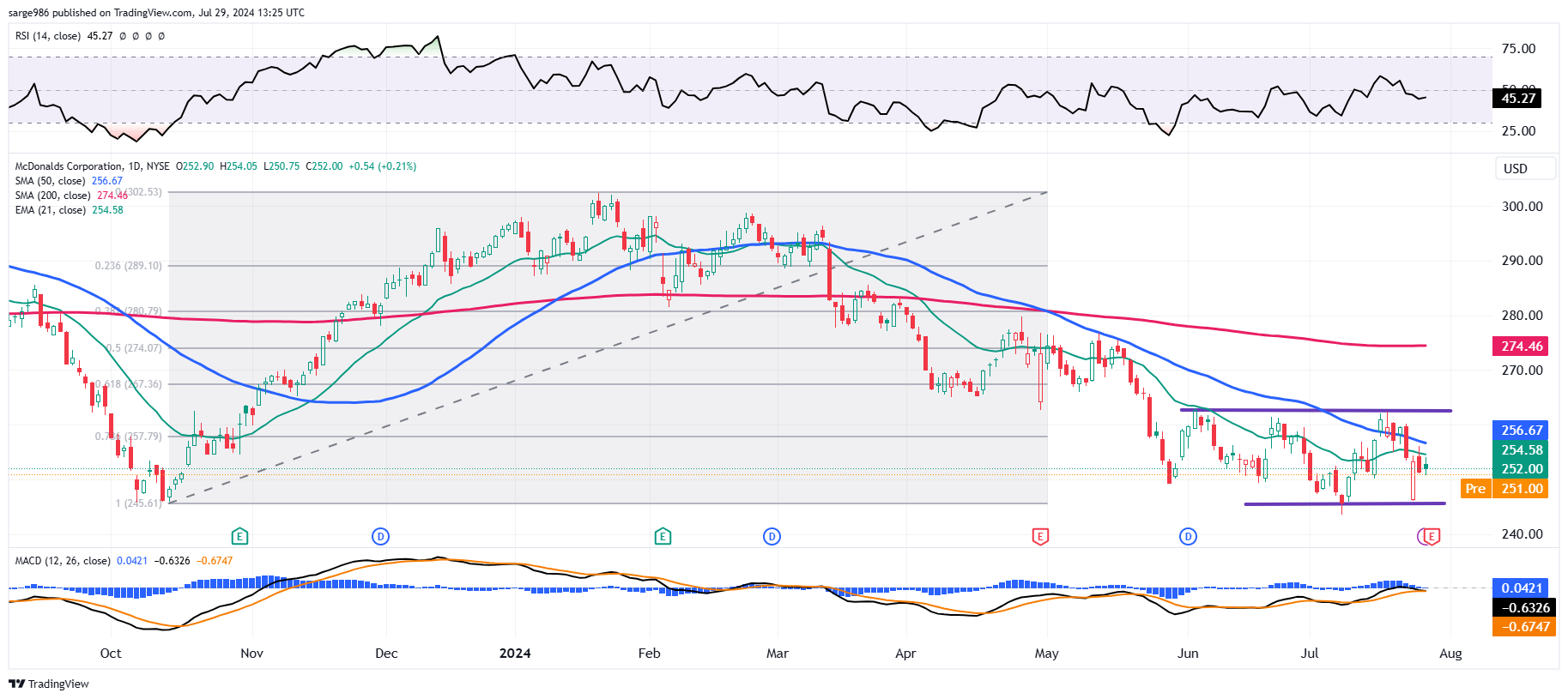
Readers will see that the shares of MCD have completed a 100% retracement of all of October into January earlier this month. The shares have now formed a base of consolidation, which can be healthy, and can also be a pattern of continuance. The base comes with a $262 pivot to the upside and a $245 pivot to the downside. The shares have now surrendered all of their key moving averages.
Should support crack here, I see the $230 area as a potential landing area as that spot supported the stock three separate times in the autumn of 2022. That spot cracks and I think we are talking about the $217-ish area. If the U.S. consumer is in trouble, this is one place, where we'll see that reality reflected.
In my opinion, MCD is possible to short up to the 50-day simple moving average, which is currently $254. A stop-loss order position at an 8% loss to net basis would be my panic point.
At the time of publication, Guilfoyle had no position in any security mentioned.