It Is Tough, But Rewarding, Being a True Contrarian
The field is wide open, and chances for success quite high for people using traditional fundamental investing. Let's take an updated look at my top-10 holdings.
You've reached your free article limit
You've read 0 of 1 free Pro articles.
I first started investing in 1978. Then got really excited about it during 1982, when the Dow Jones Industrial Average (DJIA) bottomed out at a now hard to believe 782 points.
Interest rates had hit north of 12% on money market accounts. Average dividends on even blue-chip stocks ran well below bond coupon rates. That provided plenty of competition for stocks making “risky” investments appear to be a foolish choice.
Many of the best companies in America were offered at multiples of from 4 to 8 times current earnings while also sporting 3% to 9% current yields. Utility shares often paid double-digit yields and offered federally tax-free, and commission-less dividend reinvestment on up to $1,000 per year per company.
Owning stocks was defying conventional wisdom. I was like a kid in a candy store.
Back then there were no discount brokers. Trading commissions ran about $1 per share, regardless of the stock price. That meant a $2 round-trip, making short-term trading quite expensive, especially on lower-priced shares.
Average holding periods ran about 7.8 years as investors mainly placed long-term bets on stocks which looked promising.
Everything has changed radically since then. In theory, there are no longer commissions on stock trades. Options contracts run only about 50-cents to one dollar per contract.
Average holding periods for shares is now well below one year. Traditional long-term holders are few and far between. The most popular options contracts are now same-day expirations.
Traders who only intend to hold for hours, days or weeks, care little about valuations.
That leaves the field wide open, and chances for success quite high for people using traditional fundamental investing.
It is said that the price of success must always be paid in full, and always in advance. The cost for contrarians is the frustration of being “out of step” with most other people. You can look stupid and suffer humiliation in the short-run even though you are relatively sure you will become much richer over time.
Friday August 16 was an option expiration day that saw a huge chunk of my original investments in Caleres CAL get called away after a greater than four-year holding period. I saw huge previous gains on expired covered calls and naked puts with CAL over past years as well.
The following year-to-date profit reports (source: TradeStation) show my net realized gains on my traditional and Roth IRA accounts. A good chunk of those gains came from multi-year ownership of both American Woodmark AMWD and CAL. Both those stocks took turns as my #1 largest dollar holding over the past few years.
It feels good to be able to defer taxes on the traditional IRA’s profits. It feels even better knowing the huge gains taken in my Roth IRA will be tax-free forever. My home state of Pennsylvania does not impose state-level taxes on IRA distributions from any type of IRA.
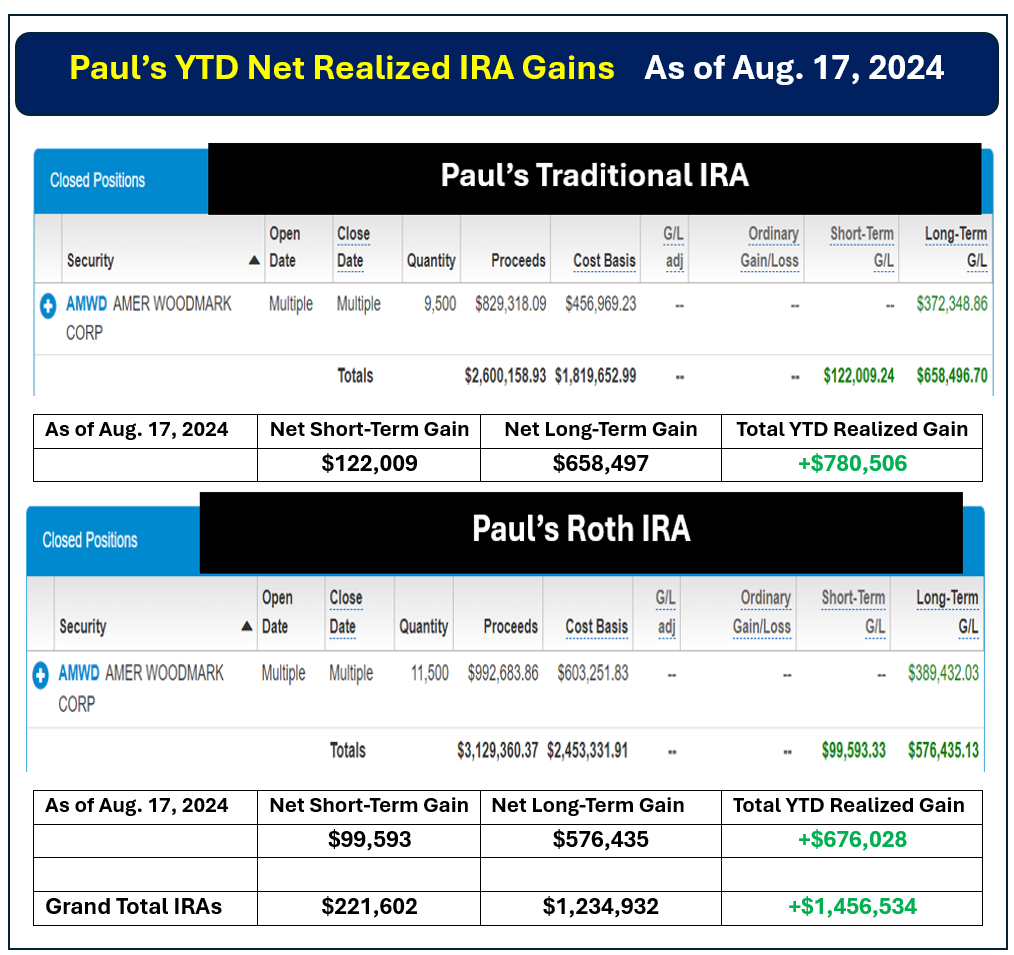
A full 84.8% of the total net combined IRA realized gains were from long-term holding periods. You do not generally make king-sized profits from frantic in-and-out trading.
Converting traditional IRA assets to Roth IRAs via taxable conversions makes incredible sense for the long-term. It is the only way to keep greedy politicians’ hands off your life-time nest egg for both yourself, and later off, your heirs.
Large market declines make for the perfect way to pre-pay taxes at beaten-up valuations while allowing subsequent rebounds to take place in tax-free status.
People lucky enough to have total assets large enough to be subject to estate taxes also see any pre-paid taxes on Roth conversions come at discounts that can range from 40% and even higher. Why is that? The amounts of tax bills paid up front will no longer be subject to estate tax later.
Under current law inherited IRAs to non-spouse beneficiaries will still get a full decade of tax-free status before being forced to be emptied out.
My taxable brokerage account has also shown large, realized gains year-to-date. As with my IRAs over 84% of all those were long-term in nature.
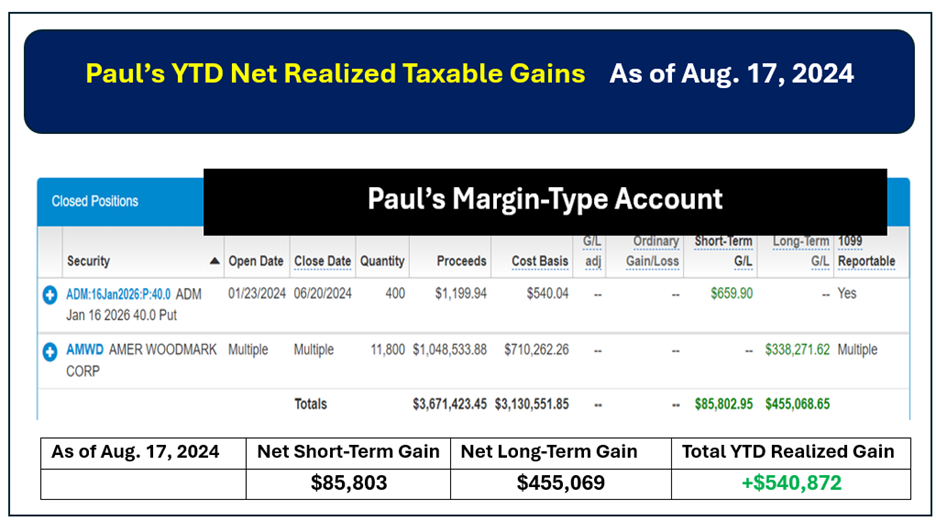
Taking a longer investment horizon pays off. Most of this year’s gains were booked on shares purchased some years ago.
The list below shows my top dollar holdings right now. I still hold decent sized, but much reduced positions in Caleres and American Woodmark. Most of those remaining shares have covered calls written against them at various price points.
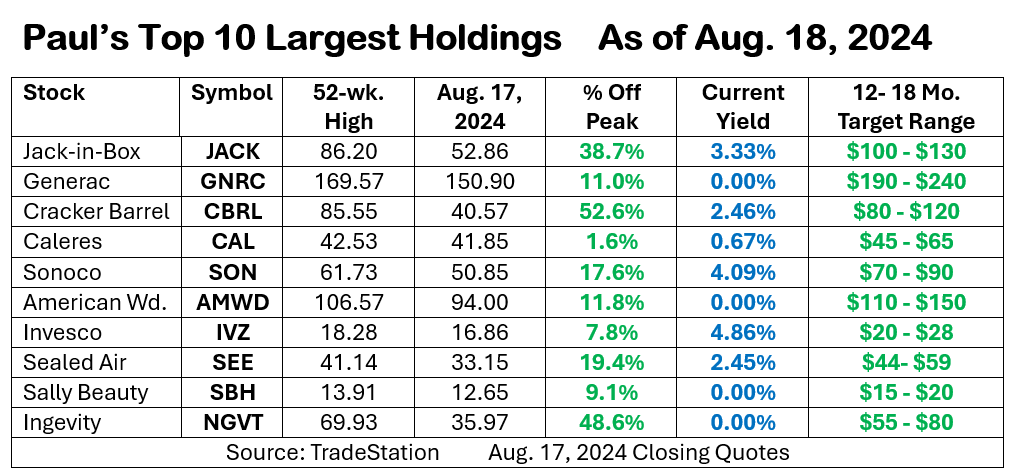
Generac GNRC, my second largest current holding, is not far from its 52-week peak. It did hit $524 during November 2021, though, leaving plenty of upside above its recent top.
Similarly, Cracker Barrel CBRL peaked between $118 and $185 during each of the eleven years stretching from 2013 through 2023. My $80-$120 goal price range might turn out to be ultra-conservative.
Sonoco SON is a Dividend Aristocrat. It raised its annual payout 41 straight years and has paid cash distributions without fail for over 90 years.
Sally Beauty SBH makes my list now due to large purchases on Monday Aug. 5, 2024, in the low $9s on the day the DJIA dropped over 1,200 points intra-day. SBH routinely fetched $18.40 to over $30 per share at peaks during each of the dozen years from 2012 through 2023.
Ingevity NGVT top-ticked between $79.80 and $120.40 during each of the seven years 2017–2023. It changed hands near $70 just over a year ago.
Invesco IVZ is a high-yielding stock with decent upside as well. It traded above $41 during both 2014 sand 2015. It peaked at $29.70 during 2021.
Jack in the Box JACK carved out a $124.50 all-time high during 2021. Projected EPS for FY 2025 (ends Sep. 30, 2025) should be not far off from what was posted in 2021.
Give these stocks a reasonable time to get revalued and they should provide outstanding profits. Six of the ten names pay dividends while you wait.
At the time of publication, Price was long shares and short options on all stocks mentioned.