From Peter Boockvar:
Positives,
1) Initial jobless claims plumbed a new multi year low at 187k, 23k less than expected and down from 209k in the week before. This brings the 4 week average down to 208k from 215k. Continuing claims were just below 1.8mm at 1.796mm, little changed w/o/w.
2) The S&P Global US composite PMI rose to 53.6 from 51.9 with the World Cup helping the services sector, along with the July 4th 250th anniversary festivities. The manufacturing component fell a hair to 53.8 from 53.9. They said on manufacturing, “It was worrying – though not unexpected – to see manufacturing growth weaken as some of the stock building seen in prior months showed signs of fading. Instead, July saw a concerning intensification of supply chain delays and accompanying renewed upturn in price pressures, constraining growth and subduing demand.”
3) New home sales in June totaled 628k annualized, 21k above the estimate and May was revised up by 38k to 618k. Months’ supply remained elevated at 9.3. Regionally it was mixed as sales in the South rose to the most since last November but fell in the West to the least since 2014.
4) Container prices fell w/o/w out of Shanghai. After 10 weeks of gains, they fell for a 2nd week to LA, by 6% and to NY by 3.5%. To Rotterdam, they were down a more modest 1% w/o/w.
5) From Google/Alphabet: Search revenue rose 17% y/o/y, YouTube by 13% and “Cloud revenue grew 82%, powered by strong demand for AI infrastructure and AI solutions. And cloud backlog grew to $514 billion.”
6) From Tesla: “Q2 continued the trend that we saw at the end of Q1, a resurgence in demand for vehicles across the globe. We achieved record Q2 deliveries globally, with sequential growth across Americas, APAC, and EMEA of 60%, 27% and 12% respectively. Additionally, Model Y set records in several key markets, including the Netherlands, Australia, and New Zealand.”
7) From American Airlines: “Revenue strength was broad based, reflecting robust demand for our product and an improving pricing environment. Geographically, all regions exceeded our initial expectations during the quarter.”
8) From United Rentals: “construction posted strong growth led by non-residential and infrastructure. And on the industrial side, power continues to post double digit growth, while metals and minerals also grew at a healthy rate…In the quarter, we saw projects kick-off in a variety of end-markets, including hospitals, airports, and LNG terminals to name a few, while data centers continue to be a source of growth.”
9) From Robert Half: “Many of our small and mid sized business clients continue to operate with lean organizations after several years of disciplined cost management. As confidence improves and strategic priorities advance, we’re seeing demand for specialized talent and consulting expertise to help execute those initiatives. While clients continue to approach hiring thoughtfully, we are seeing steady progress in client interactions and activity.” And, “Artificial Intelligence continues to complement, not replace the work performed by the professionals we place. We’re seeing growing demand for candidates who combine deep domain expertise with AI fluency and the judgment required to apply these technologies effectively and responsibly, including verifying the accuracy of their outcomes.”
10) From Texas Instruments: While market thinks it’s as good as it gets, “In the second quarter, revenue came in above the range as we saw continued growth in industrial and data center in addition to accelerated growth in automotive.” Their personal electronics business was flat y/o/y but up “upper single digits sequentially” and “communications equipment “grew both y/o/y and sequentially.”
11) From STMicroelectronics: As good as it gets here too? “During the quarter demand increased further, with strong bookings in all end markets. We saw improved visibility and signs of tight supply in several product categories.”
12) From PulteGroup: “Net new orders in the quarter increased by 6% over the same period last year, as we realized higher orders across all buyer groups. Active adult orders were up 12%, while orders among first time buyers increased 5%…I think it’s fair to say from day-to-day and week-to-week, consumer activity was impacted to varying degrees by global tensions, macroeconomic uncertainty, and the material movement in interest rates. Still, we were able to drive higher orders in the period with strong performance across all buyer groups. Along with increased sales, we are also seeing homebuyers that are willing to pay for superior locations and the upgrades that they value most.”
13) From CSX: “Stronger demand led to volume growth across our business.”
14) From Capital One: On their consumer, “So, the US consumer and the overall economy remain resilient, resilient despite the high energy prices and everything. When you pick up the news every day, one would think the world’s falling apart, but actually the consumer continues to perform remarkably well. The unemployment rate in June was lower than in February before the Iran conflict began. Jobless claims remain low. Job creation has rebounded over the past few months. Consumer spending remains strong.” More, “Now as a result of inflation, real wage growth turned negative in April and May on a y/o/y basis. But it was back in positive territory ever so slightly in June as inflation ticked back down. When we look at bank balances and debt servicing burdens of our customers, these look a bit stronger than a year ago across income levels. And our domestic card business, our credit metrics, continued to improve on a y/o/y basis in the quarter…we see real strength in the consumer and strength across our business performance in card and in auto. And that’s why while we keep a very wary eye on the economy and international developments, we are leaning in with a lot of positivity into our growth strategies.”
15) From Fifth Third Bancorp: In terms of loan growth, “Overall, we continued to see demand in sectors and markets benefiting from infrastructure investments, as well as in aerospace and defense.” Also, “On credit, trends were benign and improving” as net charge-off rates were down “with stable trends across industries and geographies despite the continued market volatility.”
16) From MMM: Strong performance was seen in “adhesives, abrasives, aerospace, electrical markets, and safety.” More, “Semiconductor, aerospace and data center business segments, comprising approximately 20% of sales, grew double digits.”
17) From GM: “The business continues to perform very well. Customer demand in North America remains steady, including for our pickups and SUVs, and pricing is consistent.”
18) From Domino’s: “The QSR industry in the US has been struggling with order counts during a difficult period of macroeconomic uncertainty. We believe this continued in Q2, where QSR order counts were flat. And despite this backdrop, demand for Domino’s remained incredibly strong. While we have not shared specific order count numbers in the past, and I won’t start sharing them now on my last call what I will tell you is that our order counts were up meaningfully in total and individually in our delivery and carryout businesses. This means that while other restaurants were fighting for orders, millions of new customers came to Domino’s.”
19) Japan’s June core/core CPI rose 1.7% y/o/y vs the estimate of 1.8% and still kept subdued because of subsidies but still above the overnight interest rate. The headline CPI gain was also 1.7% but with the renewed jump in oil prices, this news is old.
20) The Japanese July manufacturing PMI was little changed but staying firmly above 50 at 54.7 while services slipped to 51.9 from 52.2. S&P Global said “The cloud of war in the Middle East continues to loom over the Japanese private sector. Manufacturers continued to report efforts to build stocks of goods and raw materials amid ongoing supply chain disruption and higher prices linked to the conflict, despite a slight easing in overall cost inflation over the month. Selling prices continues to rise sharply, with service charge inflation accelerating as firms sought to protect already squeezed margins by passing higher costs on to clients.”
21) Australia’s July services PMI was higher by 2.5 pts to 53 and manufacturing was 51.7 vs 51.5 in the month before.
22) In the Eurozone, services rebounded back above 50 at 51.6 from 49.4 while manufacturing improved again to 52 from 51.4. S&P Global said “Germany is reporting growth for the first time in four months. France’s downturn has softened to the weakest since February, and the rest of the region as a whole is growing at a pace not seen since last November as its order book inflows jumped to a degree not beaten in over four years.” And, “The improving picture also spreads to the labor market, where companies reported the first rise in payroll numbers so far this year as business growth expectations revived to the highest since February.”
23) Services in the UK drove the lift in its PMI as it rose 3 pts to 51.8 m/o/m. Manufacturing was up to 52.8 from 52.5. S&P Global said “Hospitality companies saw demand boosted by good weather, the FIFA World Cup (England was so close!) and more domestic holidays, as high costs and uncertainty continued to deter some foreign travel. However, overall services growth remained lackluster amid cost of living pressures.” With manufacturing, “manufacturers and their customers continued to build precautionary stocks, widely linked to supply chain disruption caused by the war in the Middle East, meaning part of the recent factory upturn could prove short-lived.”
24) The ECB left its deposit rate at 2.25% as fully expected and the September meeting is live but uncommitted.
25) French business confidence in July improved by 2 pts m/o/m to the highest since March mostly helped by services and retail.
26) In the UK, the CBI industrial orders index for July was much less negative at -36 vs -65 but business is still tough. CBI said “We’re seeing manufacturers being squeezed from both sides. Costs continue to climb while weak demand limits their ability to raise prices – leaving firms to absorb the pressure through shrinking margins, weaker investment and further cuts to employment.”
27) The UK headline June CPI at 2.6% was one tenth below the estimate, the core rate of 2.6% was one tenth above with services inflation running at 3.6% y/o/y, also one tenth higher than expected.
28) Also in the UK, payrolled employment fell by 4k but the estimate was for a drop of 8k and follows a gain of 3k in June. Jobless claims in June rose 6.7k and May was revised sharply lower by 30k. As of May, their unemployment rate held at 4.9%. Also through May, weekly earnings ex bonus rose 3.4% y/o/y as expected and the same pace seen in April.
29) The July German ZEW investor confidence index of the German economy improved to 26.3 from 10.5 and above the estimate of 15.3. The Current Situation though was still deeply negative at -77.6 but up from -81 in June. The ZEW said “The economic outlook continues to improve in July; it seems that the reforms are having an effect. Especially the export oriented sectors as well as domestic demand experiencing sustained growth. Nevertheless, the uncertainty associated with the developments in the Iran conflict and the oil price remain a crucial factor affecting the prospects for a recovery of the German economy.”
30) German PPI in June fell .3% m/o/m after robust gains in the three months prior while up 1.8% y/o/y.
31) Congrats to Spain on your World Cup victory.
Negatives,
1) Another week of rising market driven interest rates globally.
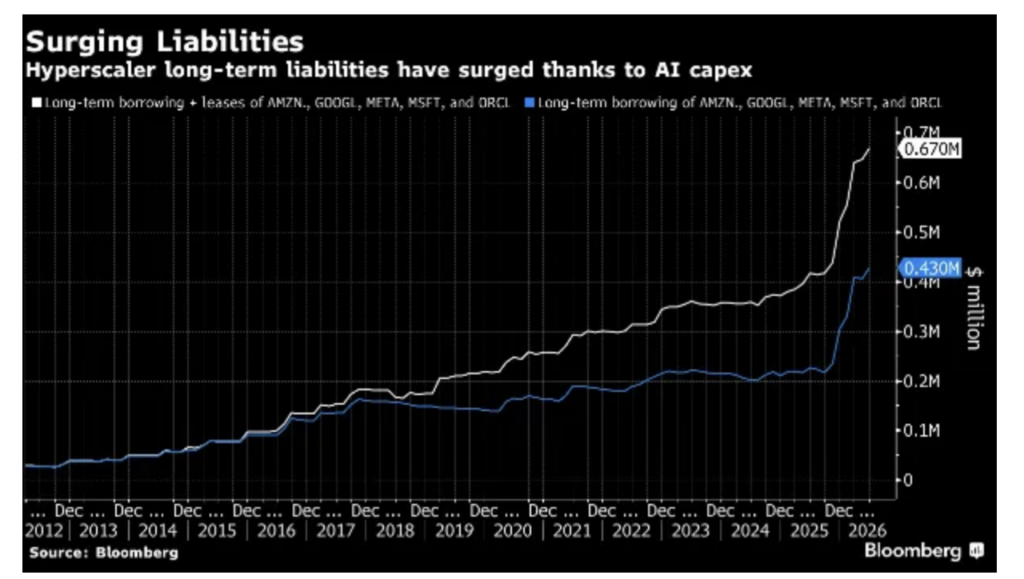
2) From Alphabet/Google: For the first time ever, “We had negative free cash flow of $5.9 billion in the second quarter, driven by our investments in CapEx.” And, “we are updating our full year 2026 CapEx guidance range to $195 billion to $205 billion, up from our previous estimate of $180 billion to $190 billion. The increase in the range is primarily due to an acceleration in the delivery of capacity to meet growing demand. As we previously shared, we continue to expect our CapEx to increase significantly in 2027, and we’ll provide more details at a later date.” For perspective, that $200b of expected spend would be 47% of revenue vs 11% in 2022.
3) From Tesla: Investors are focused on this, “As previously guided, our free cash flow ended up being negative for the quarter, most of the reason for it going negative is because CapEx more than doubled sequentially. And we expected to increase further in the second half of 2026. We continue to expect that CapEx for this year will be more than $25 billion. CapEx will grow for the next two or three years as we expand our Robotaxi fleet, expand our production capacity for Optimus, make investments for semiconductor fab, install solar manufacturing capacity and AI compute infrastructure in addition to all the other expansions we’ll do for other manufacturing for automotive.”
4) From American Airlines: “Since the beginning of July, expected third quarter fuel expense has increased by more than $700 million and nearly $1.6 billion for the remainder of the year. Even in the last week, our fuel forecast has increased $230 million in the third quarter and nearly $550 million for the remainder of the year.”
5) From Tractor Supply: “We had positive comparable store sales in April and June. However, they were more than offset by unusually adverse conditions in May, which drove second quarter results below our expectations.” In May, “Fuel prices peaked during the height of our spring selling season, putting meaningful pressure on our customers’ discretionary spending at the most important time of the quarter. Our customers often drive longer distances to shop, frequently in pickup trucks, many of which are diesel powered, making them especially sensitive to higher fuel costs.”
6) From Albertson’s: Identical sales fell .8% and “While pharmacy and digital delivered strong growth, their performance was not enough to offset broader pressures in our core business…the decline was most pronounced in our lower income customer segments, where we continued to see softness in both units and baskets.” Also, egg deflation cut comps by 50 bps. “As we look to the balance of the year, we are planning prudently around a softer unit environment while continuing to invest in actions that strengthen our competitiveness and customer value proposition. Our more cautious view reflects ongoing pressure on lower income consumers, softness in grocery industry unit trends, and the potential for additional affordability pressure from supplier cost increases.”
7) From Knight Swift Transportation: Good for them, not so for the rest of us, “So, the truckload freight market has rapidly progressed over the past few months, with spot rates trending well ahead of normal seasonality, tender rejection rates reaching levels not seen since 2021, and contractual bid activity growing increasingly supportive. This has continued to be largely supply driven, though signs of improving demand are starting to emerge.”
8) From Equity Residential: Good for them, not good for renters, said rents in the quarter rose 2.8% y/o/y with a 7 tenths drop in new lease rates well offset by a 5.2% rise in renewal rates. Specifically in July, the new quarter, new leases fell one tenth while renewal rates were up 4.9% with a blended rate of up 3%. “Positive trends around both supply and demand continue to drive our operating performance during the primary leasing season and we continue to observe growing rents as we work our way through the summer.”
9) From Ally Financial: “Consumers remained resilient, and we are encouraged by the credit performance across our portfolio. At the same time, we are mindful of the cumulative headwinds from ongoing inflationary pressures and evolving macro backdrop…delinquencies have remained stubbornly high. Clearly, we’re dealing with a consumer that is dealing with affordability. Gas price is also an issue. Overall, I’d say we still see this macro as dynamic and obviously taking a measured posture in response to that.”
10) From MMM: “We continue to see a couple of places with pressure including consumer electronics, auto and auto aftermarket and US consumer spending.”
11) From DR Horton: “Affordability constraints and cautious consumer sentiment continue to impact new home demand, and we expect sales incentives to remain elevated during the fourth quarter, with incentive levels dependent on demand, mortgage rates and other market conditions…our sales were relatively in line with normal seasonality. They were a little softer post our call in April and still see plenty of buyers out there in our sales offices as we travel and in front of people, it’s just needing to see them be a little more confident in the overall economy and their ability to move forward with a purchase today.”
12) From GM: “We continue to expect gross tariff costs of $2.5 billion to $3.5 billion for the full year, which is largely flat y/o/y. Through the first half, we incurred approximately $1.3 billion net of the $500 million in IEEPA benefit recognized in the first quarter…We continue to expect commodity inflation, logistics, and higher DRAM costs to be a headwind of $1.5 billion to $2 billion for the full year.”