Where to Add to Nvidia After CFO Notes Key Projection
If you're looking for more exposure to the AI chip leader near all-time highs, here's my strategy.
You've reached your free article limit
You've read 0 of 1 free Pro articles.
On Wednesday evening, the king of generative AI, chip designing giant Nvidia NVDA released the firm's fiscal third quarter 2025 (yes, fiscal 2025) financial results. For the three-month period ended October 27, Nvidia posted an adjusted EPS of $0.81 (GAAP EPS: $0.78) on revenue of $35.082 billion. These top- and bottom-line numbers all easily beat Wall Street's consensus view, while the sales print reflected year-over-year growth of 93.6%.
Is that a deceleration in the rate of annual growth in sales? For the fourth consecutive month, the year-over-year rate of sale growth at Nvidia slowed from the prior quarter. Mind you, that 93.6% is still beyond awesome growth and that the peak growth rate for the cycle was an unearthly 265%. This deceleration, due to the laws of scale, will continue to decelerate, in my opinion and in the opinion of many, for at least another four quarters, while remaining well above what we consider better than "good" for growth stocks.
Operations
While sales increased 93.6% to $35.082 billion, the cost of that revenue grew 89.1% to $8.926 billion. This left a gross profit of $26.156 billion (+95.2%) as gross margin improved from 74% to 74.6%. Total operating expenses grew 43.7% to $4.287 billion, leaving a GAAP operating income of $21.869 billion (+110%) as operating margin improved from 57.5% to 62.3%. After accounting for interest, other income and losses, and taxes, GAAP net income printed at $19.309 billion (+109%), which works out to $0.78 per fully diluted share versus the year-ago comparison of $0.37.
Once adjusted for stock-based compensation expense, gross margin remained flat at 75%, and operating income grew 101% after 50% growth in operating expenses. Adjusted net income landed at $20.01B (+100%), working out to an adjusted $0.81 per fully diluted share versus $0.40 for the year-ago comparison.
Business Units Sales
- Data Center generated sales of $30.771 billion (+112%), crushing estimates for roughly $28.8 billion.
- Compute generated sales of $27.664 billion (+132%).
- Networking generated sales of $3.127 billion (+20%).
- Gaming generated sales of $3.279 billion (+15%), beating estimates for roughly $3.03 billion.
- Prof. Visualization generated sales of $486 million (+17%), edging estimates for roughly $480 million.
- Automotive generated sales of $449 million (+72%), crushing estimates for roughly $360 million.
- OEM & Other generated sales of $97 million (+33%), beating estimates for roughly $87 million.
Guidance
For the current quarter, the firm is projecting revenue generation of $37.5 billion, plus or minus 2%. Wall Street was "officially" looking for $37.1 billion, so this is a beat, but there were some outlier estimates as high as $41 billion, so there was some overnight disappointment that appears to have remedied itself as the opening bells down at 11 Wall Street and up at Times Square ring aloud.
GAAP and adjusted gross margins are expected to print at 73% and 73.5%, respectively. Wall Street was looking for an adjusted 73.3%, so this is another beat. It's not in the current quarter guidance, but during the call, CFO Colette Kress said, "When fully ramped, we expect Blackwell margins to be in the mid-70s."
I think that is key. Blackwell is in full production. The overheating issue appears to have been close to nonsense. The full ramp-up is expected to be in force by February. Lastly, GAAP and adjusted operating expenses were on the high side, at $4.8 billion and $3.4 billion, respectively. Wall Street was looking for an adjusted $3.2 billion or so.
Fundamentals
For the period reported, Nvidia generated a stunning $17.629 billion in operating cash flow. Out of that came capex spending of $813 million and principal payments on property and intangibles of $29 million. That left free cash flow of $16.787 billion. That's jaw-dropping. Up 138% year over year and up 25% sequentially. Out of that number, the firm repurchased $10.998 billion worth of common stock for its treasury and paid shareholders $245 million in cash dividends.
Turning to the balance sheet, Nvidia ended the quarter with a cash position of $38.487 billion and inventories of $7.654 billion. This puts current assets at $67.64 billion. Current liabilities add up to $16.479 billion, there is no short-term debt on the books. This leaves Nvidia with a current ratio of 4.11 and a quick ratio of 3.64, though I do not think we have to do a quick ratio because I doubt that those inventories have lost any value. This is an incredibly strong current situation.
Total assets amount to $96.013 billion, including just $5.562 billion in goodwill and other intangibles. At less than 6% of total assets, this is nowhere close to becoming a problem. Total liabilities less equity comes to $30.114 billion. This does include long-term debt of $8.462 billion, which is something that the firm could take care of out of pocket four-and-a-half times over, if need be, or handle with little more than half of one quarter's free cash flow.
Wall Street
This section took some time to put together. Since these earnings were released last night, I have come across 28 highly-rated (four-plus stars at TipRanks) sell-side analysts that have opined on Nvidia. After allowing for changes, there are 26 "buy" or buy-equivalent ratings and two "hold" or hold-equivalent ratings. One of the "buys' and one of the "holds" chose not to set target prices, so we have 26 of those to work with.
The average target price across these 26 analysts is $174.81 with a high of $190 four times (Mark Lipacis of Evercore ISI, Cody Acree of Benchmark and Vivek Arya of Bank of America) and a low of $140 (Ross Seymore of Deutsche Bank). Once removing one of those highs and that low, the average target price across the remaining 24 analysts rises to $175.63.
The CEO
It may be a pain in the tail, but read this section. This is a direct quote taken from last night's call that illustrates for us laypeople the demand and growth in demand that Nvidia, as the industry runaway leader, is dealing with. Last night, Jensen Huang said:
"You see now that at the tail-end of the last generation of foundation models were at about 100,000 Hoppers. The next generation starts at 100,000 Blackwells. And so that kind of gives you a sense of where the industry is moving with respect to pre-training scaling, post-training scaling, and then now very importantly inference time scaling. And so the demand is really great for all of those reasons. But remember, simultaneously, we're seeing inference really starting to scale out for our company. We are the largest inference platform in the world today because our installed base is so large and everything that was trained on Amperes and Hoppers inference incredibly on Amperes and Hoppers."
Huang then added:
"And, as we move to Blackwells for training foundation models, it leads behind it a large installed base of extraordinary infrastructure for inference. And so, we're seeing inference demand go up. We're seeing inference time scaling go up. We see the number of AI-native companies continue to grow. And of course, we're starting to see enterprise adoption of agentic AI really is the latest rage. And so, we're seeing a lot of demand coming from a lot of different places."
My Thoughts
I wrote to you early this morning and told you that I had neither taken profits nor added to my long position in Nvidia, which is no longer one of my largest long-side allocations. So far, I think my inertia is a pretty good place to be. The business is booming. There is no doubt about that. Cash flows are more than robust, and the balance sheet is stellar. Still, does the firm simply have too many eggs in the high-end AI basket to get comfortable? Maybe. The other businesses are growing, but are so far behind that they barely register on the eyes as you go through them.
Nvidia has made me a lot of money. I am not taking my football and going home just yet, but adding at levels still close to all-time highs? For a stock that trades at 37-times forward-looking earnings and 58-times trailing 12 month earnings? At 32-times sales and 54-times book? I need a discount to add. Perhaps I'll be sorry I did not, but this has been a stellar year (so far). I am not about to start doubting myself.
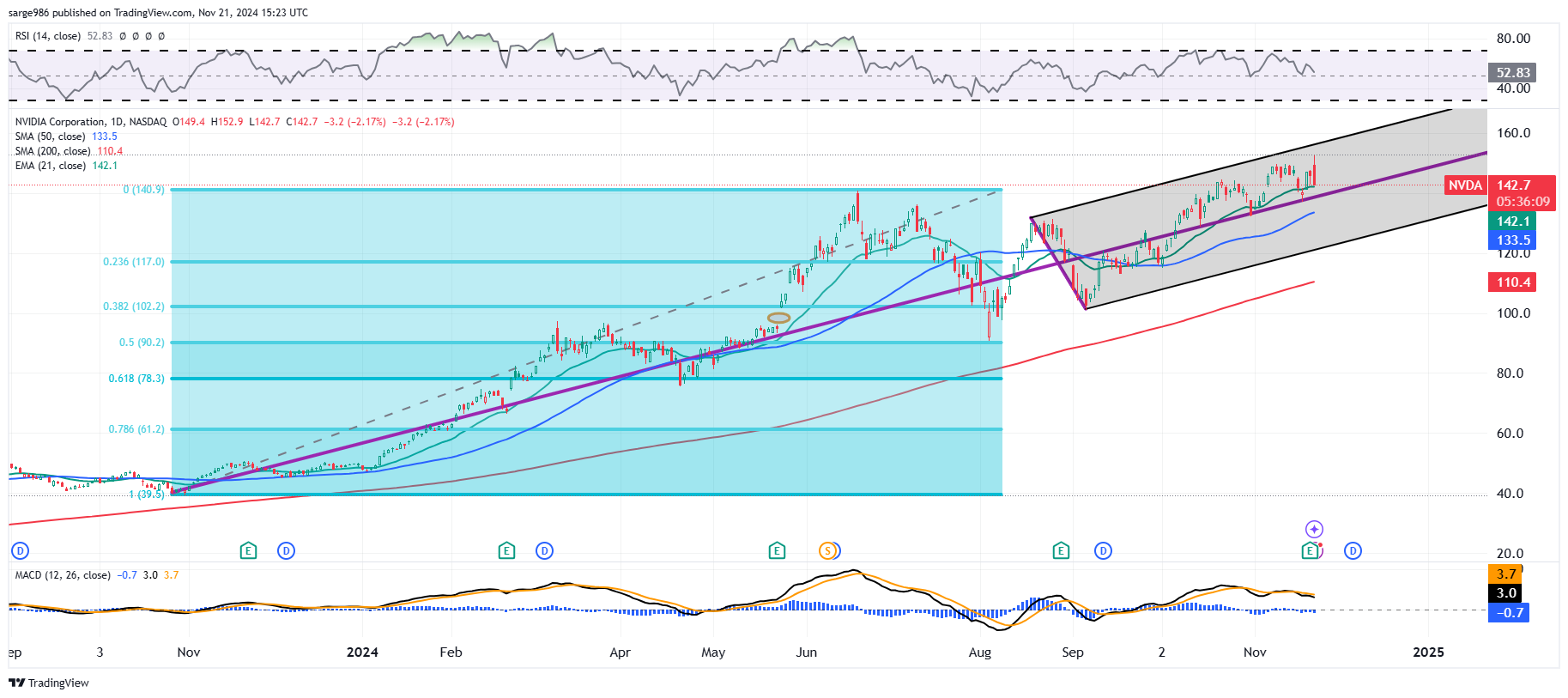
Readers will see that NVDA rallied from late November 2023 into this past June, when the stock started to sell off. Support was then found at the half-way back point (50% retracement of the rally) before NVDA found its footing and started to develop the current rally.
To gauge this rally, we go back to that same November 2023 start date and apply an Andrews' pitchfork model. We can see that of late, as the stock has enjoyed a series of higher lows and higher highs, the stock has found support at the central trendline of the model. This roughly correlates to the stock's 21-day EMA.
We see that in the current, relative strength is little better than neutral, while the daily MACD has started to look less bullish as the 12-day EMA has moved below the 26-day EMA and the histogram of the nine-day EMA have moved below zero.
While the upper trendline of the pitchfork could act as an upside pivot and could create a target price as high as $188, I think it just as likely that the central trendline and then the 50-day SMA come under short-term fire. There's the answer to your question. Where do I add? The 50-day SMA is currently $133.
At the time of publication, Guilfoyle was long NVDA equity.