What Nvidia Can Teach Us About ... Jack in the Box
It's tough to watch a your investment get cheap quickly. But here's why I expect this restaurant name to start cookin' again.
You've reached your free article limit
You've read 0 of 1 free Pro articles.
One of the toughest things in investing is seeing one of your stocks get pummeled, even though its fundamentals are getting better.
That kind of price action defies logic and can give rise to thoughts of despair. No matter how low shares might go, they could go lower. Typically, though, beaten down shares of healthy companies tend to rebound relatively quickly. Those recoveries almost always exceed the percentage declines that preceded them.
So, let's take a look at Jack in the Box Inc. JACK, for an example.
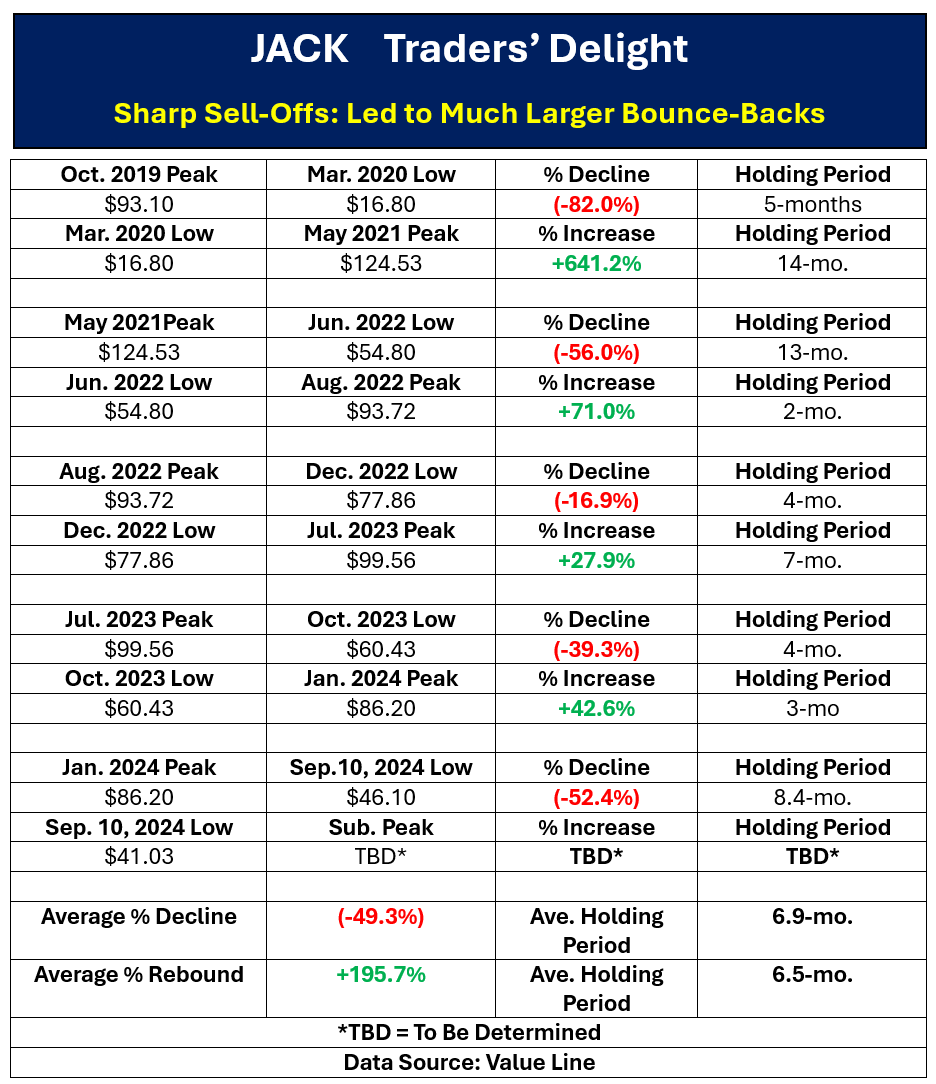
The 2-year chart below highlights the most recent up-and-down action in JACK.
The first decline shown (ended January 2023) totaled (-27.0%). The subsequent rebound equaled +51.4%.
The second decline (ended October 2023) was a 39.3% selloff. That was followed by a 3-month rally of 42.6%.
The third interim plunge took JACK down to $46.10. A rebound kicked in immediately, adding back 31.7% over the next 14-days (from $46.10 to $60.73)
The current decline hit bottom on Tuesday, with JACK down a stunning 52.4% from January’s year-to-date peak.
It takes intestinal fortitude, and confidence in your own judgment to hang in there when shares get severely beaten up.
That is when the risk is actually lowest, and the upside potential is the best.
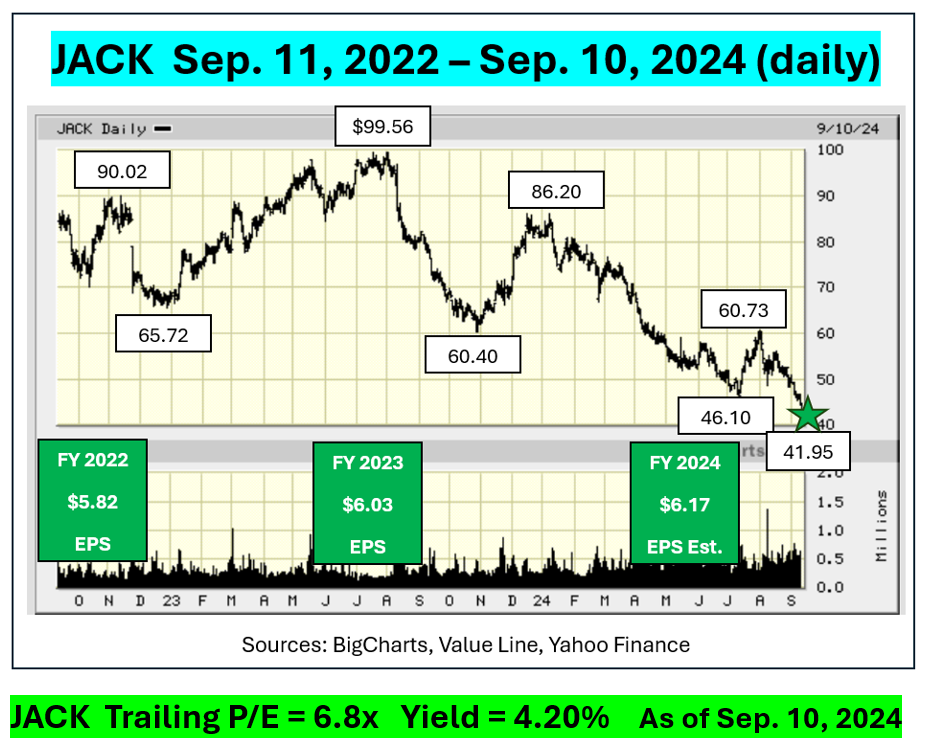
Value Line says JACK’s 10-year median price-to-earnings has run 19.0-times. Since 2015, a typical yield has been 1.61%. Today’s price-to-earnings represents a 64.2% discount to that normalized multiple. JACK’s current yield is now 169.8% above the stock’s average yield.
Ironically, the last two years saw JACK’s adjusted earnings per share climb from $5.82 (fiscal 2022) to $6.03 (fiscal 2023) to an estimated $6.17 in the fiscal year ending Sept. 29, 2024.
Is Jack In The Box a troubled company? Look at the company’s results since 2015 (shown below). Then you make the call.
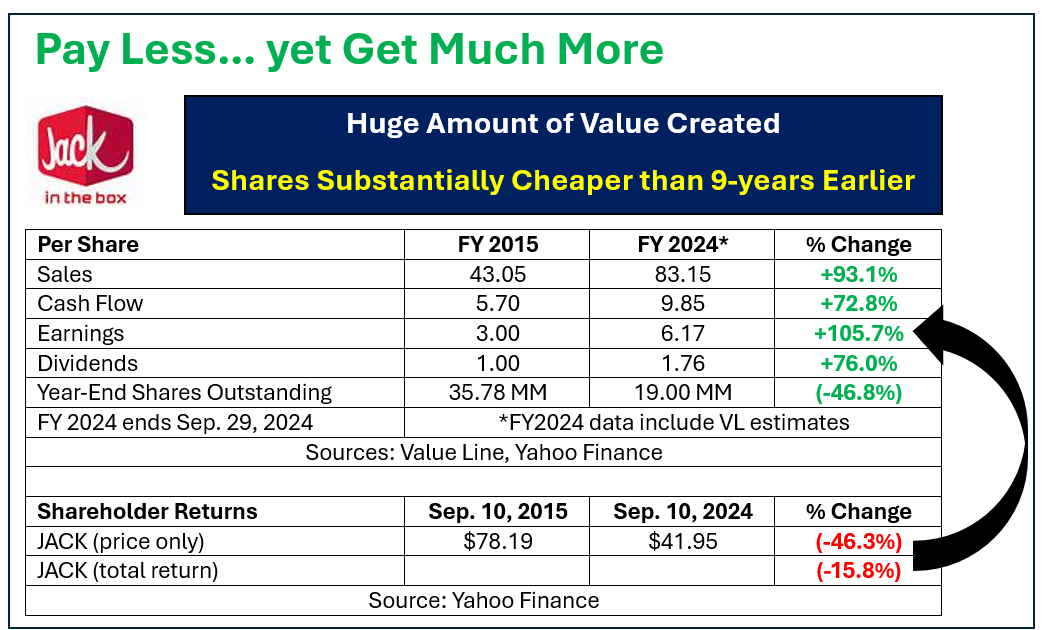
JACK is much more valuable across every major business metric, yet it is available at a huge discount to its nine-year ago price.
Getting more value for less money is never a bad thing.
Do great companies test traders’ patience, as has happened with JACK? You bet they do.
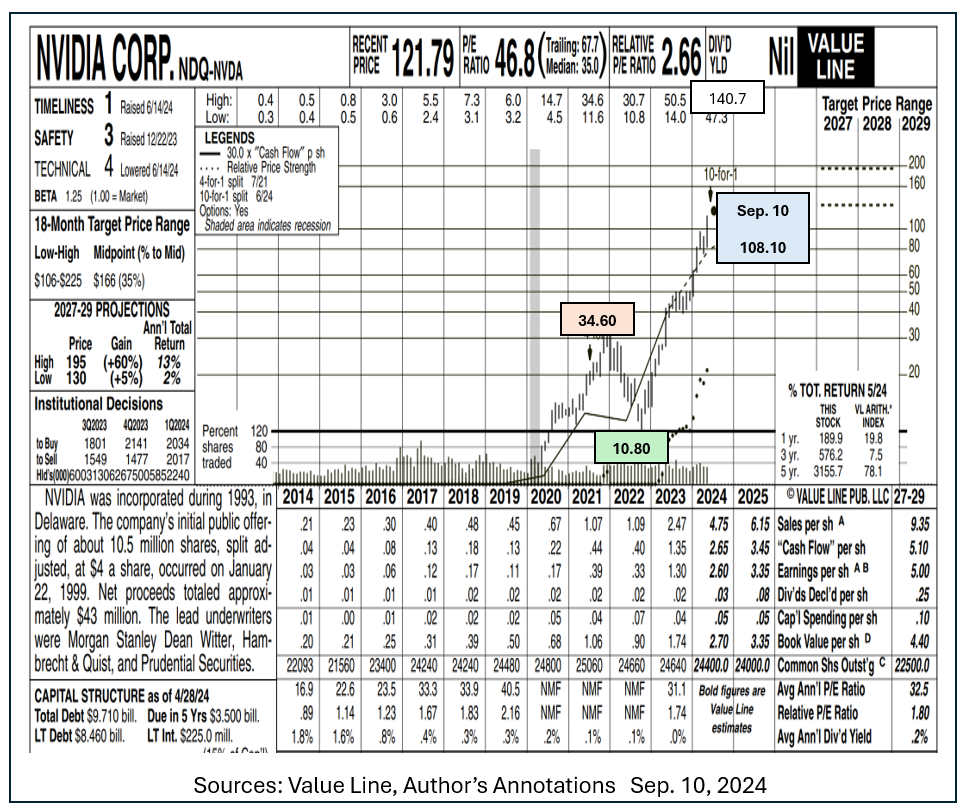
Let's compare with Nvidia NVDA. NVDA dropped from (a split-adjusted) $34.60 in December of 2021 to just $10.80 in October of 2021. That represented a (-68.8%),10-month decline.
Strange things can and do happen in the short run. Imagine how bad folks who panicked out at $10.80 felt when giving up and selling NVDA simply because it was down big at that time.
The stock then surged from $10.80 to $50.50 (+367.6%) by July of 2023. As noted earlier brave souls who sat through, or better yet, bought more on the decline saw enormous gains that far exceeded the preceding percentage decline.
NVDA’s July 2024 peak was $140.76. On Aug. 8, 2024, NVDA touched $97.52 intraday. At that moment it was off by 30.7% just since Jun. 18, 2024. As of Tuesday, NVDA had bounced back to close at $108.10.
Market prices vary much more widely than the actual values of the underlying companies.
It is only natural to feel disappointed when stocks you own get way too cheap. It is OK to feel that emotion. Smart long-term investors, though, fight human nature and sit tight or buy more when opportunities to average down present themselves.
JACK is my single largest dollar holding. The 4.2% current yield is almost as good as most CDs and better than most investment-quality bond coupons.
If the fundamentals remain strong, as was the case with both NVDA and JACK, the money made over time will more than compensate you for the short-term pain that must be suffered through.
At the time of publication, Price was long shares and short options of JACK.