Starbucks and Similar Stocks Serve Up Clues About Chances of a Recession
Consumer discretionary stocks are heating up, just as consumer staples stocks cool down. Here's what that means for the economic outlook.
You've reached your free article limit
You've read 0 of 1 free Pro articles.
Just a few months ago, there were endless discussions about an impending, inevitable recession.
Would the U.S. economy experience a hard landing, or a soft one? Would the Federal Open Market Committee reduce rates quickly enough, or would it act too slowly to prevent a recession?
Less than three months ago, on Sept. 18, the FOMC kicked off a preemptive battle against an economic downturn by reducing the Fed funds rate by a half percentage point. At the time, some analysts believed the Fed was already behind the curve.
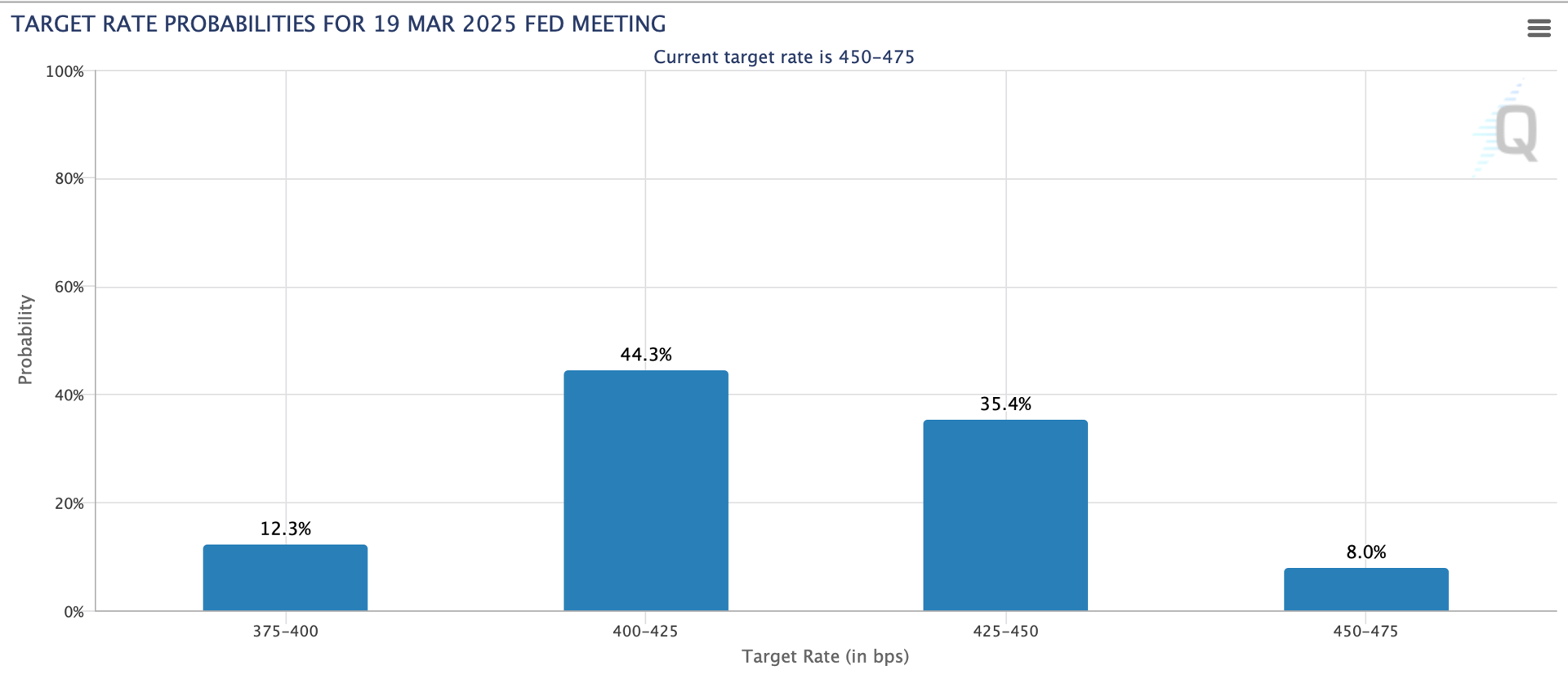
Now, talk of a recession has moved to the back burner. Looking ahead to the Fed funds rate projections for March, the most likely scenario is a total reduction of a half -percentage point over the next three meetings (44.3%). The next most likely outcome is a reduction of just 25 basis points over that span (35.4%).
More clues pertaining to the resilience of the U.S. economy can be found in the stock market. The major indexes are consistently reaching new heights, but the divergence among different types of consumer stocks is worth noting.
Consumer staples stocks tend to outperform during an economic downturn. In mid-September, just before the FOMC's half -point rate cut, the bellwether SPDR Consumer Staples ETF XLP, left chart, reached an all-time high (point A).
Since then, XLP has failed to match that high, despite a market that continues to roar higher. Instead, a lower high has appeared on the XLP chart (point B).
The recent underperformance of XLP demonstrates the change in investor sentiment regarding a potential recession.
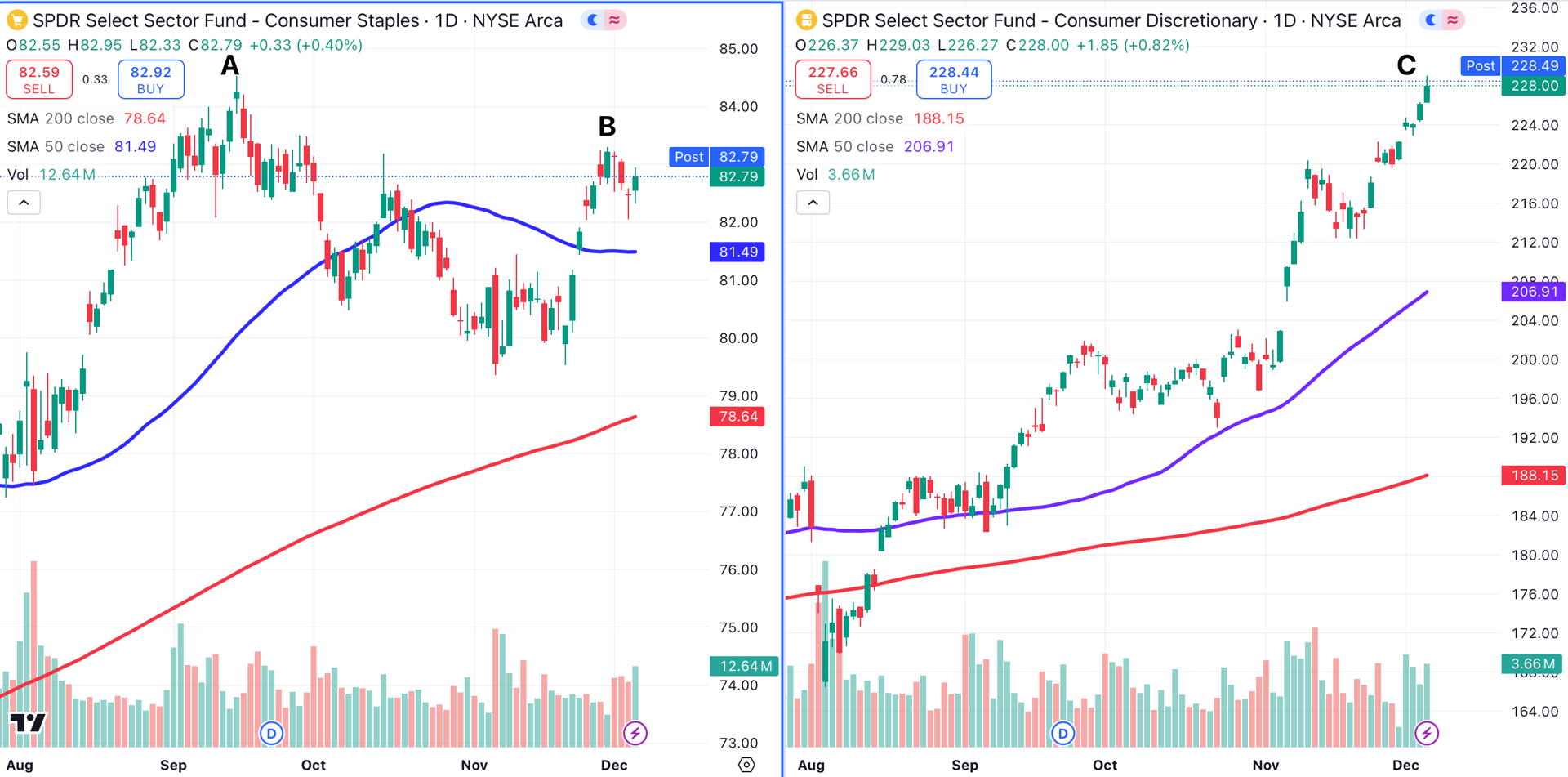
Meanwhile, consumer discretionary stocks are sending a similar message. Consumer discretionary stocks, represented on the right by the SPDR Consumer Discretionary ETF XLY, have reached all-time highs in four of the past five sessions (point C).
This sector consists of consumer items that aren’t considered necessities. Starbucks SBUX is a good example of a consumer discretionary stock.
When Starbucks popped due to the announcement of incoming CEO Brian Niccol, I purchased some puts. Nothing against Niccol, I just felt that the caffeine boost that shares of Starbucks enjoyed at the time was overdone.
I’m still skeptical about Starbucks, but you can’t fight the tape. I'm no longer holding the puts.
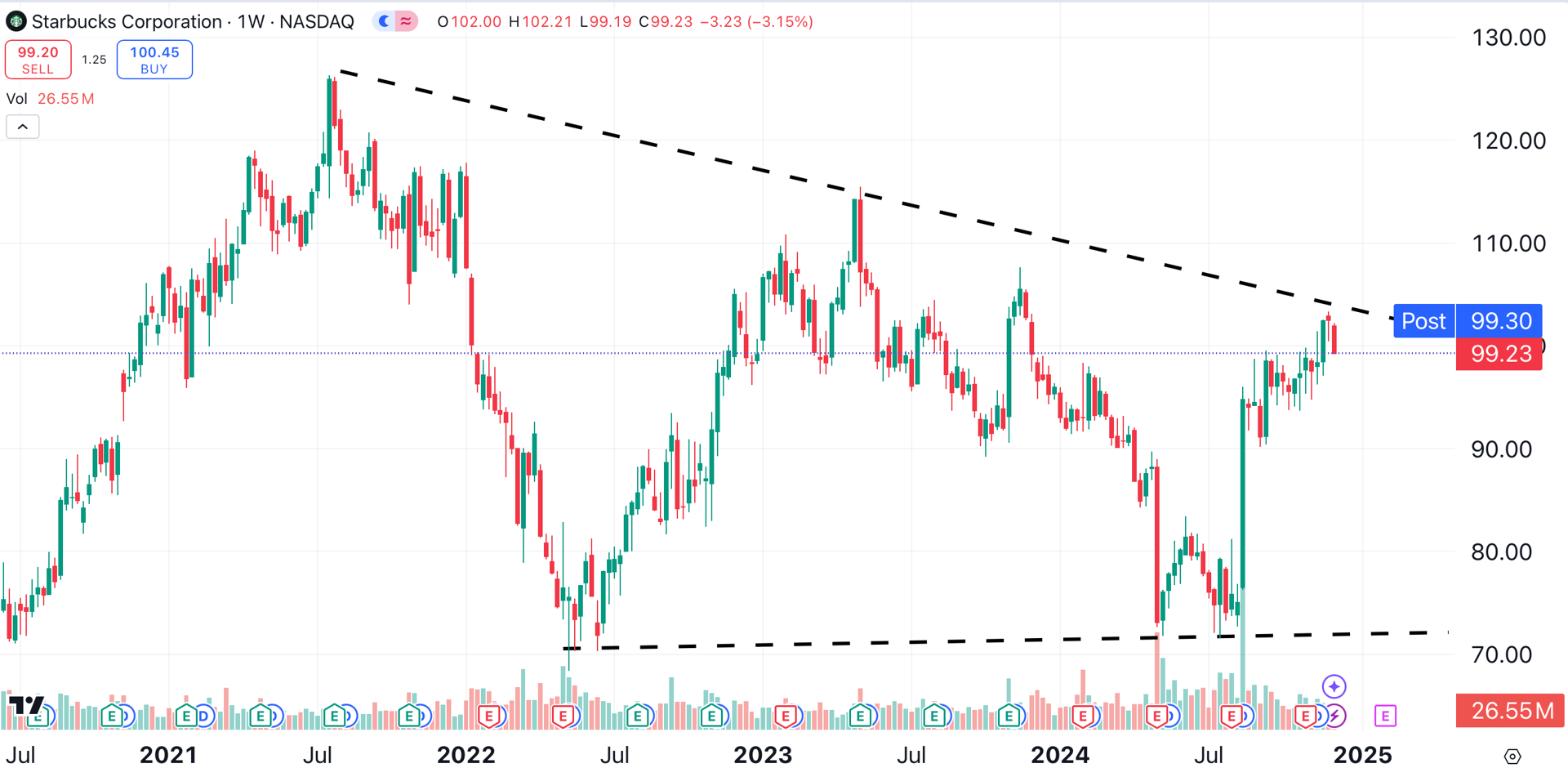
The stock is now up against a trend line, which is part of a bearish descending triangle (black dotted lines). This huge pattern formed over a two-year period, demonstrated on the weekly chart below.
Considering the price action in consumer discretionary stocks, along with projections for the next few FOMC meetings, we can only draw one conclusion: chances of an economic downturn have now been greatly reduced. Expect markets to continue moving higher as momentum rules the day.
At the time of publication, Ponsi had no position in a any security mentioned.