Setting a High Price Target for Walmart as Results Will Continue to Improve
The retail giant will be the budget-conscious consumer's best friend for the foreseeable future.
You've reached your free article limit
You've read 0 of 1 free Pro articles.
On Tuesday morning, America's largest (at least as of 2023) retailer, Walmart WMT went to the tape with the firm's third quarter financial results.
For the three-month period ended October 31, Walmart posted an adjusted EPS of $0.58 (GAAP EPS: $0.57) on revenue of $169.588 billion. These top- and bottom-line results were both good enough for decisive beats of Wall Street's consensus view. The net one-penny-per-share adjustment was made for unrealized and realized gains/losses on investments.
The numbers inside the numbers were also impressive. Globally, e-commerce grew 27%, led by store fulfillment through customer pick-up and delivery and through marketplace sellers. The global advertising business also grew, by 28% to include 26% growth for Walmart Connect in the U.S. Global inventories were drawn down 1% year over year during the quarter, to include a contraction of 0.6% for Walmart U.S., leaving stock levels "healthy."
Operations
As net sales and membership fees togethers grew 5.5% to $169.588 billion, the cost of sales increased 5.1% to $127.34 billion as gross margin improved by 21 basis points. However, operating expenses increased 6.3% to $35.54 billion, leaving a GAAP operating income of $6.708 billion (+8.2%) on an operating margin of 4.6%, up from 3.9%. After accounting for interest, other gains and losses, and taxes, GAAP net income attributable to shareholders printed at $4.577 billion (up from $453 million). This works out to $0.57 per fully diluted share, up from $0.06 for the year-ago comparison.
Business Line Performance
- Walmart U.S. generated net sales of $114.9 billion (+5%), as comps sales (ex-fuel) increased 5.3%. Transactions were up 3.1% as the average ticket was up 2.1%. E-commerce contributed a rough 290 basis points to comp sales. Operating income printed at $5.4 billion (+9.1%).
- Walmart International generated net sales of $30.3 billion (+8%), producing operating income of $1.2 billion (+7.8%). Adjusted for constant currency, net sales growth was 12.4%, while growth in operating income was 16.7%.
- Sam's Club generated net sales of $22.9 billion (+3.9%), as comps sales (ex-fuel) increased 7%. Transactions were up 6.4% as the average ticket was up 0.5%. E-commerce contributed a rough 290 basis points to comp sales. Operating income printed at $0.6 billion (+6.9%).
Guidance
For the full fiscal year, Walmart increased its projected range for net sales to growth of 4.8% to 5.1% from prior guidance for growth of $3.75 billion to 4.75%. This puts the mid-point at growth of 4.95%, which is just below the 4.97% growth that Wall Street had modeled. The firm's expected effective tax rate for the year was dropped to a rough 24.5% from prior guidance for 25%-plus. The firm now sees full-year adjusted EPS at $2.42 to $2.47, up from August guidance for $2.35 to $2.43. This is roughly in line with the $2.45 that Wall Street was looking for.
Fundamentals
Fiscal year to date (nine months), Walmart has generated operating cash flow of $22.918 billion. Out of this has come capex spending of $16.696 billion, which left free cash flow of $6.222 billion (plus-43% over the first nine months one year ago). That's great. Unfortunately, out of that number, the firm paid out $5.004 billion in cash dividends to shareholders and repurchased $3.049 billion worth of common stock for the firm's treasury. I'd prefer that returns to shareholders be kept close to in-check with free cash.
Turning to the balance sheet, Walmart ended the quarter with a cash position of $10.049 billion with inventories at $63.302 billion. This puts current assets at $86.938 billion. Current liabilities add up to $102.558 billion including debt maturing within a year of $6.825 billion. That puts the firm's current ratio at a still disappointing 0.85. Long-time readers know that despite being long the stock, we have been disappointed with Walmart's balance sheet and its allocation of free cash for some time now.
Still, we feel the firm is better run and a solid choice when compared to competitors like Target TGT. Costco COST and Amazon AMZN are competitors, but use far different business models in reaching consumers. We don't really do "quick ratios" for large brick-and-mortar retailers due to the inventory-heavy nature of the business.
Total assets amount to $263.399 billion including just $27.942 billion in goodwill. At 10.6% of total assets, this is not an issue. No other intangible assets are entered. Total liabilities less equity comes to $169.123 billion. This includes long-term debt of $33.645 billion. This is down a rough $2.5 billion from the start of the year, but because of a good reason. It has simply migrated to the "current debt" bucket, making it something that the firm will have to make decisions on fairly soon.
My Thoughts
The firm's improved execution of its own business and its ability to compete better in an evolving arena is without doubt. Cash flows are robust. Allocations of said cash flows and balance sheet management remain corporate weak spots. I am long the stock, because I think this continuation in improved results will continue. The rest may come over time, but Walmart remains the chain that consumers rely upon, especially consumers struggling with their budgets as inflation has bottomed in September and is already accelerating. I have been well to do and I have lived in close to abject poverty. No exaggeration. Walmart is the budget-minded consumer's best friend. I don't think that will change soon.
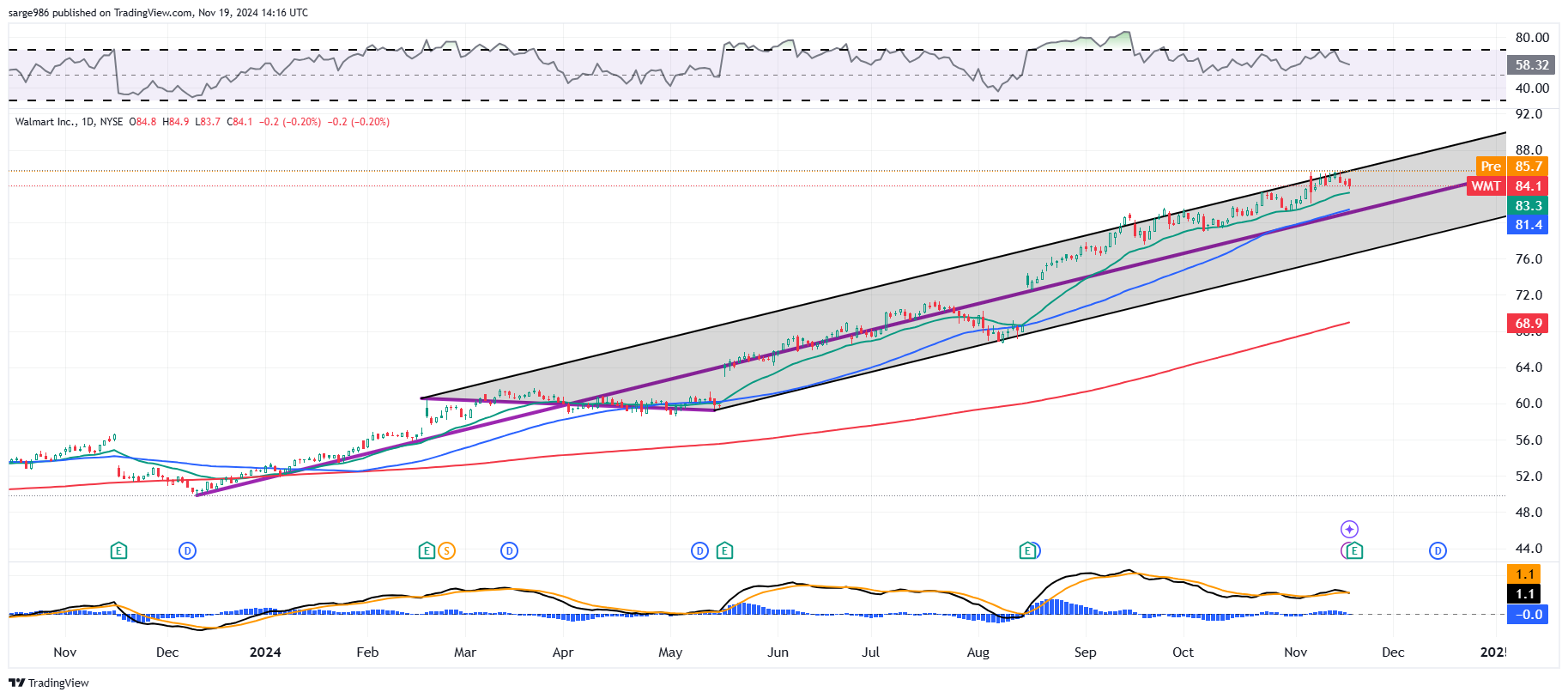
Readers will see that WMT has remained inside a rising Andrews' pitchfork model that goes back to late 2023. I see no reason to take profits or move out of WMT until at least that central trendline, which is running concurrently with the 50-day SMA cracks. Until then, I ride the wind.
Relative strength is relatively strong. The daily MACD is fairly bullish looking as all three components are in positive territory. That said, I would like to see the 12-day EMA pull away from the 26-day EMA this morning. The top trendline of the pitchfork remains my pivot as it has been tested often and still held.
Walmart (WMT)
Target Price: $103 (which I think may be the high on Wall Street)
Pivot: $86 (moving trendline)
Add: down to 50-day SMA
Panic: On loss of lower trendline
At the time of publication, Guilfoyle was long WMT, AMZN equity.