Little Risk and Reward in Buying Rivian, Even With Potential $6 Billion Boost
The electric vehicle maker is asking a lot of its investors and they might not go along for the ride.
You've reached your free article limit
You've read 0 of 1 free Pro articles.
As many readers know, I drive up and down the East Coast more often than is healthy. I live both out on Long Island and on the Atlantic Coast of Central Florida. One thing I have now seen for several years in both my New York and Florida neighborhoods was the growing adoption of Tesla TSLA vehicles as the primary household (Florida) vehicle, or as more of a "station" car in New York.
While Tesla has remained the dominant electric vehicle in these communities, I have also noticed a few EVs that had been manufactured by the legacy internal combustion powered automakers and, every once in a while, a Rivian RIVN.
The only change that I have noticed over recent months has been a mild, but notable, increase in Rivians, not just on either end of my 18-to-21-hour drive (depending on traffic), but now even in between my two bookends. As the population of the Carolinas has exploded, so has the traffic. Those states, once a barren region through which I could speed, have slowed with their two-lane interstates due to congestion and, with that congestion, came folks from other states who had already adopted electric vehicles.
Today's News
Late on Monday night, Rivian Automotive received conditional approval for a loan of up to $6.6 billion from the Department of Energy's Advanced Technology Vehicle Manufacturing Loan Program. The total includes $6 million in principal and a rough $600 million in capitalized interest.
If this loan is finalized, the funds would support the construction of a new facility in Stanton Springs North, Georgia. This would substantially expand the firm's capacity for domestic production. The plan would be to build the facility around the company's midsize platform, which is where the R2 midsize SUV, and R3/R3X midsize crossover come from.
The firm would like to build the new facility in two tranches, starting in 2028, creating 7,500 jobs by 2030. Those would be Rivian hires in addition to the 2,000 full-time construction jobs that would be created for the duration of the project.
Two Weeks Ago
Volkswagen VLKAF and Rivian announced an expanded $5.8 billion (up from $5 billion) investment by the former as the two firms form a joint venture meant to develop next-generation electric architecture and "best in class" software for both companies' future electric vehicles. There might be good cause for concern as the incoming administration in the U.S. backs away from the Biden administration's eV-related subsidies and/or incentives, but what also matter is where this joint venture is located or primarily located, as the question of tariffs will likely become at some point an issue, as far as sourcing supplies and parts is concerned.
Further Back
On October 4, Rivian disclosed that the firm was experiencing a disruption in production due to a shortage of a shared component within its Enduro motor system on the R1 and RCV platforms. The firm, at that time, revised its full-year guidance for 2024 production to between 47,000 and 49,000 vehicles, down from prior guidance for 57,000 and announced a new outlook for deliveries to between 50,500 and 52,000 vehicles.
Earnings and Fundamentals
Rivian Automotive reported the firm's fiscal third quarter financial performance. For the period, which ended September 30, Rivian posted an adjusted EPS of $-0.99 (GAAP EPS: $-1.27) on revenue of $874 million. These top- and adjusted bottom-line numbers both fell well short of Wall Street's expectations while the net revenue print reflected a year-over-year contraction of 34.8%.
For the third quarter, Rivian generated operating cash flow of $-876 million, while spending $277 million on capital expenditures. That's a free cash flow of $-1.153 billion. Over the past 12 months, free cash flow has run to $-5.118 billion.
The firm ended the quarter with a cash position of $6.739 billion, inventories of $2.68 billion and current assets of $9.837 billion. Current liabilities add up to just $1.933 billion, which includes no short-term debt. The firm did have long-term debt of $5.468 billion, which is not too bad, given their cash position. Just remember, the firm is taking on another $6.6 billion in long-term debt from the Department of Energy.
Rivian will not report its Q4 numbers until late February. Right now, consensus is for an adjusted EPS of $-0.65, a GAAP EPS of $-0.787 and revenue of $1.36 billion. That would be good for sales growth of roughly 3.5%.
Conclusions
Rivian probably makes a nice vehicle. I spoke to one of those drivers who said he liked his Rivian better than he liked his Tesla. I have no firsthand experience myself and that one man is the extent of my survey of individuals at I-95 rest stops in its entirety. The firm is expected to cut its losses almost in half next year. As far as actually showing a profit is concerned, I think we have a way to go. The balance sheet is not in bad shape, but there is a significant cash burn going on.
This firm is kind of asking its investors to do what Tesla once asked of theirs: believe in a speculative idea. The difference is that Tesla was a first mover and built a cult-like following. I don't know if a second or third mover can demand that kind of loyalty. There will be more pressure on Rivian to put a halt to the cash burn at an earlier stage of its development than there was on Tesla.
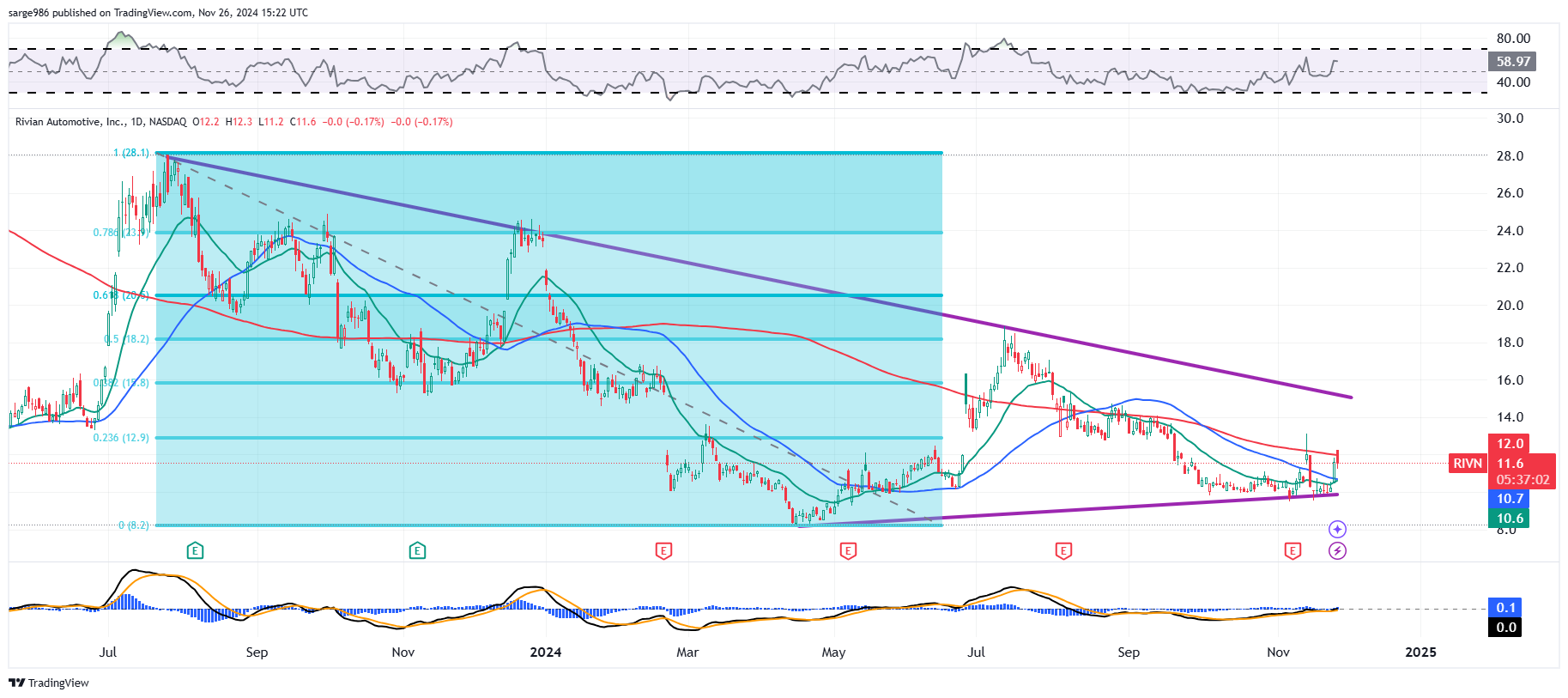
Readers will see a closing pennant of sorts that goes back to July 2023. This is almost a descending triangle, which would be bearish, but is not due to the higher low made this November. The stock sold off from July 2023 into April 2024 when it bottomed. Resistance had been hit close to the "halfway" back point (50% retracement) in July before selling off yet again.
Readers will see that the stock then hit resistance this November (twice) at the 23.6% Fibonacci retracement level of the entire sell off, which makes a lower low and does appear to be bearish. Relative strength is healthy and the stock's daily MACD tells us little with all three components bunched close to zero.
My two cents? This is speculation. That said, there is little in the way of risk versus reward as the share price is rather low. Additionally, the last sale is battling around its own 200-day SMA right now as the 21-day EMA tries to overtake the 50-day SMA. One could bring on increased long-side exposure by portfolio managers, while the other could provide an upward push by the swing trading crowd.
No miracles here, but a take and hold of that 200-day line (currently $12) could produce a last sale around $16, or where the next Fib. level is, which would be a 38.2% retracement of the entire sell-off.
At the time of publication, Guilfoyle had no positions in any securities mentioned.