I Sold Intel at $108. Now I’m Buying It Back.
After an excellent quarter, Intel’s pullback creates a chance to rebuild a winning trade.
You've reached your free article limit
You've read 0 of 1 free Pro articles.

On Thursday evening, chip design and manufacturing giant Intel (INTC) released its second-quarter financial results. For the three-month period ended June 27, Intel posted adjusted EPS of $0.42 (GAAP EPS: -$2.24) on revenue of $16.128 billion. Those top and bottom-line results (even the GAAP EPS print) beat Wall Street’s expectations. The adjusted EPS and sales (good for annual growth of 24.8%) prints absolutely crushed the consensus view.
These results, aided by the continued and elevated demand for CPUs for AI-related purposes, allowed Intel to issue guidance that far exceeded anything that Wall Street was looking for. CEO Lip-Bu-Tan commented in the press release:
“AI is driving unprecedented demand for compute, and as we continue to execute, Intel is well-positioned to capture sustainable growth across our CPU franchise, ASICs, advanced packaging and vast wafer foundry network. Our Q2 results represent our strongest revenue growth in more than fifteen years, enabled by greater speed, accountability, and customer focus.”
CFO Dave Zinser added:
“We delivered a strong second quarter, exceeding our financial guidance on robust demand and improved execution, including volume upside driven by higher factory yields and improved cycle times. AI-driven compute continues to strengthen, and to support expected growth this year and next across products and foundry, we are meaningfully increasing our investments in equipment, clean room space, and substrates.”
Operations
As net revenue grew 24.8% to $16.128 billion, the cost of those sales increased 3.2% to $9.619 billion. That left a gross profit of $6.509 billion (+83.8%) as gross margin ran all the way from 27.5% to a stunning 40.4%.
Total operating expenses decreased 29.9% to $4.713 billion, leaving a GAAP operating income of $1.796 billion (up from $3.176 billion). This took GAAP operating margin up to 11.1% from -24.7%.
After accounting for interest, other income & expenses and taxes, GAAP net income attributable to shareholders printed at -$11.033 billion (compared to the year-ago print of -$3.024 billion). This works out to a fully diluted GAAP EPS of -$2.16, versus last year’s -$0.67.
Once adjustments are made that include a $12.529 billion negative mark to market on escrowed shares, gross margin prints at 41.8% (up from 29.7%) and operating margin lands at 17.2% (up from -3.9%). This works out to an adjusted net income attributable to shareholders of $2.197 billion (up from -$441M), leading to a fully diluted adjusted EPS of $0.42, up from the year-ago comp of -$0.10.
Segment Performance
Client Computing & Physical AI Group generated revenue of $8.877 billion (+12.8%), producing operating income of $2.343 billion (+14.1%) on an operating margin of 26.4% (up from 26.1%).
Data Center & AI generated revenue of $6.262 billion (+59%), producing operating income of $2.474 billion (+290.8%) on an operating margin of 39.5% (up from 16.1%).
Foundry generated revenue of $5.765 billion (+30.5%), producing operating income of -$2.089 billion (versus -$3.168 billion).
Guidance
For the current quarter, Intel is projecting revenue generation of $15.8 billion to $16.8 billion. This brings the low end of the range well above the $15.2 billion that Wall Street had in mind.
As the company sees an adjusted gross margin of 42% and an adjusted tax rate of 11%, adjusted EPS is now seen at $0.38. This is far better than the $0.28 that had been the consensus coming in. Intel also sees a profitable GAAP EPS of $0.31.
Fundamentals
For the period reported, Intel generated operating cash flow of $7.006 billion (+241.8%). Out of that came capex spending of $2.652 billion. That would have left $4.354 billion in free cash flow during a normal quarter. Here we have more than $12.2 billion in net SCIP partner contributions. These are cash injections from external financial partners participating in Intel’s manufacturing joint ventures. The company counts these funds against free cash flow. Hence, that number landed at -$8.419 billion.
Turning to the balance sheet, Intel ended the period with a cash position of $29.727 billion and inventories of $12.961 billion. This landed current assets at $57.213 billion. Current liabilities add up to $35.67 billion, including short-term debt of $1.988 billion. This leaves its current and quick ratios at 1.60 and 1.24, respectively, which is healthy. Intel is well in control of managing its obligations.
Total assets amount to $202.439 billion, of which just 11.4% is labeled as either goodwill or other intangibles. That’s not an issue. Total liabilities less equity comes to $99.296 billion. Out of that number, $48.549 billion is in long-term debt. I don’t love that, but at least with a cash position like Intel has, this is manageable.
Opinion
The quarter was excellent. The guidance was awesome. Operating cash flow is more than robust. The balance sheet is in better than decent shape.
The stock is down with the market Friday after a down day Thursday. As an investor who is long the name but sold a chunk back on July 8 with a $108 handle (communicated to readers that day), I see this as an opportunity to add that portion back to my position after having extracted some capital for my cash position.
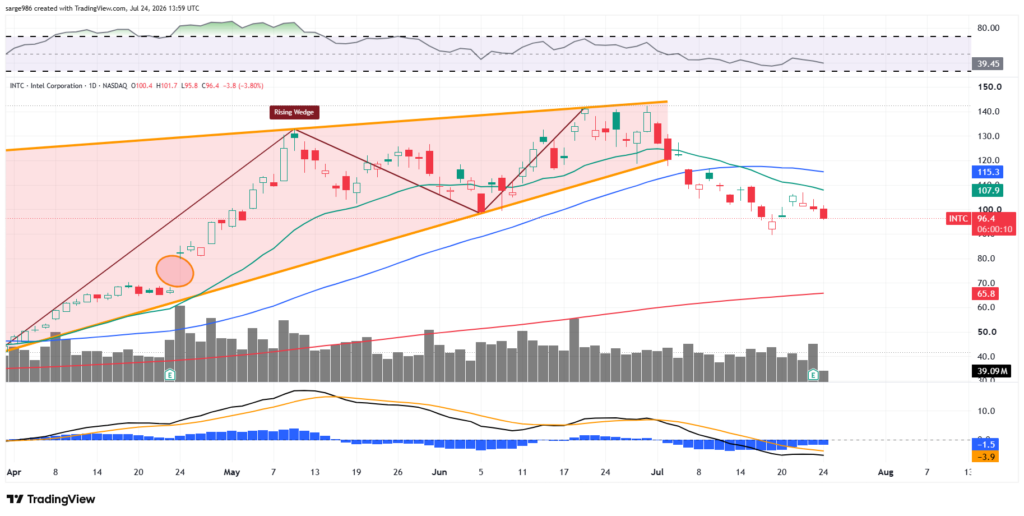
Readers will see that INTC fell out of bed in early July when the share price broke down from a Rising Wedge of bearish reversal. The shares have lost their 50-day simple moving average (SMA) forcing professional managers (why I did) to reduce exposure as well as their 21-day exponential moving average (EMA) (impacting swing traders). In addition, neither the daily moving average convergence divergence (MACD) nor the RSI (relative strength) looks especially poised for a rally.
That said, my out trade has been successful, and I need to rebuild that part of my long position while the “trade around the core” move looks smart. This makes the 50-day line my pivot. I am willing to add down to the stock’s 200-day SMA. A loss of that level would be cause for a move out of the name, in my opinion. That said, I am bullish Intel.
At the time of publication, Guilfoyle was long INTC equity.