I Just Might Have the Key to a Tesla Trade
This EV maker has proved to be a risky play, but here's why a Trump presidency could smooth out the playing field for TSLA and its American competitors.
You've reached your free article limit
You've read 0 of 1 free Pro articles.
You all know I had been short Tesla TSLA for a few weeks. I had traded the position well and I had been up nicely. So much for that. I'm not complaining. My portfolio has been decisively net long for months. One short trade acts as a nice hedge against a market gone awry and is easy to camouflage among the winners when the market runs as it has. I covered that short position at a loss last week and felt a little stupid doing so. Thank goodness I did, though.
Tesla CEO Elon Musk has endeared himself to the incoming president, Donald Trump, participating in the campaign both physically and as a donor. One could have seen the rally in TSLA shares coming from last Tuesday on, and so it has been. The stock was up 29% last week, and I see it trading close to 4% higher again on Monday morning.
Let's look at why a Trump administration could be good for U.S. electric vehicles and how one could handle TSLA now. But first ....
Friendly Analysts
Wedbush analyst Dan Ives, who has now regained his four-star (of five) status at TipRanks, reiterated his "outperform" rating on TSLA, which is considered to be "buy-equivalent," while raising his target price from $300 to $400. Ives commented over the weekend, "We estimate the AI and autonomous opportunity is worth $1 trillion alone for Tesla, and we fully expect under a Trump White House these key initiatives will now get fast tracked as the federal regulatory spiderweb that Musk & Co have encountered over the past few years around FSD / autonomous clears significantly under a new Trump era."
Ives is not alone. On Friday, the five-star rated analyst, John Murphy reiterated his "buy" rating on Tesla, while raising his target price to $350 from $265. Murphy wrote... “Our analysis has shown that TSLA should be relatively indifferent directly to most policies discussed in our recent election note but may benefit from a shift to a federal regulation of autonomous vehicles/full self-driving (FSD) nationwide. In addition, it is difficult to judge how Elon Musk’s increasingly close public relationship with President Trump could benefit Tesla, but this needs to be monitored closely.”
Why will the inauguration of Donald Trump be a tailwind to a company like Tesla and other U.S. electric vehicle manufacturers? Because of the likelihood of Trump tariffs on foreign, especially Chinese, EVs. Those imported EVs ordinarily sell for much lower prices than do Teslas and other U.S.-made EVs. Trump's moves could make purchasing those foreign-made electric vehicles as expensive as purchasing their U.S. counterparts. Such an environment, while preventing deflation or even disinflation, also protects huge numbers of middle-class U.S. jobs and the wages they draw.
Running the Numbers
Readers will likely recall that the stock started moving in a northerly direction back when it released its third-quarter earnings. The company beat both unadjusted and adjusted earnings expectations, but fell just a tad short of revenue projections. Margins expanded somewhat nicely, and the stock ran.
For the quarter, Tesla had generated operating cash flow of $6.255 billion. Out of that number came capital spending spending of $3.513 billion, leaving free cash flow of $2.742 billion. That was more than double the free cash flow generated for the previous quarter and more than triple the free cash flow for the year ago comparison.
Turning to the balance sheet, Tesla ended that quarter with a cash position of $33.648 billion and inventories of $14.53 billion. That put current assets at $56.379 billion. Current liabilities added up to $30.577 billion, including shorter-term debt of $2.291 billion, but also deferred revenue of $3.031 billion, which as we know is not a true financial obligation unless one can't deliver.
All of that put Tesla's current and quick ratios at 1.84 and 1.37, respectively. Both are more than acceptable, especially for an industrial business, which is really what Tesla and the other car companies are, even if they are considered by investors to be discretionaries. Once adjusted for deferred revenue, these ratios improved to 2.05 and 1.52 in that order. Very nice.
The Charts & My Take
This is what we had been looking at:
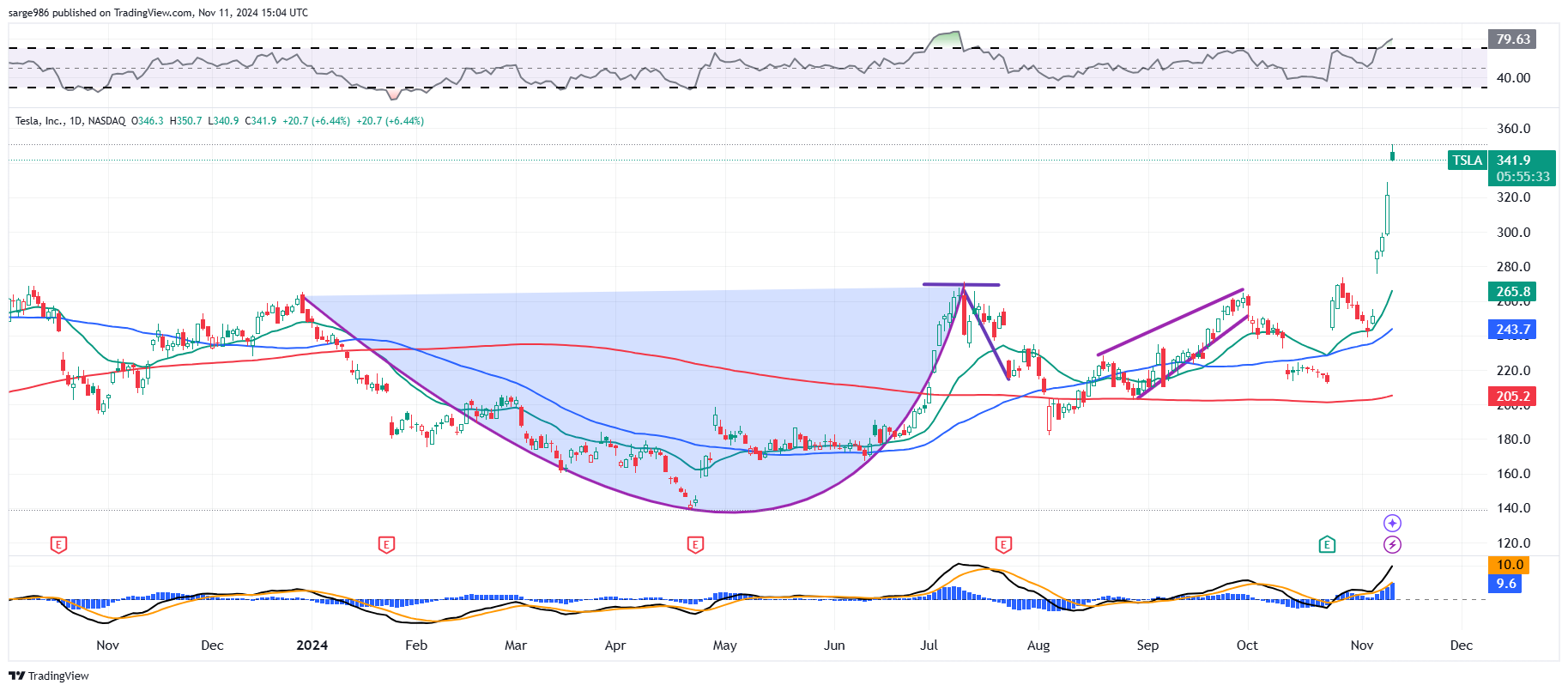
A failed cup with handle followed by a rising wedge. That's a bearish set-up and it did work ... for a while. What if I was looking at TSLA all wrong? Let me show you:
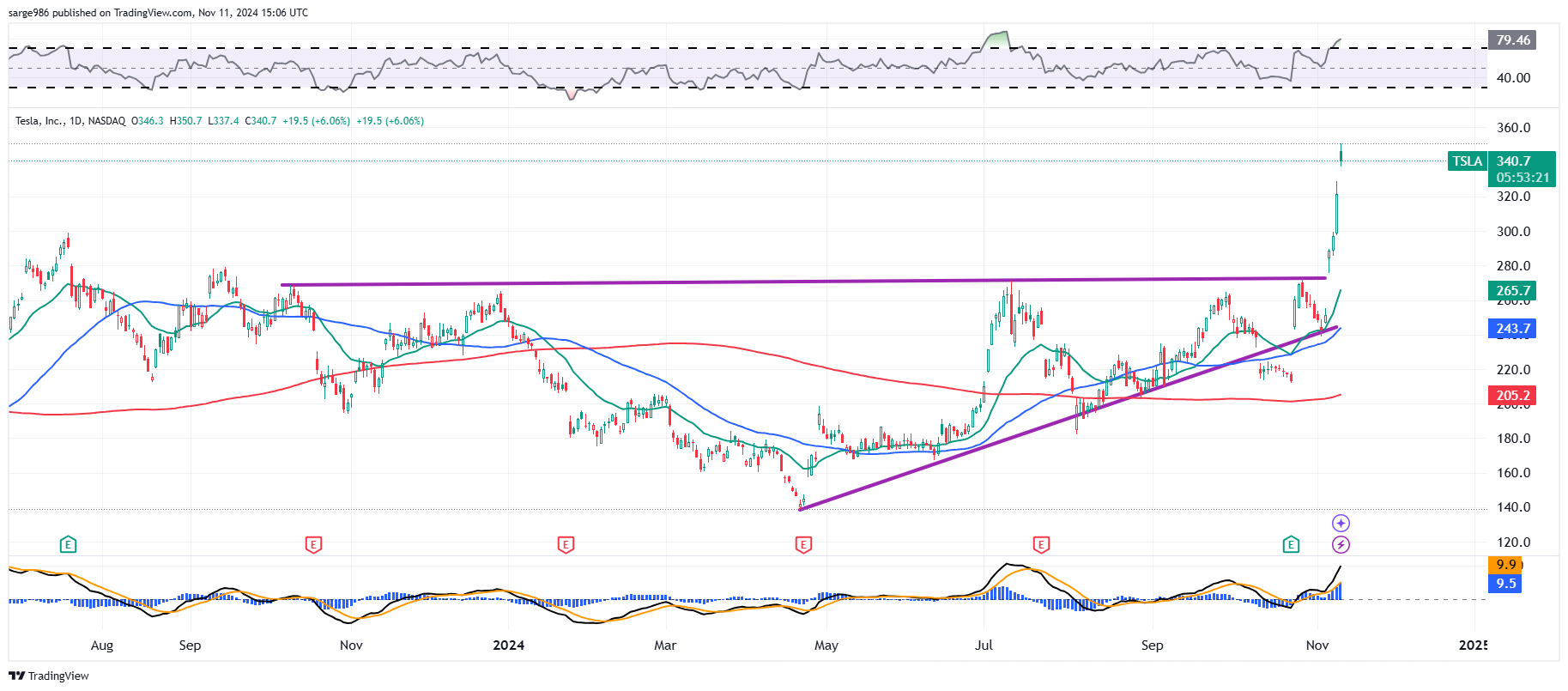
How I missed this now "impossible to not see" ascending triangle", I do not know. Is the ride over? With Tesla, that's almost impossible to tell. The chart displays a $273 pivot, with a reading for Relative Strength that's deep into overbought territory. The daily MACD has seen all three components spike and now sports an extremely bullish posture. Based on the pivot, I would likely have placed a target on the stock of roughly $341. The stock traded at $350 this morning.
So, do I buy the shares here? No. Do I short them? No, my won/loss percentage is truly awful when I short this stock.
Idea?
Maybe a buy/write. For example, in minimal lots, buy 100 shares of TSLA at or close to $342, while selling one $360 Dec. 20 call for about $23. That way, the net basis for the long position drops to $319 and the profit is capped at 12.9% through Dec. 20. Food for thought.
At the time of publication, Guilfoyle had no position in any security mentioned.