How to Trade Palantir vs. Dell as Both Stocks Are Added to the S&P 500
As the date for inclusion in the index approaches, the two stocks could soon diverge. What if a trader were to simply trade Palantir against Dell?
You've reached your free article limit
You've read 0 of 1 free Pro articles.
When companies are added to an index, mutual funds and exchange-traded funds that mirror that index are forced to buy shares of those stocks. As a result, the stocks of companies added to an index can become volatile as the date of inclusion approaches.
On September 23, three names will be added to the S&P 500. Tech stocks Palantir Technologies PLTR and Dell Technologies DELL, as well as insurance underwriter Erie Indemnity ERIE, are slated to join the large-cap index.
Some traders might simply buy these stocks ahead of the September 23 event, but that’s a risky proposition. It’s likely that sophisticated investors have already arbitraged these names in anticipation of their inclusion into the index.
A different type of trade comes to mind. What if a trader were to simply trade Palantir against Dell?
The advantage of a pair trade is that the outcome isn’t dependent on market direction. If stock A is better than stock B, then stock A should outperform stock B, regardless of whether the market moves up or down.
If the charts are to be believed, then Palantir is hands-down a better stock than Dell.
On Wednesday, Palantir closed at a three-year high. The stock has more than doubled since the start of this year, gaining 110%.
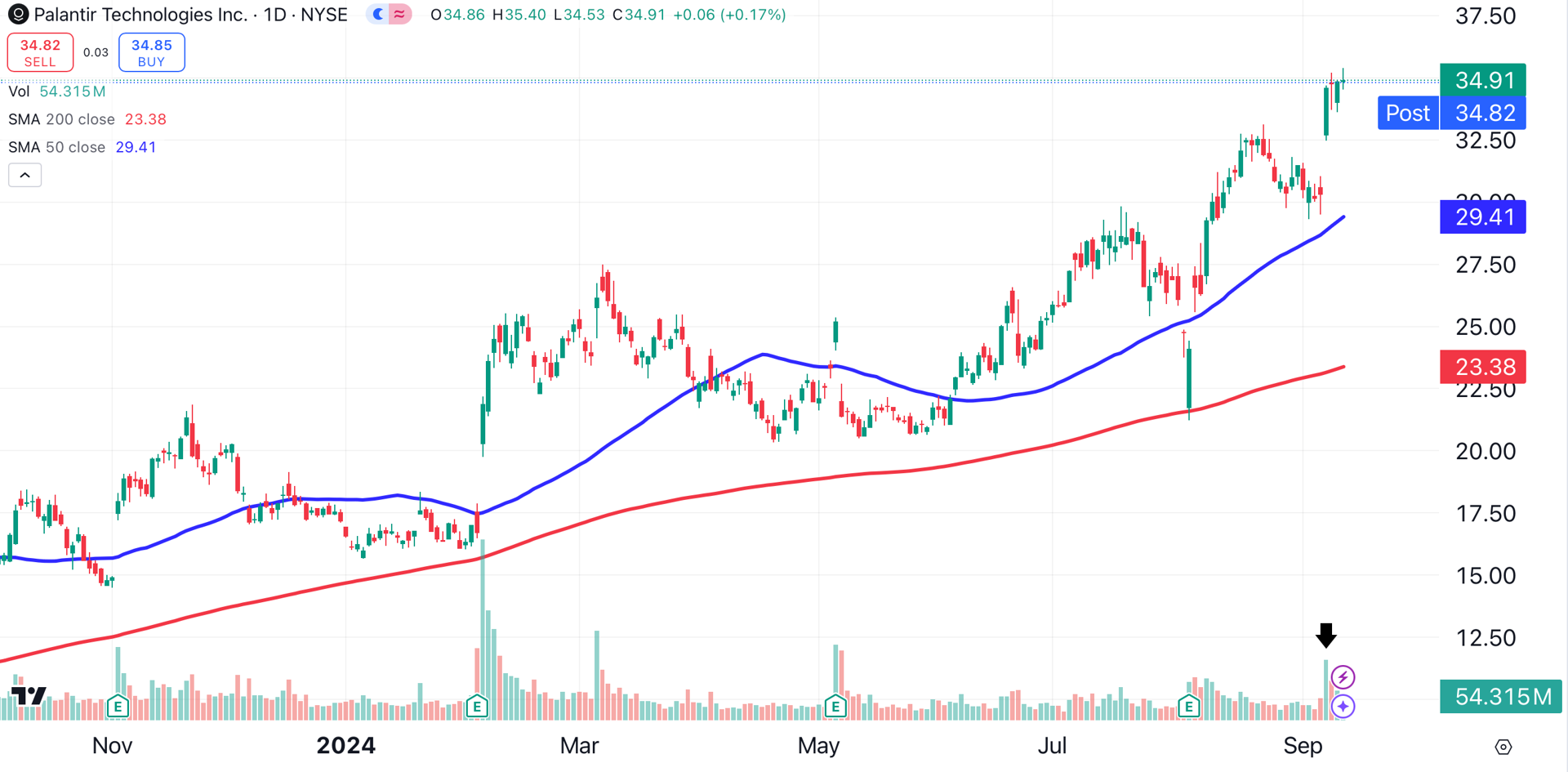
Palantir’s persistent uptrend is complemented by its rising 50-day moving average (blue). This stock hasn’t closed below its 200-day moving average (red) in over a year. Palantir’s volume has increased in recent days, helped by the news of its inclusion into the S&P 500 (arrow).
Shares of Dell are also having a good year, gaining just under 50%, but that’s where the comparison ends.
Dell’s chart features a large rounded top (shaded yellow). This bearish formation suggests that the path of least resistance for this stock is lower.
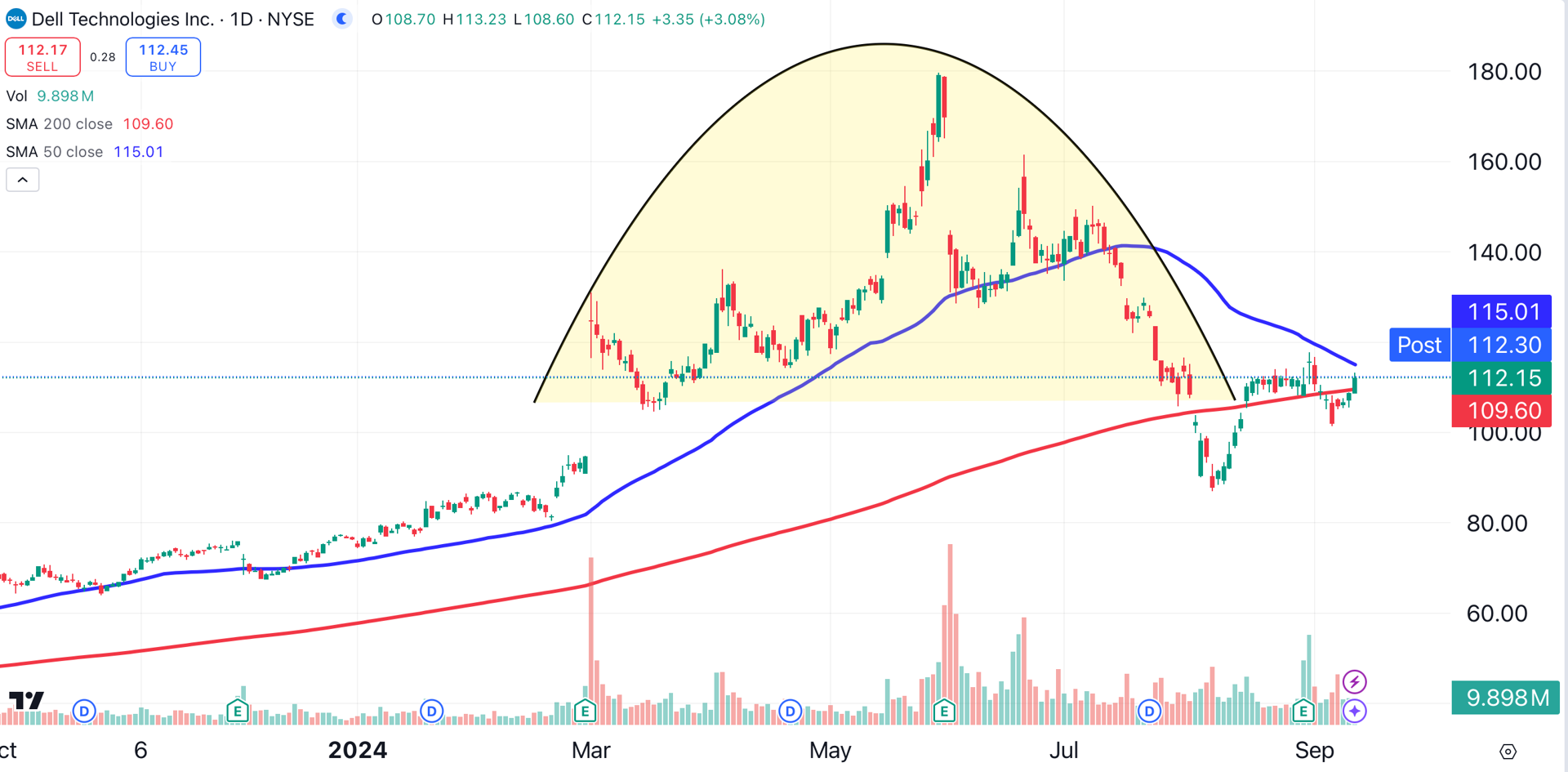
Unlike Palantir, Dell’s 50 day moving average is falling (blue). That moving average could soon cross below Dell's 200-day moving average (red), a sign of bearish momentum.
When creating any long/short pair trade, it’s helpful to use equal dollar amounts for your long and short positions. Since Dell shares are priced more than 3x higher than Palantir shares, a trader would need 3.3 shares of Palantir for each share of Dell to create opposing positions of equal dollar amounts.
At the time of publication, Ponsi was long PLTR, short DELL.