Berkshire Hathaway’s New CEO Signals Shift With $2.6 Billion Delta Decision
Under legendary head Warren Buffett, the firm sold all of its airline holdings years ago.
You've reached your free article limit
You've read 0 of 1 free Pro articles.
Does Berkshire Hathaway’s (BRK.A), (BRK.B) 13-F filing still matter?
Of course it does, at least to some degree.
The firm remains a large conglomerate and a fundamentals-focused investor in a number of U.S.-based companies. Warren Buffett is still the GOAT when it comes to value investing, and I am sure he still has more than a little impact on the decisions made by current CEO Greg Abel. That said, Berkshire Hathaway’s latest 13-F filing, released last weekend, makes one thing clear.
Abel probably has the final say and that’s probably what Buffett wanted when he retired. No, Abel does not have the track record of his predecessor, but to take him lightly would probably be reckless. He’s been in the room with both Buffett and Charlie Munger for years when investment decisions were made.
Berkshire closed out more than 15 separate long equity positions during the first quarter. Among those were Visa (V), Mastercard (MA), UnitedHealth (UNH) and Domino’s Pizza (DPZ). Though the position was smaller than those others, the firm also exited its position in Amazon (AMZN). FYI, your author today is still long AMZN.
Going The Other Way…
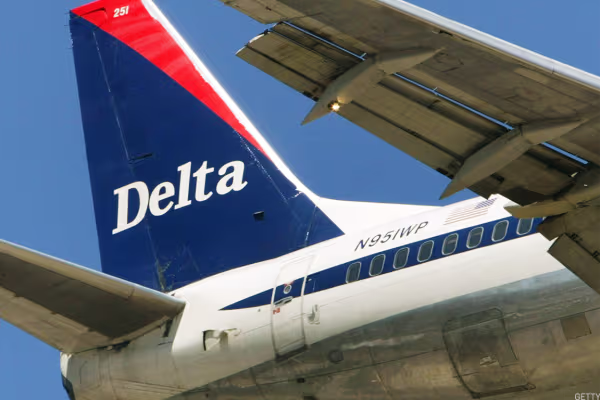
Under Abel’s leadership, Berkshire opened a new $2.646 billion stake in Delta Air Lines (DAL). This is Berkshire’s first venture into the airline space since Buffett exited all of his airline-related holdings during the pandemic year of 2020. In less than a quarter, DAL went from not existing among Berkshire’s holdings to being the conglomerate’s 14th largest holding.
The firm also significantly increased its exposure to Alphabet. During the quarter, Berkshire grew its holdings of the A stock (GOOGL) by 179% so that it’s now more than a $10 billion position. Berkshire also opened more than a $1 billion position in the C stock (GOOG). Combined, Alphabet is now Berkshire’s seventh-largest holding. Why buy both? One, the A stock tends to run with a slight “voting rights” premium, while Alphabet tends to repurchase the C stock when implementing its share repurchase program.
Berkshire also opened a new, but much smaller position in famed New York retailer Macy’s (M). The firm also increased quite sharply its holdings in Occidental; Petroleum (OXY). The core of Berkshire’s book remains Apple (AAPL), American Express (AXP), Coca Cola (KO) and Bank of America (BAC).
Why I Disagree on Amazon…
Roughly three weeks ago, Amazon reported the firm first quarter financial results. For that period, Amazon posted a GAAP EPS of $2.78 on revenue of $181.519 billion. That bottom-line number beat Wall Street’s expectations by more than $1 per share. The top-line print beat the consensus view by more than $4 billion. Let that sink in. The revenue number also reflected year-over-year growth of 16.6%, the most aggressive pace of growth experienced by Amazon since Q2 2021.
Guidance? For the current quarter, Amazon guided revenue towards a range of $194 billion to $199 billion. That would be good for year-over-year growth of 16% to 19%. That was a decisive beat. Operating income is seen at $20 billion to $24 billion. The midpoint of that range is in-line with what Wall Street was looking for. Let’s not forget how hot the firm’s custom chips have become.
Looking into that quarter, AWS generated sales growth of 24% to $37.587 billion (+24%), beating expectations. AWS produced an operating income of $14.161 billion (+23%), which crushed Wall Street’s view. Here’s why Abel probably got out of Dodge: For the period reported, Amazon generated operating cash flow of $26.032 billion. Out of that number came capex spending of $44.203 billion, leaving “free” cash flow of -$18.171 billion.
Free cash flow, due to the big up-spend on AI infrastructure, has dropped to $1.232 billion over the trailing 12 months, down from $25.925 billion a year ago. As tough as that looks, this was not unexpected. The firm, in my opinion, has the most to gain, among the mega caps, from the advent and adoption of AI and what that can do to reduce overhead, ultimately increasing margin.
The Chart
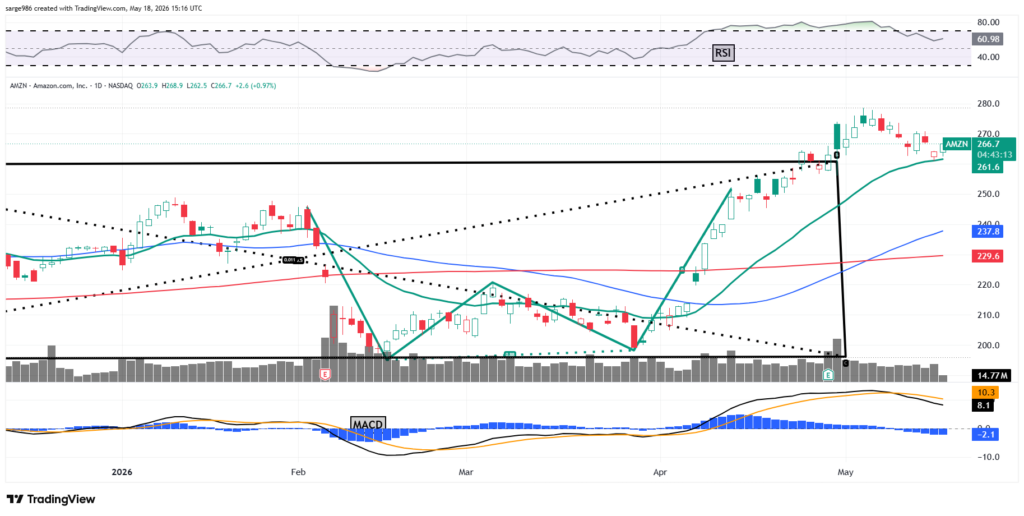
Readers will see that AMZN had broken out from a $259 pivot in late April, created by a rectangle pattern after having come out of a double-bottom pattern of bullish reversal. Relative strength is strong, but no longer technically overbought. The daily MACD is now rather bearish looking, which is a concern. I’ll have to keep my eyes on that indicator. The stock has recently found support at its 21-day EMA, close to the pivot created by the rectangle. Holding that line was crucial. My target price for AMZN remains $324.
At the time of publication, Guilfoyle was long AMZN equity.