3 Ways for Investors to Play Lower Rates and a Lower Dollar
Investment experts weigh in on the fallout/impact from Fed cuts/lower rates, including a lower U.S. dollar, housing stocks potentially rallying, and more.
You've reached your free article limit
You've read 0 of 1 free Pro articles.
When the Federal Reserve cuts interest rates — as it’s all but guaranteed to start doing in September — it has wide-ranging impacts on markets.
What are the implications for the dollar? Housing? U.S. stocks? Global equities?
Three MoneyShow experts share their views — and picks — for you this week.
Mike Larson MoneyShow
The MoneyShow Chart of the Week: Why a Falling Dollar Matters
Federal Reserve Chairman Jay Powell didn’t equivocate. He didn’t parse his words. Instead, he said clearly and concisely on Friday that the Fed is ready to cut interest rates...and SOON! His specific comments in Jackson Hole, Wyoming were...
Powell’s speech had wide-ranging impacts on many markets. But as you can see in the MoneyShow Chart of the Week below, one of the most significant moves was in the US dollar! This multi-year chart shows the Dollar Index (DXY), a gauge that tracks the greenback’s performance against six major world currencies. They include the euro, Japanese yen, British pound, Canadian dollar, Swedish krona, and Swiss franc.
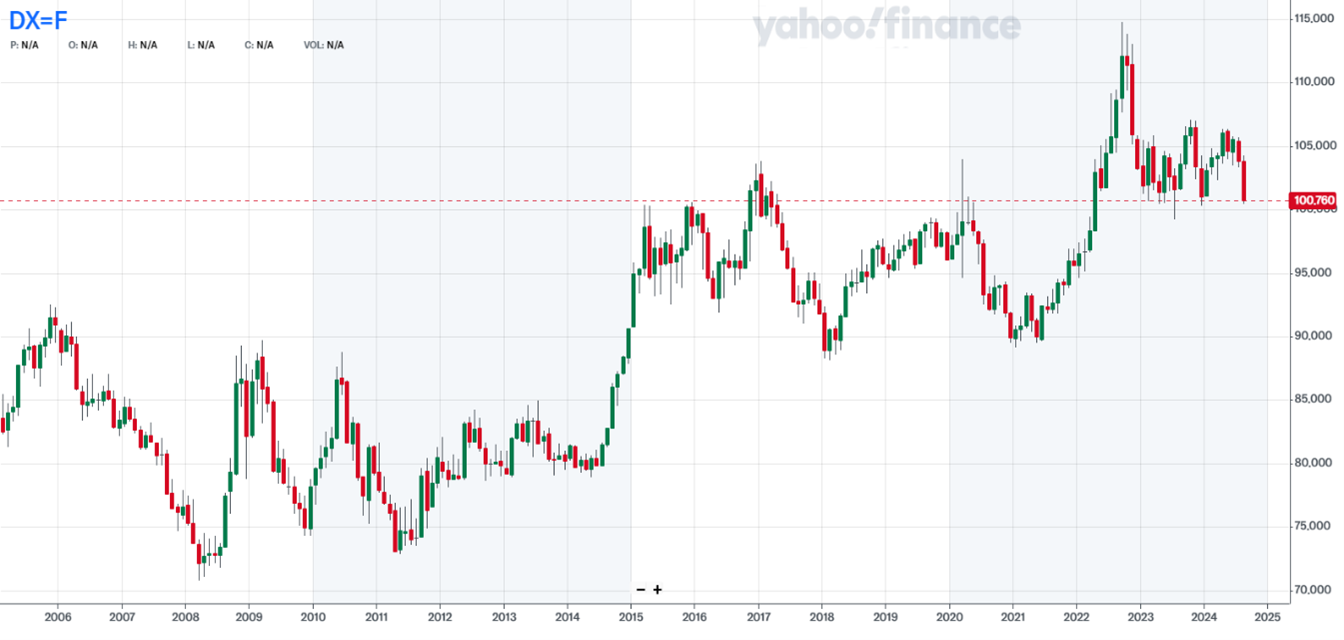
You can see that the dollar took off to the upside in 2022 as the Fed aggressively raised interest rates. That’s because relative yields are a key currency driver. Higher yields in one country versus another tend to boost the currency of the higher-yield nation relative to the currency of the lower-yield one.
But after moving mostly sideways in 2023 and early 2024, the DXY now appears to be breaking down. Should it fail to hold this 100-101 level, a drop toward 90 could be in the cards.
That creates profit opportunities for currency traders, of course. But it impacts other markets, too. A falling dollar tends to boost commodity prices, including the prices of precious metals. It also typically gives global equities a tailwind.
So if you’re a US-based investor, it might cost you more to travel overseas if the dollar breaks down. But your PORTFOLIO can rack up some nice gains — as long as you’re invested in the right kinds of assets! So, like I keep saying “Be Bold,” buy gold...and now, add some foreign stocks and funds to the mix, too.
Robert Isbitts ETFYourself
An ETF Worth Targeting as Dollar, Volatility Concerns Swirl
How big could this US dollar decline story get? Pretty dang huge! Right now it is risk. Unrealized risk. Like unrealized return, the dollar is slipping but the downward move has not truly “cashed in” yet. I keep seeing signs it could. Meanwhile, I like the Invesco S&P 500 High Dividend Low Volatility ETF SPHD here, advises Robert Isbitts, editor of ETFYourself.
How to profit off of the dollar move, beyond the little option trading stuff I do on the side, is not yet entirely clear. If we’re looking for a reason that September and October could be like some past fall nightmares, though, I think the culprit may be the greenback.
(Editor’s Note: Robert Isbitts is speaking at the 2024 MoneyShow Orlando, which runs Oct. 17-19. Click HERE to register)
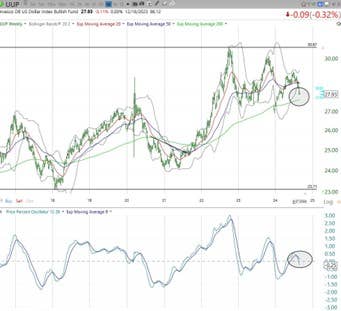
Yet with the stock market potentially set up to be “risk off” if the dollar goes from weak to worse, the biggest equity ETF position I currently hold in the CORE portfolio is the SPHD...and it is knocking on the door of a new high.
I first bought it back in March. It survived the August flash-crash thing, continuing higher throughout most of it. It is up 16% since that purchase, while the S&P 500 is up less than 10%. That is not a sign of a sustained “broadening” of the stock market beyond mega-cap tech. But it could be the start of one.
Meanwhile, we talk so much here about the 2-10 US Treasury spread, the most reliable recession indicator of the past 75 years. But recession, reschmession! We just want to make money and not lose it.
So, it is worth noting that, year to date, the ETFs that represent the current 2-year and 10-year Treasury securities are even-Steven. But they took very different routes to get there.
I see more evidence that the short-term part of the yield curve will begin to slide faster than the long end does. Translation: The yield curve will likely un-invert during Q4, if not sooner. For investment purposes, that could continue to benefit the CORE portfolio and any other portfolio that has a chunk of assets in short-term Treasuries. Because, other than T-bills, there is not only still decent yield there, but some lower-risk price appreciation potential, too.
Recommended Action: Buy SPHD.
John Eade Argus Research
A Homebuilder Primed to Profit as Mortgage Rates Fall
Housing is in a summer slump, but help is on the way. Meanwhile, DR Horton Inc. DHI is one of the largest US homebuilders based on home deliveries and revenue. We remain bullish on homebuilders because we believe there is currently a major shortage of affordable homes, asserts Jeff Eade, president of Argus Research.
A 50-basis point decline in the 30-year mortgage rate since June and a likely rate cut from the Fed may not solve all of the market’s affordability issues — but they sure will help. Housing starts fell to an annual rate of 1.24 million in July, which is the lowest pace in more than four years, according to data from the Department of Housing and Urban Development and the Census Bureau.
Starts peaked at 1.8 million in April 2022, just a month after the Fed’s first of 11 interest rate hikes in March 2022. Tighter monetary policy ended a long recovery from the Great Recession of 2007-2009. But signs that the Fed is poised to ease policy and reduce the funds target could bring buyers back into the market.
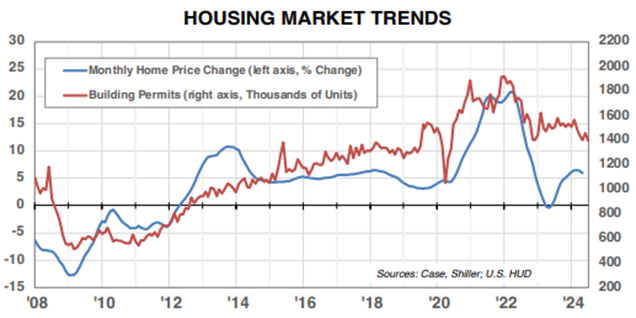
From a housing perspective, relief can’t come soon enough. Based on the August 16 GDPNow estimate from the Atlanta Fed, residential fixed investment is expected to decline by an annualized 11.7% in 3Q after a 1.4% drop in 2Q. While the S&P/Case-Shiller National Home Price Index jumped 5.9% in May, we expect growth to soften to 5% for June.
We remain bullish on the sector because demographics point to strong demand amid a decades-long shortage of affordable homes. In our view, DHI’s size, financial strength, and geographic diversity provide an edge in delivering affordable homes. Approximately 69% of the homes DHI delivered in the 12 months ended on June 30 sold for less than $400,000.
Recommended Action: Buy DHI.