Intel Might Be Too Hot After Incredible Guidance Sends Stock Soaring
Here's my trade idea after Lip-Bu-Tan proves he's the right CEO for the foundry giant.
You've reached your free article limit
You've read 0 of 1 free Pro articles.
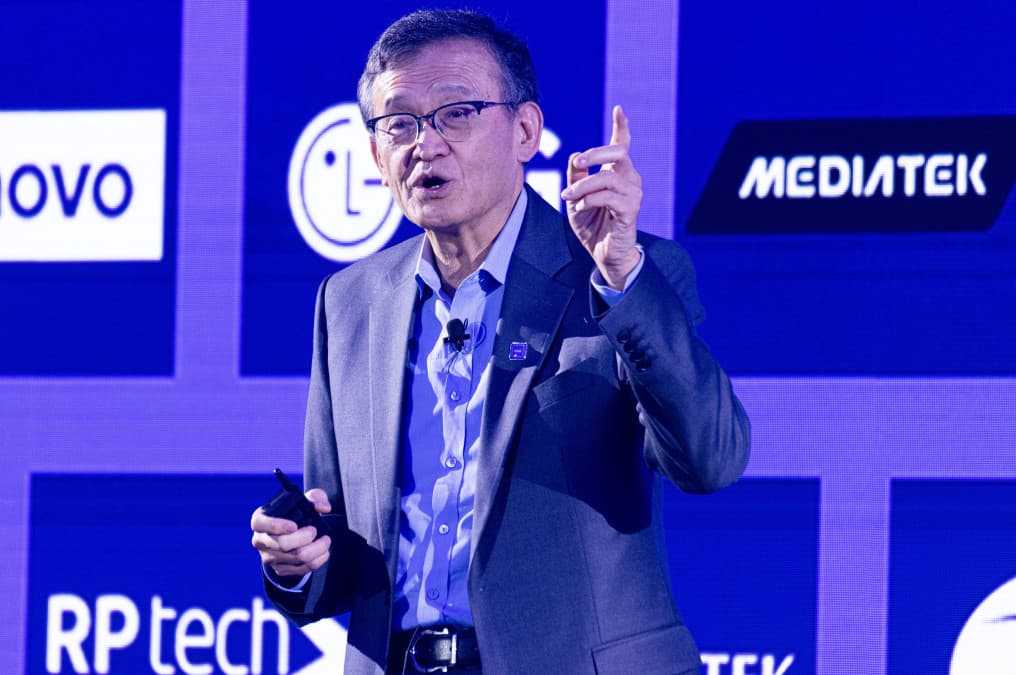
On Thursday evening, chip designer and foundry giant Intel (INTC) released the firm's first quarter financial results. The numbers were incredible.
The guidance was better than strong. The stock is soaring. Lip-Bu-Tan took over as chief executive at Intel in March 2025 from interim co-CEOs David Zinser and MJ Holthaus, who had run the shop briefly after Pat Gelsinger's disastrous run ended in December 2024. It's safe to say that the still-newish CEO, little more than a year into his tenure, has the ball rolling in the right direction.
For the first time in a long time, I have written something complimentary, or at least somewhat complimentary, about what used to be one of my favorite stocks.
For the period ended March 28, Intel posted an adjusted EPS of $0.29 (GAAP EPS: -$0.73) on revenue of $13.577 billion. The adjusted EPS print beat Wall Street by an incredible 28 cents per share, while the top-line number bested the consensus view by more than a cool $1 billion. That number was also good for year-over-year growth of 7.2%. That was easily the strongest annual sales growth performance for Intel for any quarter in two years. Adjustments were made primarily for restructuring charges.
Speaking of Lip-Bu-Tan, the CEO commented in the press release:
“The next wave of AI will bring intelligence closer to the end user, moving from foundational models to inference to agentic. This shift is significantly increasing the need for Intel’s CPUs and wafer and advanced packaging offerings. With a solid foundation in place, we are addressing this opportunity by listening to our customers and driving their success with our technical expertise and differentiated IP. This deliberate reset to how we operate drove a sixth consecutive quarter of revenue above our expectations, as well as new and deepened relationships with strategic partners.”
Operations
As net revenues grew 7.2% to $13.577 billion, the cost of those sales increased 2.9% to $8.23 billion. This left a gross profit of $5.347 billion (+14.5%) as GAAP gross margin improved from 36.9% to 39.4%. GAAP operating expenses grew 70.6% to $8.483 billion to leave a GAAP operating income/loss of -$3.136 billion, down from -$301 million. This, of course, does include those restructuring charges and other adjustments. GAAP operating margin dropped from -2.4% to -23.1%. Once adjusted, operating margin improved from 5.4% to 12.3%.
After accounting for interest, other income and expenses and taxes, GAAP net income loss dropped to -$3.728 billion from -$821 million. That works out to a fully diluted EPS of -$0.73, down from the year-ago comp of -$0.19. Adjusted, net income improved from $600 million to $1.5 billion. That worked out to a fully diluted EPS of $0.29, up from $0.13 a year ago.
Business Unit Performance
- Client Computing Group generated revenue of $7.727B billion(+1%), producing an operating income of $2.516 billion for an operating margin of 32.6%.
- Data Center and AI generated revenue of $5.052 billion (+22%), producing an operating income of $1.542 billion for an operating margin of 30.5%.
- Intel Foundry generated revenue of $5.421 billion (+16%), producing an operating income/loss of $2.437 billion for an operating margin of -44.9%.
- All Other generated revenue of $628 million (-33%), producing an operating income of $102 million for an operating margin of 16.2%.
- Note: Intersegment eliminations amounted to $5.3 billion.
Guidance
For the current quarter, Intel is projecting net revenue of $13.8 billion to $14.8 billion. Wall Street was looking for something down around $13.05 billion and this range just blew the street away. Most of Wall Street will have to upgrade this stock and increase their target prices on this news.
The firm is also looking for a current quarter gross margin of 37.5% (GAAP) or 39% (adjusted) and an EPS of $0.08 (GAAP) or $0.20 (adjusted). The guidance for adjusted EPS crushed Wall Street's consensus view for something like $0.08.
Fundamentals
For the period reported, Intel generated operating cash flow of $1.019 billion. Out of that came capex spending of -$4.963 billion and payments of $215 million on finance leases. Offset, these outlays were $1.959 billion in partner contributions and $107 million in proceeds from government incentives. That left free cash flow of -$2.016 billion. (No, the math does not work, but this is how the firm laid it out in the material provided.) Either way, free cash flow remains a huge problem.
Turning to the balance sheet, Intel ended the period with a cash position of $32.789 billion and inventories of $12.426 billion. That put current assets at $62.157 billion. Current liabilities add up to $26.885 billion. This includes short-term debt of $2.004 billion. That leaves the firm's current and quick ratios at 2.31 and 1.85, respectively, which is very healthy. Intel will have no problem meeting short-to-medium term obligations.
Total assets amount to $205.332 billion. Goodwill and other intangibles add up to just 11.3% of this total, which is perfectly acceptable. Total liabilities less equity comes to $80.343 billion. That's fine, but $43.027 billion of this is labeled as long-term debt. That does not necessarily mean that this balance sheet is weak, because it is not, but I would like to see the firm whittle that number down.
Opinion
A better day has clearly dawned at Intel.
Corporate execution is better. The new CEO appears to be the right CEO. Profitability, at least on an adjusted basis, is not shaky. Cash flows still stink. That's a product of the foundry, even with improved sales, still hemorrhaging money and the advent of AI, which requires a sharp up-spend.
Still, I think this is a name that can better compete going forward, against the firms that had previously stolen its lunch, such as Nvidia (NVDA) , Advanced Micro Devices (AMD) and Taiwan Semiconductor (TSM) . The rally in INTC shares on Friday morning is taking the shares of some of these stocks along for the ride.
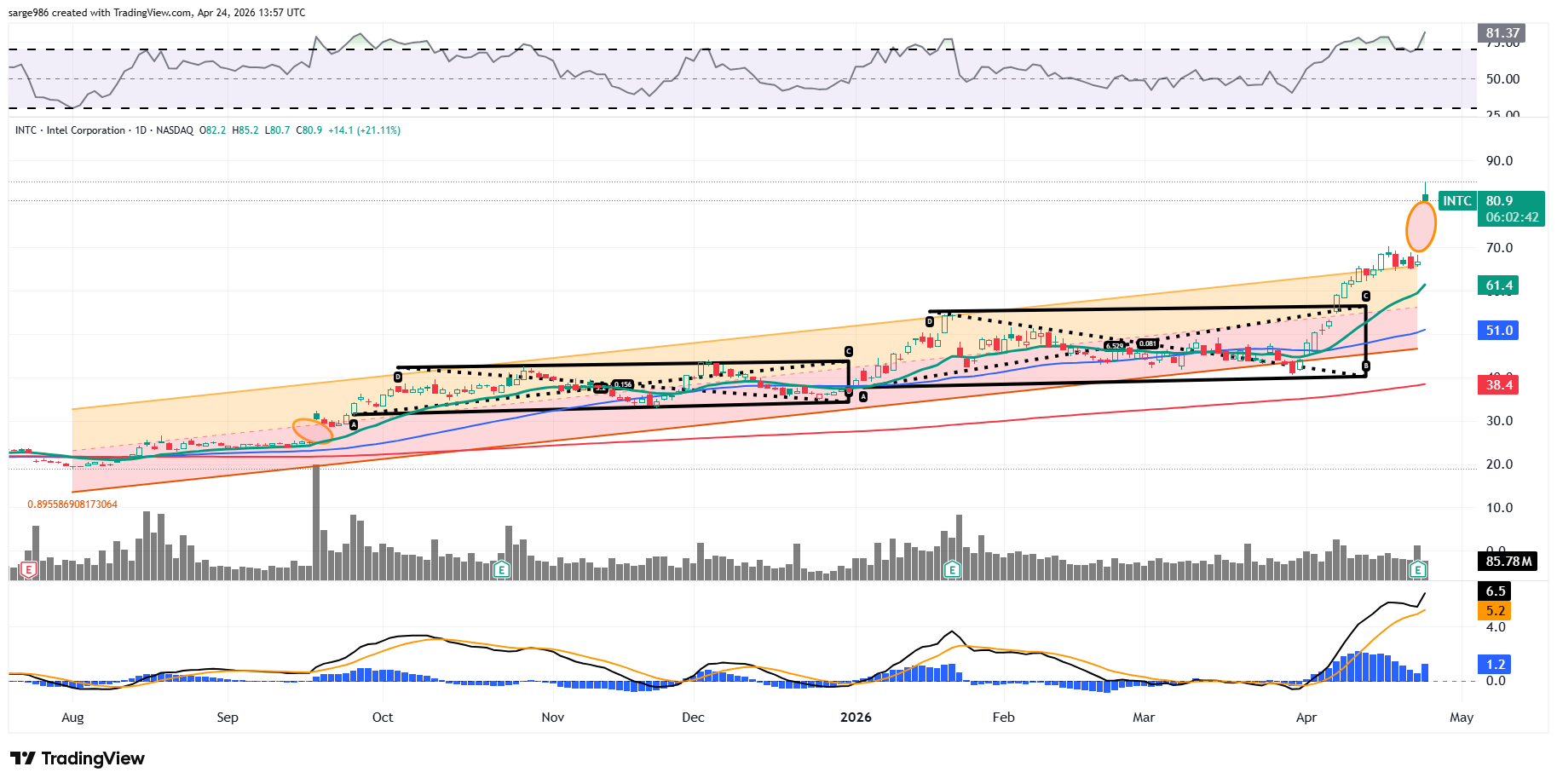
Readers will see that the shares of INTC had developed a basing period of consolidation that ran into late December 2025 before breaking out and developing a new "flat base" that ran into early April 2026. That uptrend is illustrated here by a Raff Regression model. Early in April, the shares retook both their 21-day EMA and 50-day SMA. This put swing traders and portfolio managers on the same team. The stock has clearly broken out from this trend.
Moving on to the indicators, relative strength is not just hot but now entrenched in technically overbought territory. Below the chart, the daily MACD is postured more than bullishly. The histogram of the nine-day EMA is now well above the zero-bound as are both the 12-day EMA and the 26-day EMA. Enhancing the situation, that black line is running well above that gold line.
Conclusion
This run is a bit too hot for me. I want to be long INTC, but not up 23% for the day prior.
I am enjoying the adjacent move in both AMD and TSM that this move has caused. I am likely to short some INTC on Friday as a hedge against losing the gains made in those other names. I would lie to re-initiate Intel as a long position to the Sarge-folio once an attempt is made to at least start to fill the gap created on Friday morning.
Related: Nikkei Sets Record as Tech, Consumer Plays Battle in Japan
At the time of publication, Guilfoyle was long NVDA, AMD and TSM equity.