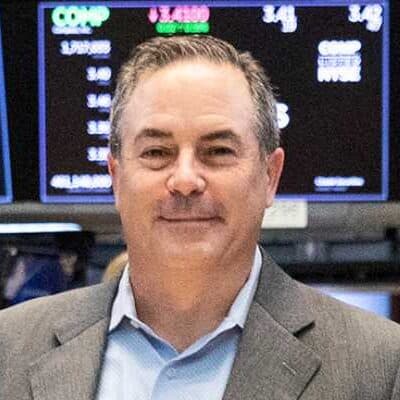
VIDEO: Can Market Recovery Continue?
As the market responds to better-than-expected economic data, investors are looking for signs that the momentum can continue.
You've reached your free article limit
You've read 0 of 1 free Pro articles.
In today’s Daily Rundown Video, Chris Versace is joined by fellow TheStreet Pro contributor and founder of Sarge986 LLC, Stephen “Sarge” Guilfoyle, to discuss this week’s inflation data and how it may translate into Fed action in the coming months.
"Yesterday was about as solid a day as we've had in some time," Guilfoyle said of the market's response to the latest data. "To see up days, positive momentum, coupled with increasing trading volume, that would go a long way toward making me feel like maybe the market's going the way you want to be."
The two also run through their thoughts on the economy and talk stocks, including Nvidia NVDA, Palantir PLTR, Starbucks SBUX, Dutch Bros BROS and Alphabet GOOGL.
More Pro Portfolio
- We're Initiating a New Position in This Oversold Bullpen Stock
- Weekly Portfolio Roundup: Opportunity Was the Name of the Game
- We've Got the Scoop on Our Stocks
Transcript
CHRIS VERSACE: Hey, folks. Chris Versace here with an extra special Daily Rundown video. You know, typically I, you know, share my thoughts with you about what's going on with the market, the economy, and, of course, touching on the portfolio. But today we're bringing in Stephen Sarge Guilfoyle to chat with us about the CPI report, about the market, about the slow August, and we'll probably touch on a few other things as well. So with that, Sarge, thanks for joining me today.
STEPHEN SARGE GUILFOYLE: Thank you for having me, Chris. Hello, everyone.
CHRIS VERSACE: So, Sarge, you know, the market went through a bit of a kerfuffle last week let's call it following the unwinding of the N trade, the N carry trade. But it's kind of ground its way back. The July PPI report that showed probably a little more progress than folks were thinking helped, you know, further that effort yesterday. But today we got a July CPI report that, you know, based on the headlines, was largely in line with the market and what it was thinking. Did anything in that report, you know, kind of stand out to you?
STEPHEN SARGE GUILFOYLE: At a headline and core level. No mean it's right as expected. I guess that's why the market's taking it with a muted response. PPI was much more exciting. It was below expectations across the board. Even though it was small, it got the algorithms excited. And as we all know, the algorithms control price these days. So they took off.
We had our most positive day yesterday since that kerfuffle. All the trading volumes were higher. Everything except energy was higher. They bought Treasury securities. I mean, yesterday. It was about as solid a day as we have had in some time, even though we had had a series of up days since the Monday bottom of that three day yen carry sell off or whatever the heck you want to call it. But it was just it. It was the most convincing of the three or four days since, that we're all in the right direction. But until yesterday, the trading volumes have been dropping each and every day.
CHRIS VERSACE: Well, I think some of that is typical of what we tend to see in August. People are on vacation squeezing in that last beat a vacation before everybody's quote, back to work after the September holiday. So I'm not surprised by that.
STEPHEN SARGE GUILFOYLE: But yeah, but the down days were awful. So you don't want to see much lower volume on up days than you do on down days because that means that the professional money isn't being convinced to get back in. They got their faces ripped off. But yesterday was the first day I felt like maybe they were trying to get back in even if they were paying up from where they sold.
CHRIS VERSACE: So with that, do you need to see more of that type of volume to of, you know, suggest that, yes, this can continue and we can go further?
STEPHEN SARGE GUILFOYLE: To make me feel like that, yes. I'm not convinced that we're going to go higher. I don't know what we're going to do. But, yes, to see updates, positive momentum coupled with increasing trading volume, that would go a long way towards making me feel like maybe the market's going the way where you want to be net long to a great degree.
CHRIS VERSACE: Now a second ago, you said that you're not necessarily convinced. And I've kind of shared my view that I expect August to be a little bumpy. And I'm going to tie this into my next question. You know, the market is seemingly convinced that we're going to have, you know, the equivalent of four rate cuts with three meetings left to go. That kind of implies a bigger move in September, 50 basis points according to the CME FedWatch tool. But based on what you saw in the July PPI, the July CPI data, can the market be disappointed when it comes to September?
STEPHEN SARGE GUILFOYLE: The market can certainly be disappointed because while inflation is visibly slowing, it was supposed to slow these months, you know, just due to base effects. I think you're going-- I believe you're probably going to see a re-acceleration in consumer level inflation, maybe not a tremendous re-acceleration, but a re-acceleration probably from October on. So it's not going to impact the September rate hike decision. Because I don't think that--
CHRIS VERSACE: Rate cut, rate cut.
STEPHEN SARGE GUILFOYLE: Rate cut, rate cut decision because I really don't believe that the economists at the Fed are smart enough or on the ball enough to see this base effect. It probably is going to force the year over year number at least to get to go a little higher for the balance of the year, probably for the fourth quarter and probably into the first quarter.
So we're not out of the woods as far as inflation goes. And we know we're not out of the woods as far as economic activity goes. We're pretty certain that the economy has been slowing down significantly. We know the labor market has been slowing down significantly. So there is a reason here for the Fed to want to act, to try to get ahead of the decelerating economy and try to balance to the dual mandate.
I find it, it's going to be-- I think it's going to be a difficult road. It's going to be a difficult road to do properly and to do without upsetting the apple cart. So I see there as being a significant chance that the apple cart does get upset. We saw JP Morgan and Goldman yesterday, right? Their models both show a higher likelihood that we're either in or going into a recession than they did just a week or so ago.
You know, I've been saying, I think we're closer to a recession than most people believe for quite some time now, just because I follow GDI as well as GDP. And GDP has said, we've been on the verge of recession for about a year and a half. So, I mean, there's a lot of things you can look at that say this economy is not as good as it's been advertised. And if we were growing at 0.4% in 2023, as GDI suggests, instead of 2.5%, then we're starting off close to recession as we slow down.
CHRIS VERSACE: Interesting interesting. So you don't put a lot of stock in that rolling Atlanta Fed GDP forecast that says 2.9%, even though we're going to get a lot of data this week that could revise that lower, potentially higher.
STEPHEN SARGE GUILFOYLE: Well, they were pretty accurate for the second quarter, the Atlanta model as long as you're only following GDP. And they were not accurate in the first quarter. In the first quarter Saint Louis was much more accurate. I think they were around 1.6% in Saint Louis for the first quarter. And it was like 1.7, something like that. Maybe it was 1.4.
So know, there are several models out there by several feds. Atlanta gets all the press. But it's not always the most accurate model. As I said, Saint Louis nailed it. Cleveland's been predicting, you know, zero point something for quarter after quarter for some time now. And we chuckle because they're so far off as far as GDP goes.
But if we look at GDI they nailed it. So, I mean, how do you measure growth? If GDI and GDP are supposed to equal the same number, and they don't, and they're off by 2 percentage points, the Fed tells you in their instructions to average the two. So if 2023, if it was 0.4% and 2.5% GDI versus GDP, then the average is 1.45%
An honest economist would have said growth in 2023 was around 1.545% Yet everyone said growth is 2.5% because it sells a story. It sells a narrative. It's how CNBC sells advertising. So yeah, everyone just takes, the more optimistic number because it's more well-known. But even the Fed in their instructions tells you to average the two. So I get a little going off on my tangent there and it got me a little fire.
CHRIS VERSACE: Well that's, that's all right. You know, from time to time we want to, you know, hear what you're thinking and that we can reflect on that. Because as an investor, we like to source a lot of different pieces of information and different opinions. And sometimes it allows us to, you know, double check our thinking, you know, from time to time, you know.
And you and I have talked in the past, I've talked with others on the Pro Platform. You know, sometimes I get some pushback on what I'm thinking. It forces me to reassess. But there's nothing wrong with that because we have to continue to test our thesis, test our mettle, whether it's our thoughts about the market, the economy or even what's in the portfolio.
So I always welcome that sort of thing. It's also why I welcome questions when we have portfolio office hours on Tuesdays over in the portfolio forum. I love it. But that said, that said, let's try and get back on track here. So the market tends to be, you know, a little kind of call it in August. How are you using the month of August?
And I'm asking this, Sarge, because we used last week's, you know, drop in the market, the volatility, if you want to call it that, to call up some names into the portfolio. And we have shared that we are going to rearm the bullpen over the next couple of weeks. So are you are you identifying immediate opportunities for the Sarge Portfolio or are you just-- or are you more kind of kicking the tires, building a list of things that you might pounce on if volatility re-emerges?
STEPHEN SARGE GUILFOYLE: Well, when volatility emerges, like it did last Monday, during the pre-opening, was the day. Excuse me. So that was when I struck, actually. I mean, I increased my longs in NVIDIA, in Palantir and in SoFi ahead of the opening last Monday, because those prices were so dislocated, I couldn't see myself being very wrong. So as those are three of my really core longs.
And I had sold a bunch of NVIDIA on the way down, fortunately at higher prices. So as the stock took a hit, I took a hit too, but to a lesser degree. So I reloaded a little bit. I haven't reloaded the whole ball of wax that I sold, but I reloaded to a degree. So NVIDIA is back, I think in my top 10 holdings or so.
Palantir and SoFi are both also in top, top 10 holdings. Although SoFi, it hasn't rebounded like I wanted it to. It's rebounded, but it's up just a few percentage points. But Palantir has been outstanding. They reported last week that stock is, I think, really on its way to outperforming as an AI data centric operation. And NVIDIA is NVIDIA.
The only competitor is AMD, which I'm also long, and really for now and AMD is not really a competitor. NVIDIA is in a class by itself. UBS's analyst trying to remember his name. Arcuri, I think five star analyst over at tipranks. He came out with a note this week. And he said, even though this Blackwell architecture is going to be delayed, the purchasers of this hardware are so aggressive they'll buy last year's hardware just because they need the chips.
CHRIS VERSACE: Yeah, I mean it's a story of, you know, being stocked out getting your hands on what you can. And we chatted about that with members. I think UBS came out, they reiterated their outperform. They reiterated their 150. To me, the more telling news was what we heard from Taiwan Semiconductor with their July revenue report, that was just, you know, lights out. I mean, there's no other way to put it.
That's so impressive. So, I mean, really and you've seen the Philadelphia Phillies Semiconductor Index has been really doing great since that report came out. After it led on the way down, it has been the leader on the way back up.
CHRIS VERSACE: Agreed, agreed. And then, you know, earlier today, we heard from Hon Hai or Foxconn, as it's also known, which is one of Apple's manufacturing partners. They came out and said that they see the third quarter ramping very nicely compared to the second quarter, both on a year over year and sequential basis. They see seasonal ramps and new products, i.e., iPhone 16, you know, moving higher.
But they also had a lot of very positive things to say on the AI front as well. So I think we're going to start seeing the AI basket, if you will, start to work again. You know, NVIDIA, Marvell, we also have Qualcomm in the portfolio as well. But you mentioned Palantir.
And there was a member who during yesterday's office hours just said, hey, like, what's the thinking on Palantir? How is it positioned? And I know you've been a big bull on it, Sarge. Can you share your elevator thesis on Palantir?
STEPHEN SARGE GUILFOYLE: Palantir has been with me since it was a stocks under 10 name back when I ran that portfolio. So, I've really been in it since it was trading at about $6. But couldn't buy it for myself, so I no longer ran that portfolio. So my net basis is around $16. But it's been a name I've been in since pretty much since it really became-- I became aware of it.
It's got such a large government business. It has a growing commercial business. It is the, in my opinion, the quintessential number one AI platform/use of big data that really shows outcome. It really other than ServiceNow which is also a big data type firm, they're really the two runaway winners I see in enterprise artificial intelligence that is not part of the infrastructure. They're users rather than infrastructure.
CHRIS VERSACE: But services.
STEPHEN SARGE GUILFOYLE: Right, right. But really think Palantir has a chance to really become something special here. So I really didn't want to miss that. I mean, just take a look at this guy, Alex Karp, the CEO. This guy looks like Einstein, right? I don't know if it's just my imagination.
But, you know, when I got a guy running stuff that's so up there in intellect, in requiring intellect to understand that I have trouble understanding it, I want the guy to look like an eccentric. And this guy looks like an eccentric. I mean, you hear him speak. The only other guy that makes me-- he makes me say, wow, that guy is brilliant.
The only other CEO that can do that to me is probably Satya Nadella over at Microsoft.
CHRIS VERSACE: Interesting, interesting. So you see Palantir, and as you said, ServiceNow, which we own in the portfolio as kind of confirming signs of enterprise adoption. But Palantir also has that federal or government angle as well, right?
STEPHEN SARGE GUILFOYLE: They might be spying on us. But you know what. If somebody's spying on me, I want to make I want to make money off of it.
CHRIS VERSACE: So right, right. No, I get it. I get it. But so the reason I ask that is because, you know, several weeks ago, maybe a little bit more, there was some concern as we went through the June quarter earnings season about all this additional spending that was announced on AI and data center. And some folks in the market were kind of saying, OK, well, when are we going to start to see this.
Is there too much hype or as I like to say, hopium around this AI? And when ServiceNow reported, I pointed to that and the price uplift that they're getting because of the inclusion of AI, saying that we are in the early innings. But this is a nice confirming data point. You're viewing Palantir kind of like that, where you're saying, oh, yeah, this AI thing, it's for real and it's starting.
STEPHEN SARGE GUILFOYLE: Oh, yeah, And Palantir. I mean, not that it will be. Nothing's been said about it, but it could end up in the S&P 500 within a quarter or two. I mean, it's ready. It already qualifies. It was not considered last go around when stocks like GoDaddy were. I think Palantir is probably a little more important going forward than GoDaddy. So I think it just-- you might get a benefit, just from the inflows alone if it is announced that there will be in the next addition to the S&P 500, or maybe the addition after that.
But I think it's definitely on the road to going there. It's profitable every quarter. It's growing, and it's become it's becoming central to a lot of businesses. The way they sell their operations with these boot camps, it's unique and it almost always comes away with an increased sale. However they put on this little show. I've never been to one of them, but they put on a little user show with the customer.
And they're coming away with deals. They're coming away with increased deals. And the military and the intelligence services aren't backing away either. I mean, they have a chance to be a real powerhouse. I don't know whether they'll put them in my AI basket or my defense basket.
CHRIS VERSACE: What's your price target, Sarge, for Palantir?
STEPHEN SARGE GUILFOYLE: $36 right now. But it's fighting right now around a $30 pivot. It's been there now for about four or five days without actually taking and holding the pivot. But $36 is just a target for now. I mean, if it hits $36 tomorrow, I'm not selling my Palantir. I'm selling maybe a little bit and changing my target. And my targets are not out prices. They're where I reevaluate.
CHRIS VERSACE: And with that, you know, members are no stranger to my having to raise price targets, you know, like United Reynolds. You know, that's one that as infrastructure is continued to improve, you know, over the last two years, I've had to raise and raise and raise my price target. Have you had something similar with Palantir? Because you've been in it for some time.
STEPHEN SARGE GUILFOYLE: Yeah, My first price target, I think, was $10. I mean, you know, I've had to raise price targets often and, and when it has dipped I have added. So I've actually been able to increase the position size over time. So I mean, when it was first in the SU-10 portfolio, I had to change the position size a few times.
And since it's been in my own book on a holding of my own, I've had to change price, target prices, a number of times. And I've done a couple of really just as a counter piece when I've seen-- there are a couple of analysts that don't like Palantir. And when they come out with one of their hit jobs, sometimes I'll come out with a counter piece, and I'll just raise my target price by $1, just because I have such a stronger track record than some of these analysts do in this name.
I mean, if you've been wrong on Palantir for two years, just shut up and go away, man. If you're a three star analyst, or that's not a terrible thing to be. You would probably be a four star analyst if you just shut up on Palantir.
CHRIS VERSACE: OK. For someone who wants to get in the flow of Palantir, is there any-- what are the top one, two, three things that you pay attention to help verify, tell you that you're on the right track, if you will, as it relates to Palantir?
STEPHEN SARGE GUILFOYLE: As long as the government business is growing and the commercial business is growing and overall sales are growing by 23ish percent or more. I feel like we're going in the right direction and they won't dock the stock for its high valuation. Because based on traditional metrics, it's expensive. There's no way to get around that.
They're either pricing in a tremendous increase in business or just incredible margins going forward. They're pricing in something. Because if they're just pricing in the stock on its performance, it is admittedly expensive. All right.
CHRIS VERSACE: Let's pivot two quick things. Yesterday, Starbucks got a new CEO, Chipotle lost one. What do you think? Well, I got short Starbucks on the news. I mean, it's great for Starbucks. Niccol's done a great job over there at Chipotle. I got in and out of that name so many times over the past couple of years thinking that it was probably too expensive, and all I had was a slightly profitable trade usually, when I could have probably been invested in the name the whole time and made some decent money.
So I have not-- I've traded CMG, OK. I have invested in it poorly. Starbucks has been a disaster for quite some time now. I guess if anybody can fix Starbucks, it might be this guy. I don't know about Chipotle right now. I mean, they were down 7.5% yesterday. Let me tell you what they're doing now. Because I don't know. They're up 0.2, 0.3%.
CHRIS VERSACE: So yeah, so my concern with Starbucks is, I agree. I mean, we owned Chipotle in the portfolio at one point. We did extremely well with it. You know, Niccols is as I said this yesterday, he's a great operator. He's a great menu innovator, no question.
The only concern I have is that I think Starbucks problems are a lot bigger than the problems that Chipotle faced when he came on board. Starbucks is also a much larger operation in terms of store count, geographic footprint. And there are other businesses outside of the simple, you know, storefront that he's going to have to contend with. So I think it's a big job. He might be the person to do it, but I think there's going to be some pain along the way.
STEPHEN SARGE GUILFOYLE: There will definitely be pain, especially when you're talking about the economy. If the consumer is feeling pressured, they're not going to pay premium prices for coffee and a Danish. I mean, it's just not going to happen. They're going to go to 7-Eleven or Cumberland Farms or one of those places.
CHRIS VERSACE: Or Dutch Bros or Dutch Bros.
STEPHEN SARGE GUILFOYLE: Well, since you're in Dutch Bros or Dutch Bros. But I never see them, though they're not-- I live in Florida and New York.
CHRIS VERSACE: The whole-- the whole-- yeah, no, of course you don't. The whole story behind Dutch Bros., it's classic. It is geographic expansion and they're moving from west to east. Do you remember when we were on stocks under 10 together and I had Habit Burger? It was the exact same story.
And what happened as they finally got some real geographic footprint exposure, they got taken out by Yum. Brands. Now, I'm not going to say that's going to happen to Dutch Bros. But it's that time tested geographic expansion. It worked for Starbucks. It worked for Duncan. It worked for McDonald's. It worked for Habit.
It's going to work for others. It's working for Cava. That's the story behind Dutch Bros. And I think that, you know, if we do see the Fed enter the long expected rate cutting cycle, cost of capital for expansion is going to come down. I think they might even be able to surprise on the upside with their expansion. So I do like that. They're a smaller footprint in terms of location size.
It's all beverages. So there's no food that they really have to worry about. It's kind of a cleaner story, dare I say, Sarge, an early Starbucks story. But let me get let me get one last thing, because I know we're bouncing up against the clock here.
Google, the reports out that the DOJ is going to look to break it up. Is this something to worry about in the near term? Because I think Google is going to fight it. There might be some concessions. Ultimately, I think it could go away, especially if there's a sea change in Washington after the election.
STEPHEN SARGE GUILFOYLE: I kind of I tried to address this in market recon this morning. And it's really, if you look at a chart of Google, they had an ascending triangle that dragged from the last part of 2023 into 2024, which produced a pop. It worked. Beautiful, beautiful technical move.
Then there was a rising wedge, which is a pattern of reversal, which took us into the recent sell off. That worked twice. So we have back to back, easy to visualize technical patterns that work like a charm, if you're strictly a technical trader in Google. Now, suddenly the stock sold off. It's in between the 50 and the 200.
It doesn't have a technical pattern, so it's got to rely on the news flow right now. And those are your pivot points. It could go up to the 50 and take off. It can go down to the 200 and turn into a real problem. And I'm really torn. I don't think I care about this stock with my money until it takes or loses one of those moving averages, because that's where the portfolio managers will be pressured by their risk managers to either increase or decrease exposure.
CHRIS VERSACE: So to be clear, because you're focusing on the technicals here, if it bounces off the 200 moving day average, you become interested.
STEPHEN SARGE GUILFOYLE: Which it's kind of done once already. Kind of.
CHRIS VERSACE: Right, right. But if it rebounds and pushes through the 50 day moving average, you're as interested.
STEPHEN SARGE GUILFOYLE: I'm much more interested, as a matter of fact. I'd rather pay the higher price in that instance because when you take and hold a level, there's acceleration. And then there's the catch up. When you just defend a level, there is often another attempt or a third attempt or a fourth attempt. So a lot of times when you hold a level, it's good for a much smaller trade. When you take a level on momentum, you have a chance for a trend.
CHRIS VERSACE: OK all right. Well, let's leave it there, Sarge. We covered quite a bit of ground. And you have us watching the technicals on Google for our next move. Thanks so much, Sarge. I always appreciate our conversations. And I know members are as well and look forward to doing this with you again.
STEPHEN SARGE GUILFOYLE: Rock on.
At the time of publication, TheStreet Pro Portfolio was long NVDA, BROS and GOOGL.