A Shift in Market Character Calls for a Shift in Tactics
Bonds are hurting the market and it is time to react to the damage being done.
You've reached your free article limit
You've read 0 of 1 free Pro articles.
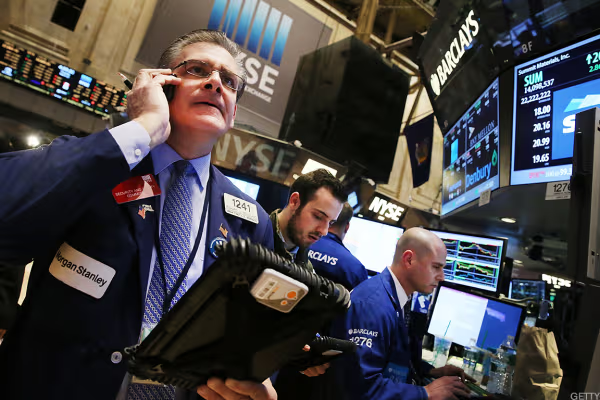
The character of the market changed on Friday, and negative sentiment over the weekend has made things worse. The S&P 500 closed at the lows of the session, down 1.2%, while the Nasdaq Composite fell 1.5% and the Dow Jones Industrial Average lost 537 points, or 1.1%. The selling was broad rather than rotational, and the close at the lows is a warning that indicates that sellers were not finished when the bell rang.
The source of the pressure is not a mystery. Inflation worries and the bond market became the focus, providing a convenient excuse to sell equities. The 10-year Treasury yield jumped more than 13 basis points on Friday to close at 4.595%, the highest since February 2025. The 30-year ended at 5.127%, the highest closing yield in nearly 20 years.
This is a global bond rout, not just a U.S. story, with yields rising around the world amid resurgent inflation fears. When the discount rate moves to this degree, the most extended part of the stock market is where the damage hits first, and that is why the chip-fueled rally was hit the hardest.
Oil is adding to the problem. Brent is up 1.8% Monday morning to $111.16 with West Texas Intermediate above $107. The Iran situation is still on hold with no path to resolution, and the weekend brought more confusion rather than less, with President Trump posting Sunday that the clock is ticking for Iran.
The Strait of Hormuz remains functionally closed and global inventories are drawing down at a record pace. Higher oil prices fuel inflation worries, which in turn push interest rates higher, which in turn feed equity selling. That is the loop that is gaining traction.
The China Data Adds the Other Jaw
For weeks, the stagflation focus has been about inflation keeping yields elevated. However, data from China over the weekend raised concern about the growth side of the vise.
Chinese retail sales rose just 0.2% in April from a year earlier, a sharp deceleration from 1.7% in March and the slowest pace since late 2022. Industrial output, investment, and the real-estate sector all undershot expectations.
The world’s second-largest economy is showing demand-side cracks at the same time the inflation side is keeping central banks pinned. That is stagflation pressure that is building from both directions, and it also casts a negative light on the empty results from the Trump-Xi summit.
Warsh Inherits an Uncooperative Economy
The Fed has its next Chair approved, but Kevin Warsh is unlikely to deliver the dovish tone the market wants. Warsh clearly wants lower rates, but the data may make that impossible. Stubborn inflation, oil through $111, a global bond rout, and the long end of the curve at levels not seen in two decades do not give an incoming chair much room to ease.
The market has already done this math and does not believe the easing story regardless of who runs the Fed. The incoming chair wants to cut, and bonds are voting that he cannot. Equities are caught between the two.
The remaining catalyst on the earnings calendar is Nvidia (NVDA), which reports on Wednesday after the close. This is the last major event of the earnings season and the bar is high.
Nvidia stock has declined on the day of its earnings release in three of the last four quarterly reports, and every one of those was a beat. The options market is pricing a move of 8% to 10%. A strong number is already in the price, and the China hope that lifted the stock has been recast as a negative.
After Wednesday there is a catalyst vacuum into a holiday-shortened week. That is the setup that gives negative seasonality the benefit of the doubt rather than the fade.
Strategy: React, Do Not Anticipate
I have written many times that it is better to be reactive than anticipatory. The goal is to stay with the trend and with momentum rather than to keep guessing when a top or a turn will arrive. That discipline is what kept us with the rally that ran from April. Trying to call the top during that run was very costly for the anticipatory bears that keep trying to predict a turn.
The same discipline that kept us long is the one that turns us defensive now. Reacting to a change in character is not a contradiction of trend-following. It is the other half of it.
The signal is not a forecast or a prediction. The signal is the character of the action shifting, and Friday into Monday delivered that shift on every axis that matters. The S&P 500 closing on the lows, the 30-year at a two-decade high, a global bond rout, oil through $111, and Chinese demand cracking is a change in character, not just volatility or noise.
When the evidence is this broad, the reactive method says take action and move without hesitation. My cash levels have been high for a few weeks, and I may raise them further. That is not a panicky reaction, and it is not a market call. It is flexibility, and flexibility is the entire point right now.
We may give back some gains at this stage, and there is always hesitance to sell stocks that have treated us well. The hardest stock to sell is the one that has produced the best gains, which is exactly why discipline has to override the instinct.
Although I’m being much more cautious at this point, I remain optimistic and positive because I know the opportunities will come. They are just not here yet, and there is no edge in forcing them. Some new setups will take time to develop, and the job now is capital preservation and readiness rather than hunting.
It is time to protect gains, maintain flexibility, and let the new leadership prove itself before we put precious capital on the line.
At the time of publication, Rev Shark was long NVDA.