Stunning Small & Mid-Cap Outperformance Is Hardly Unprecedented
Think the recent market rotation is unusual and can't last? Think again.
You've reached your free article limit
You've read 0 of 1 free Pro articles.
People seem to believe that the rotation from large-cap technology to Russell 2000-type stocks is an anomaly. Those folks don’t have long memories of market history.
Mega-caps dominated the market from 1996 through the winter of 2000 in the same way they did recently. When the tech/internet bubble burst in March of 2000 it ushered in a multi-year period when lesser-followed names far outperformed the largest ones.
The chart below shows how the S&P 600 fared from 2001 through 2010 versus the S&P 500. Mega-caps fell sharply through February 2002 while small company shares rose nicely.
Both groups then declined from March 2002 through the early fall but shares of smaller companies held up relatively better.
The S&P 600 then went on a huge, multi-year run-up extending through the first half of 2007. Both groups suffered during the late 2007 sub-prime credit crisis, which then morphed into The Great Recession of 2008-09.
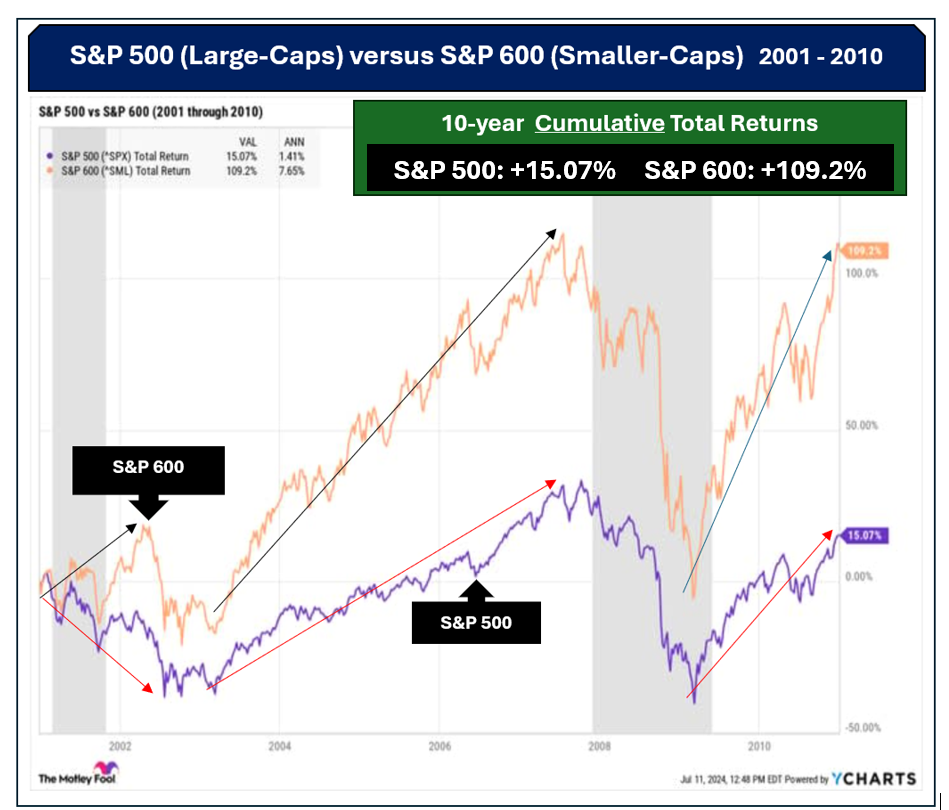
March 9, 2009 proved to be the latest major pivot point before the one this month. Stocks bottomed that day at levels never to be seen again. While most stocks recovered nicely, the period from that nadir through the end of 2010 once again proved tremendous for those invested in smaller company shares.
The entire decade illustrated saw the S&P 500’s cumulative, not annualized, total return at just +15.07%. Smaller company shares surged by 109.2% in total return over the same time frame.
That represented an amazing +724.6%, decade-long edge in total return.
From Wednesday July 10, 2024, through Wednesday July 17, 2024,the Russell 2000 index moved up 10.1%. Many investors would be happy to see that kind of move over an entire year.
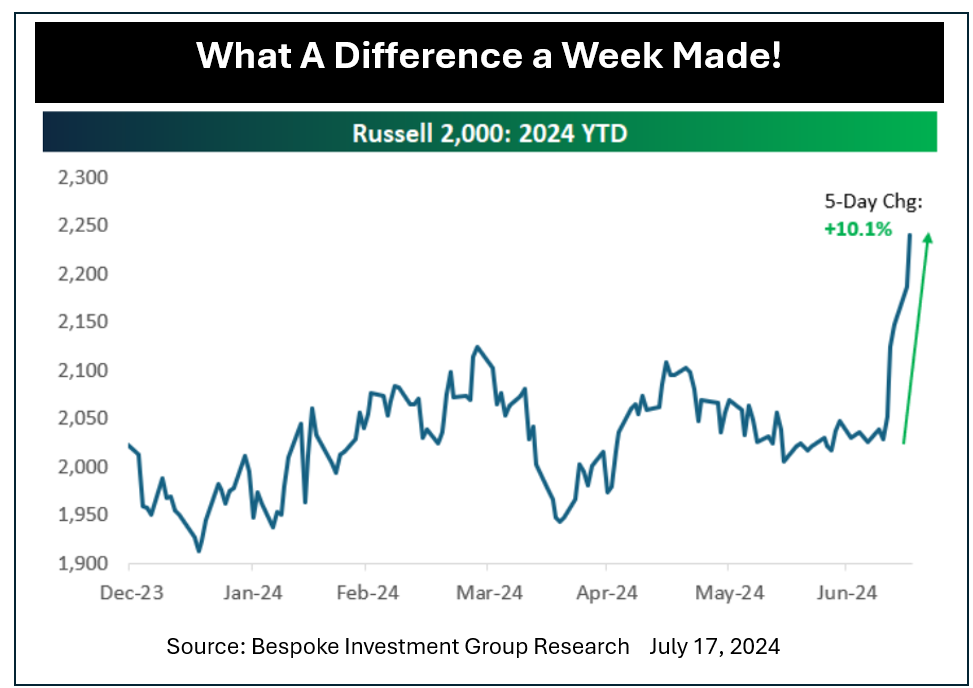
That was the largest five-trading day outperformance that the Russell 2,000 has ever seen against the S&P 500! The last five days eclipsed prior five-day stretches that took place on Oct. 19, 1987, following the largest five-day percentage declines in the DJIA ever and on March 25, 2020, just two days after the Covid-Panic bottom was in.
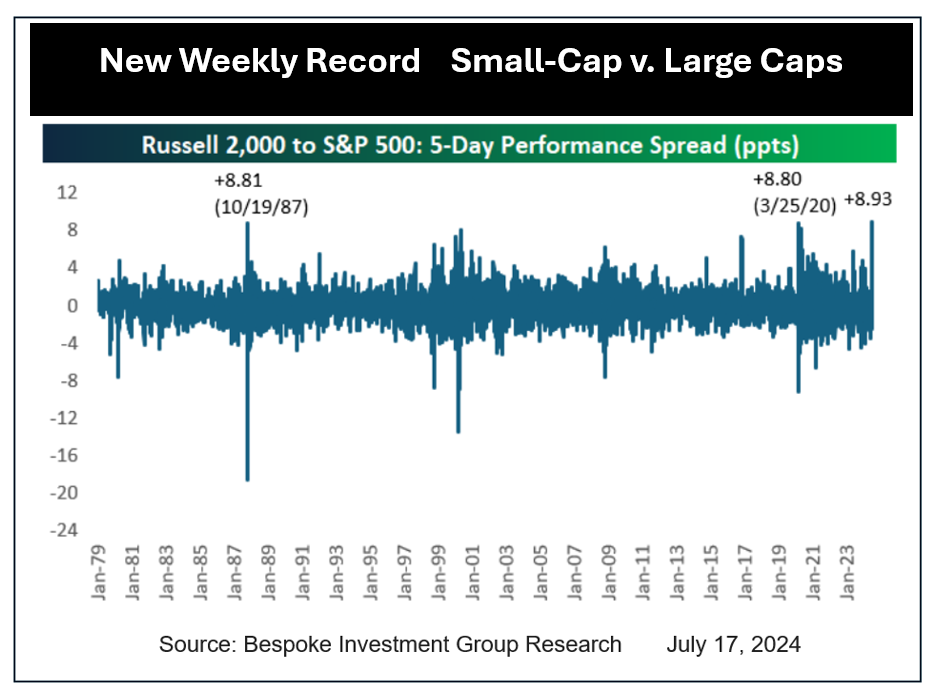
History says that the recent 180-degree shift in sentiment will persist for months or years, rather than be just a momentary pause in the way trading has gone in recent years.
Those who act on that information are likely to see similar market action to what took place from 2001 through 2010.
Large-cap valuations are exceedingly expensive based on all prior history. Many smaller company shares are at historically cheap valuations.
Buying at very low valuations sets you up for the double bonus of experiencing multiple expansion multiplied by growing earnings. That is a surefire recipe for terrific future returns.
Another benefit of buying truly beaten-up shares? Current yields are well above normalized levels simply due to paying less per share to qualify for them.
My recent article covers this same topic in a somewhat different way.
Great Ideas That Look Good Today?
Jack in the Box JACK
Cracker Barrel CBRL
Sonoco SON
Carter’s CRI
Dollar General DG
Helen of Troy HELE
Designer Brands DBI
All but Helen of Troy pay nice dividends.
At the time of publication, Price was long shares and short naked puts on all stocks mentioned above. He had positions in any index funds or ETFs.