JPMorgan Has Encouraging Words at Barclays Bank Conference
* But there is a lot to digest!
JPMorgan (JPM) guides Q3 investment banking and markets revenue to be mid-to-high teens (year over year). Markets should decline sequentially on normal seasonality after record third-quarter revenue:
* The AI investment cycle is driving “a tremendous amount of capital spending,” adding a meaningful source of economic activity.
* Management sees “nothing flashing red, and very little flashing yellow,” with the main concern concentrated in companies facing direct disruption from AI.
* JPMorgan sees emerging weakness among companies exposed to the lowest-income U.S. consumers, though it does not view the trend as systemic.
* Companies “in the center of the bull’s-eye for disruption from AI” are the main area of concern across JPMorgan’s client base.
* Middle-market credit remains healthy, corporate and board confidence is strong, and deal activity is “quite robust,” according to management.
* The AI investment cycle is driving “a tremendous amount of capital spending,” adding a meaningful source of economic activity.
* Management cautioned that the economy may be late-cycle, saying it “feels too good” and warning that deterioration could arrive quickly if conditions turn.
* Absent a major market disruption, JPMorgan expects investment-banking fees for the quarter to rise “mid to high teens,” with strength across products and geographies.
* Management expects revenue, volume and compensation costs tied to outperformance to increase overall expense guidance, characterizing them as “good expenses.”
* Markets revenue is expected to rise “mid to high teens” year over year in the third quarter, despite a seasonal sequential decline from a record second quarter.
* Private-capital activity is accelerating, with roughly $4 trillion of invested capital seeking liquidity across 30,000 companies and $2 trillion of dry powder awaiting transactions.
* JPMorgan sees a potential $5 trillion AI investment cycle through 2030, spanning hyperscalers, frontier models and the broader ecosystem, supporting sustained capital-raising and advisory activity.
* Mid-September activity remains broadly strong: investment-banking pipelines are holding across products and geographies, while M&A activity is running at its highest level in some time amid strong management and board confidence.
* Firmwide business is performing well enough that revenue-, volume- and compensation-related costs from outperformance may lift expense guidance; management characterized these as “good expenses,” with more detail due at earnings.
* Management sees little “flashing red” and only limited yellow flags despite war, oil above $100, elevated rates and hawkish central banks; U.S. middle-market credit remains benign and corporate clients continue to look through volatility.
* Weakness is emerging among companies exposed to the lowest-income U.S. consumers, while businesses directly vulnerable to AI disruption are another area of caution; neither issue is currently viewed as systemic.
* AI-related capital spending, U.S. supply-chain reshoring, electrification, defense/remilitarization and renewed private-capital transactions are supporting economic activity and may make this late-cycle backdrop more durable than usual.
* CIB outperformance versus peers is attributed to sustained investment in banking coverage and systematic trading, tighter integration of commercial and investment banking, and continued market-share gains; management believes this momentum is continuing.
* While describing conditions as “so far, so good,” management acknowledged the economy feels almost “too good” for a late-cycle environment and warned that deterioration could emerge quickly, signaling vigilance rather than a currently observed slowdown.
* More than $4 billion of the initiative’s planned equity capital has been deployed, with management saying the underlying financing need is “bigger than we thought.”
* JPMorgan has completed $200 billion of financing across 1,600 companies and 330 capital-markets transactions under its Security and Resiliency Initiative, exceeding expectations after one year.
“It’s certainly some crazy 4d chess to say there’s whatever a 10% chance of annhilating humanity. But by the way, um, how much allocation would you like in our IPO?”
If you respect your hard-earned capital and you want to hear the “emes” (Yiddish for “truth that does not shift”) from a bunch of investment pros that take ownership of their winners AND losers … run, don’t walk to watch Carter, Guy and Dan on MRKT CALL at 11 AM.
@carlquintanilla Q — Again, I would ask your guest that perhaps the reason why AI related valuations are declining is that the sector is OVEREARNING with double and triple ordering, in particular, of memory and semis…. and investors are smelling this out! My case is that the…
Boockvar on Hikes and Rates, Chatter on the Consumer
The following is from Peter Boockvar:
Can a hike tame long rates? Maybe/Chatter on the U.S. consumer/Overseas news
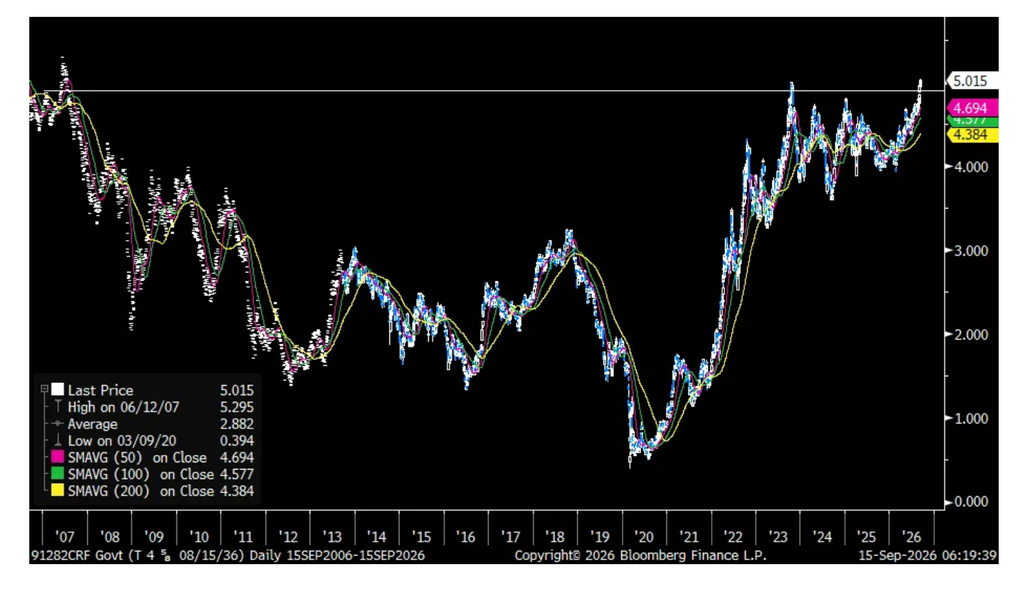
Just to remind, a close above 5% in the 10 yr note yield would be the first time since July 2007. The question after Wednesday afternoon is whether a Fed rate increase on the short end can calm this move on the long end as some hope/believe. As I think that much of the move higher in long rates has been REAL rates, I’m skeptical it could. What could instead is if the Bank of Japan this week not only raises rates but emphasizes the need for more, and long rates in Japan can fall, that might calm the rise in rates globally.
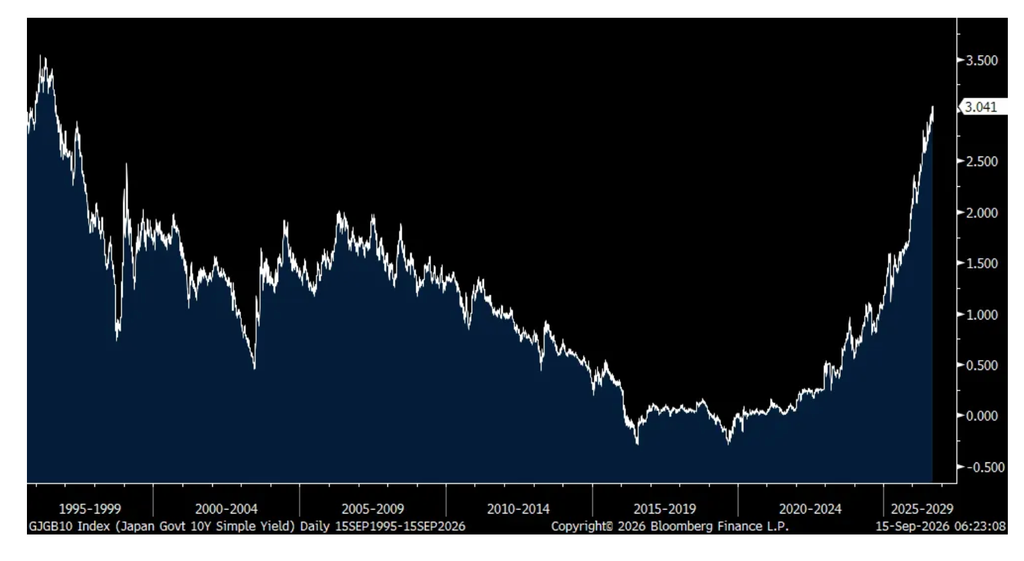
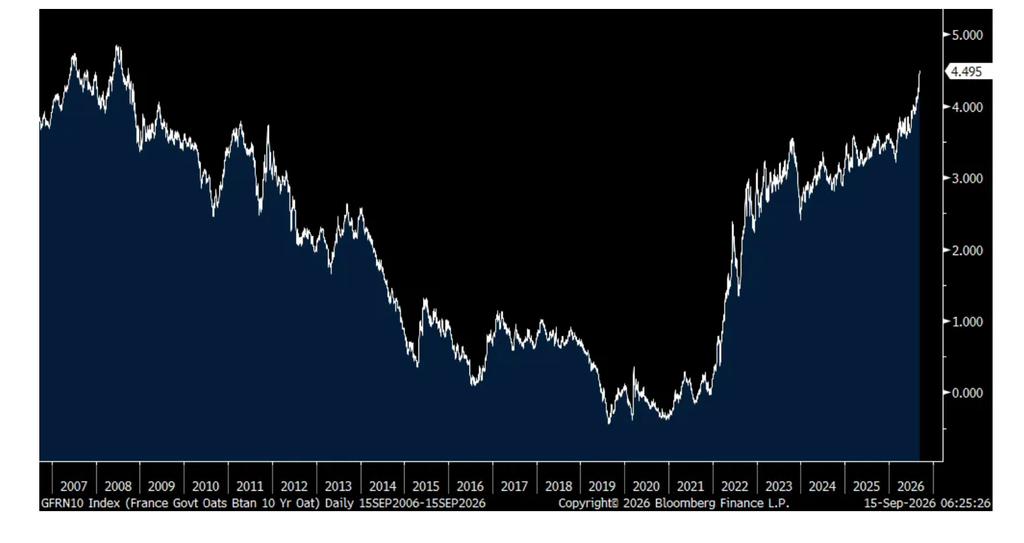
And the rise in rates today is global again with the 10 yr JGB yield in particular at a fresh 30 yr high, the 10 yr French Oat yield at a new 18 yr high, the German 10 yr Bund yield now at a 17 yr high and the UK 10 yr Gilt yield at an 18 yr high.
10 yr Treasury Yield
10 yr JGB Yield
10 yr French Oat Yield
In case you didn’t see, Bank of America fell 5% yesterday after they said investment banking fees in the quarter are expected to be under expectations and trading results were going to be flat q/o/q. This is what Brian Moynihan said on the consumer and business, and as always is positive:
“So if you look at the consumers in the month of August, they were up 4% of spending into the economy versus last August. And yes, gas drove a part of that. But the reality is that there was more spending on cruise bookings, more spending on restaurants, both quick serve, a lower growth rate, but regular full serve restaurants, a higher growth rate.”
“So the consumer spending on a broad basis, out-of-home entertainment, it’s been big. The movies have come back because they’ve had some good movies. So the consumer is spending money. And if you look at their paychecks, you can see the paycheck and you can see the wage growth is 3% plus to 4%.”
“And then we look at their credit. The credit quality is as good as it’s been in a long time…They’re normalized to levels that are equivalent to where they were pre-pandemic.”
“On the small, medium sized business, the good news is they’re using lines of credit a little bit more. They think about all the issues that you read about in the paper every day, but the good news is credit card is good in the commercial book, that the small and medium sized loan growth is solid. They’re using their lines, not all the way back to where they used them, but they’re using their lines, which is good news. And they seem to have a stable employee base…So we feel very good about the underlying US economy.”
From Dave & Buster’s, down 11% pre-market:
“It’s a tricky reality of where we are right now. As we’ve communicated in the past, certainly, that lower end consumer has been impacted more. That’s not unique to us, but that is a pressure we’re facing. I guess what I’d say, and I think you all have noted that we didn’t discuss the economy at all in our prepared remarks. And the reason is we believe all these areas that we’re focused on, there’s latent and significant opportunity there, notwithstanding the environment.”
“I’ll just talk about maybe the occasions with kids and occasions without kids. That occasions without kids is where we’ve seen more of a decline. And so when you think about how that’s impacting our strategy, we are an adult first occasion, but families are welcome, and we can’t alienate families. And so what you’re seeing is our focus on where do we drive that appeal for the adult occasion.”
The August Cass Freight shipments index rose 5% m/o/m and by 2.1% y/o/y and which marks “the first y/o/y gain since January 2023. This ends a 42 month downturn by this measure, the longest on record.”
The caveat, “As this roughly offsets the declines in the past few months, we hesitate to describe this as a major improvement in freight demand.”
As for pricing where we know trucking spot prices have risen sharply, they were up another .7% m/o/m and by 11.3% y/o/y. “The sequential increase is in line with expectations and as indicated by the spot market. Even as spot rates slow with modest sequential declines, the much larger contract market is adjusting higher.”
China’s economy in August remained a really mixed bag. Retail sales remained soft, up just .4% y/o/y, half the estimate as home prices continue to drop with weak sales still. From a wealth effect impact, I tie the two together and believe consumer spending won’t inflect much higher until home prices stop falling. Industrial production grew 5.2% y/o/y which was above the estimate of 4.8% and we know certain areas like EV’s, solar panels, robotics, tech hardware and software, etc… are doing well.
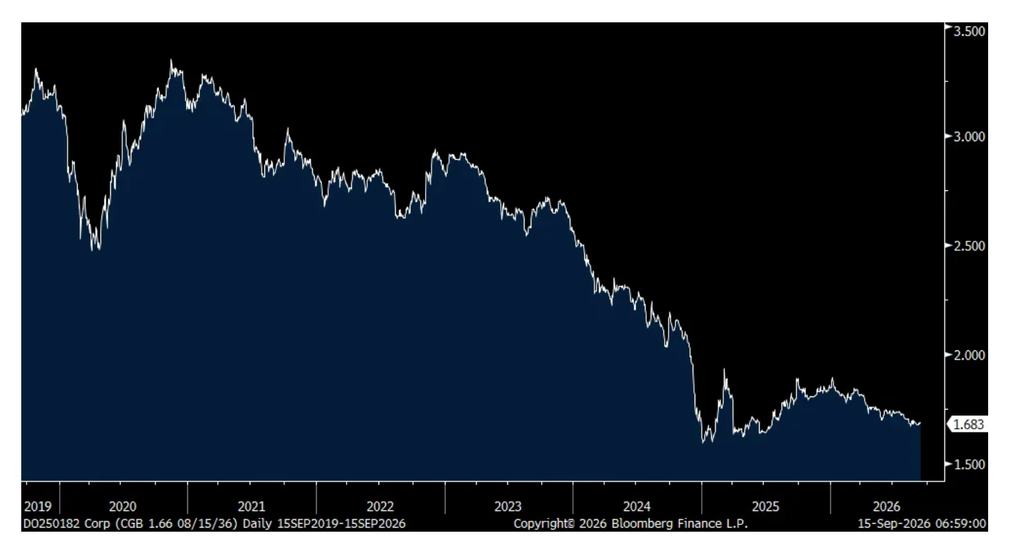
While yields around the world continue higher as we know, the Chinese bond market is the best performing. Their 10 yr yield was little changed in response to the data but only at 1.68%, just off the lows seen in early 2025.
China’s 10 yr Yield
UK payrolls in August shrunk by 26k, well more than the estimate of a 5k person drop and is now down for 7 straight months. Pay growth ex bonuses in the 3 months ended July rose 3.5%, unchanged with June with the private sector up 2.8%, near a 6 yr low.
There was also a drop in job openings and the ONS said “was driven mainly by smaller businesses, which cite labor and operating costs as reasons for not hiring new staff of replacing leavers.”
As seen with the Labor budget over the past year plus, we’re witnessing again that you can’t tax your way out of a budget problem because of the negative economic impact.
Finally with the economic data, the September German ZEW investor confidence index on their economy was little changed at 34.7 vs 34.2 in August. The positive was more in the Current Situation which was less negative at -47.1 vs -61.1 last month.
The ZEW said, “The ZEW indicator of economic sentiment remains stable. Experts are cautiously optimistic about a recovery of the economy. The growth continues to be driven by fiscal measures and is further bolstered by export momentum. Nevertheless, the risks are considerable: Persistent high energy prices resulting from a continued war in Iran and the additional uncertainty caused by hybrid attacks place a burden on the economy.”
More Tales From Nvidia: Just Who Can Access AI Technology? (Issue #249!)
One argument left out in the latest self-regulatory frenzy is it is not just what the technology can do, the bigger issue may be the who can access the technology.
Right now, the who is everyone, including adversarial parties.
The modern AI datacenter has over 200-times the compute power as the fastest supercomputer, Fugaku, did, in 2020 (this is how fast things move so just extrapolate). Fugaku was a supercomputer at a Japanese research facility. Fugaku could only be used by the scientists there. The No. 2 supercomputer at the time was three times less powerful than Fugaku, and was an IBM-built system located at the U.S. Department of Energy’s Oak Ridge National Laboratory in Tennessee. That supercomputer was also only used by U.S. government scientists.
These types of technologies were only accessible to a select group of people, who were well vetted, along with the work they were doing on them.
Now, 200-times to 600-times the compute power of the most powerful supercomputers from 2020 is available to virtually anyone, with only very limited controls, at best. It is also running software, especially the agents, that can be quite unpredictable with their behaviors.
The technology for nuclear bombs and other state secrets was always closely held.
This amount of computing power cannot be made available to the masses that include malicious actors of all kinds. Drones become available to everyone, next thing you know people are putting bombs on them and blowing everything up. Making this amount of compute available to the world at large is multiples more dangerous.
It is clear the bad guys are already trying. This article is interesting.This stuff is happening. Anthropic to its credit seemingly tried to cut some of it off, but I highly doubt all of it is being cut off by them, Open AI, and everyone else. It is kind of Nvidia (NVDA) saying its highest end parts were not going to China, yet somehow the Chinese still had and have access to all of it.
This amount of compute cannot be a mass market product. Just like kinetic weapons cannot be a mass market product, and nuclear weapons especially cannot be a mass market product.
We have made public stuff that belongs in government and university research laboratories, along with all the other things that are not public domain. These types of technologies never were public domain. Never, ever, ever.
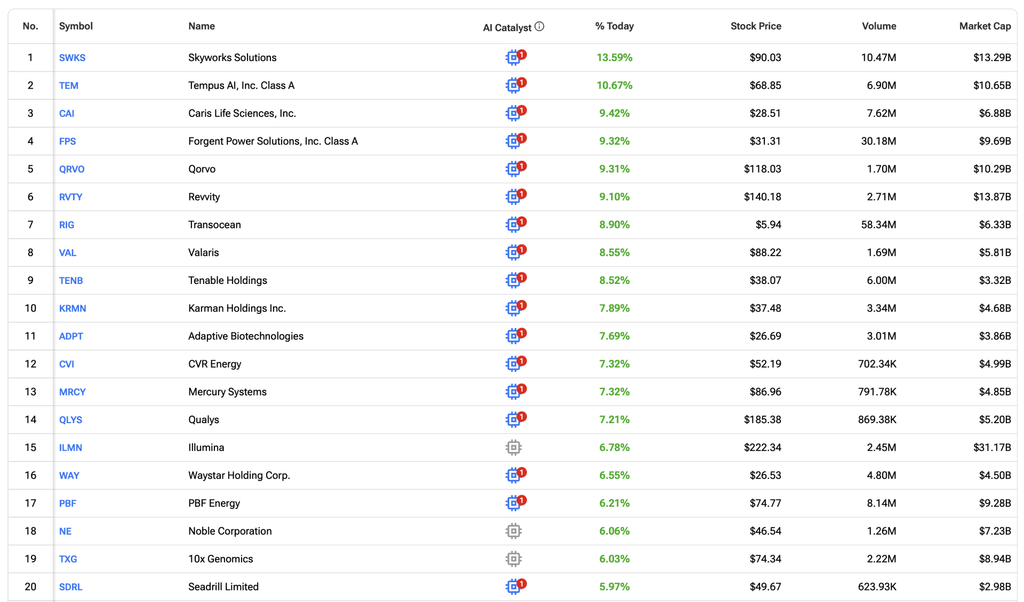
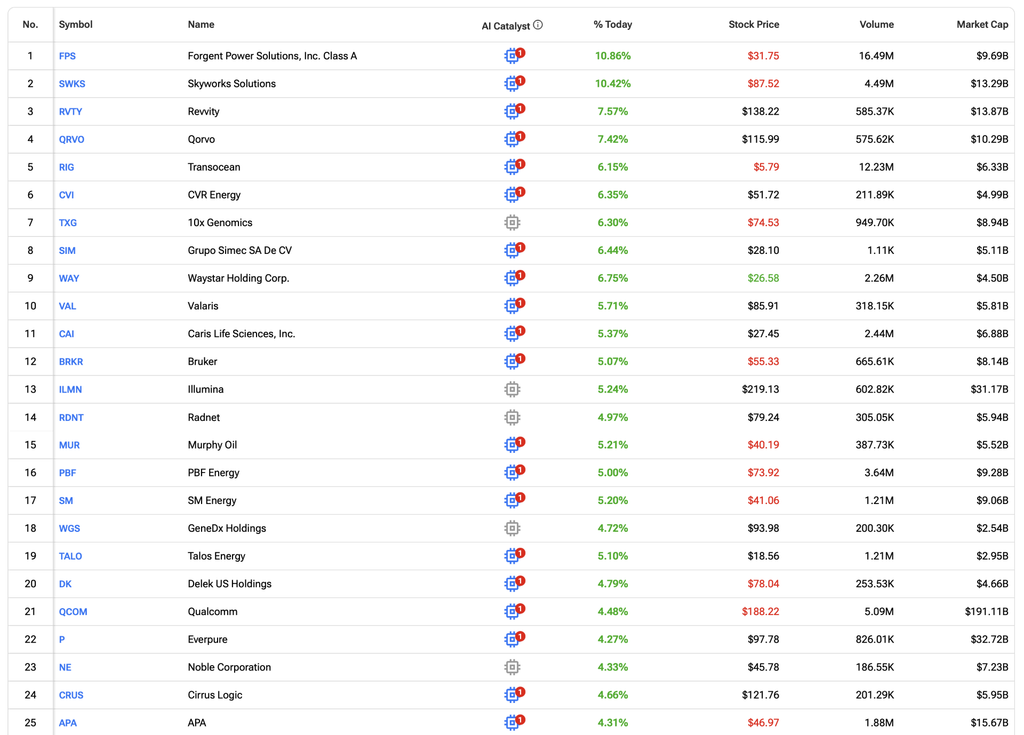
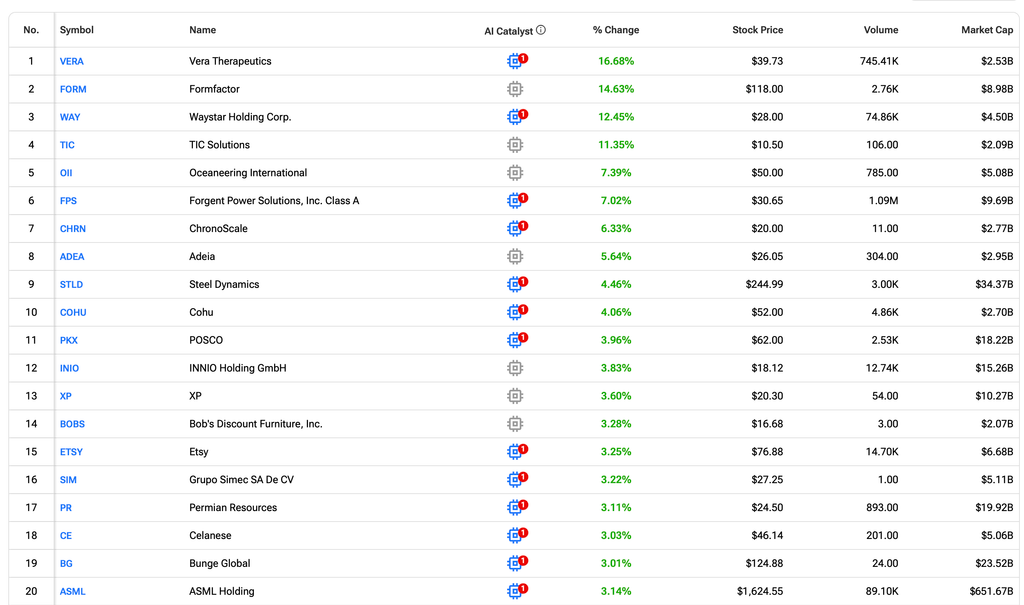
– VEEA +74% (announces proposed merger with NovaGen to create a $750M Edge AI-powered global health platform)
– MYSZ +45% (extends rally after unveiling an acquisition-led strategy to build a defense-technology platform)
– BDRX +18% (extends high-volume rally after interim results detailed eRapa Phase 3 preparations and MTX240 pipeline progress)
– VERA +17% (no clear fresh catalyst identified; unusually large, liquid biotech move)
– RLGT +14% (fiscal Q4 results showed accelerating revenue and profit growth, stronger margins and no net debt)
– TNON +13% (extends rally after early repayment of convertible notes removed a near-term conversion overhang)
– FPS +7.1% (rallies into fiscal Q4 results with investors focused on record orders, backlog growth and margin expansion)
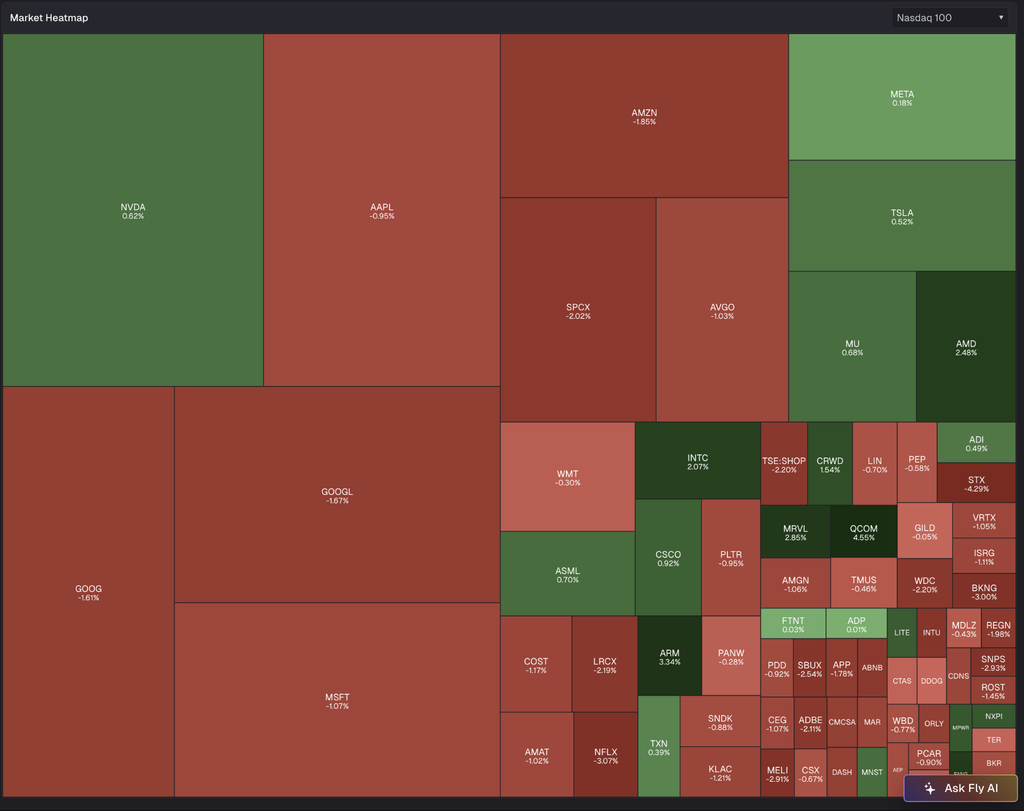
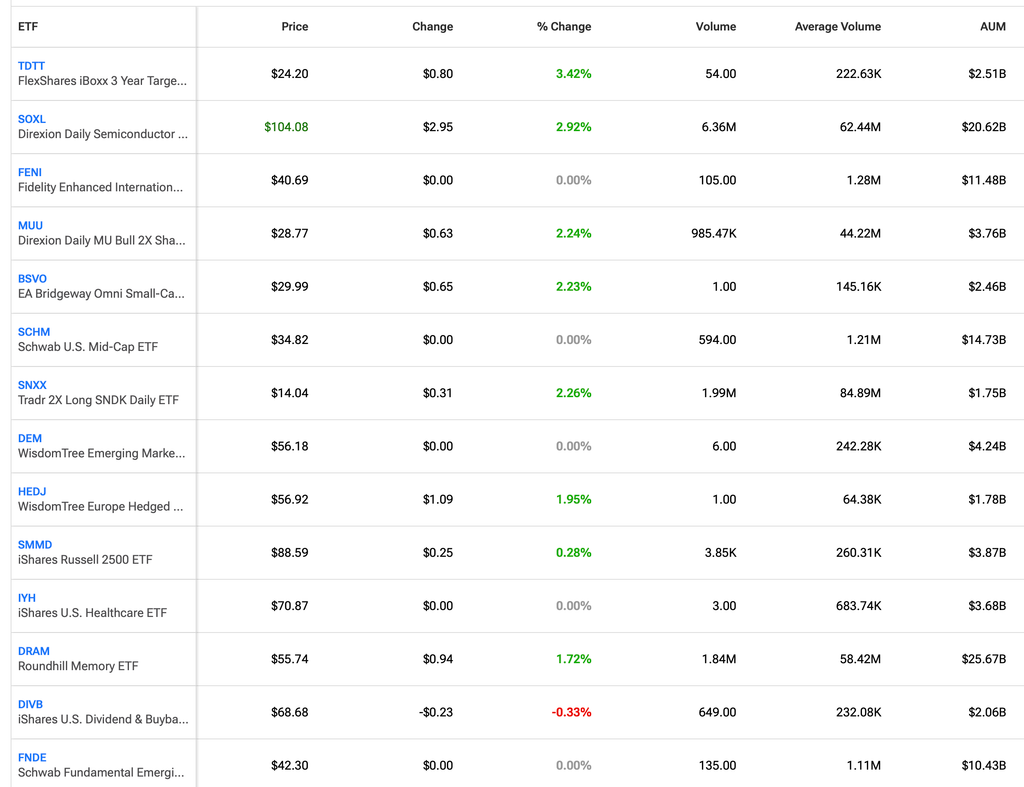
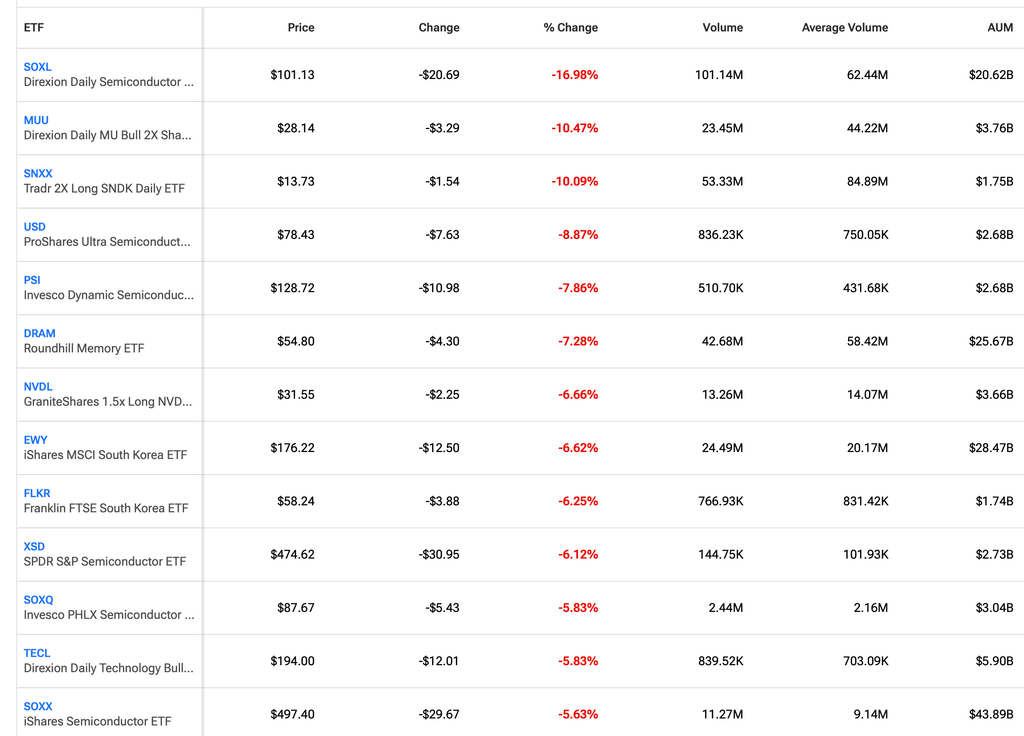
– ASML +3.1%, COHR +1.7%, INTC +1.6%, LITE +1.1% (chip and optical-hardware names rebound after Monday’s selloff as a new advanced-node chip launch reinforces demand expectations)
– NOK +2.7% (Rosenblatt initiates at Buy on AI optical-franchise potential)
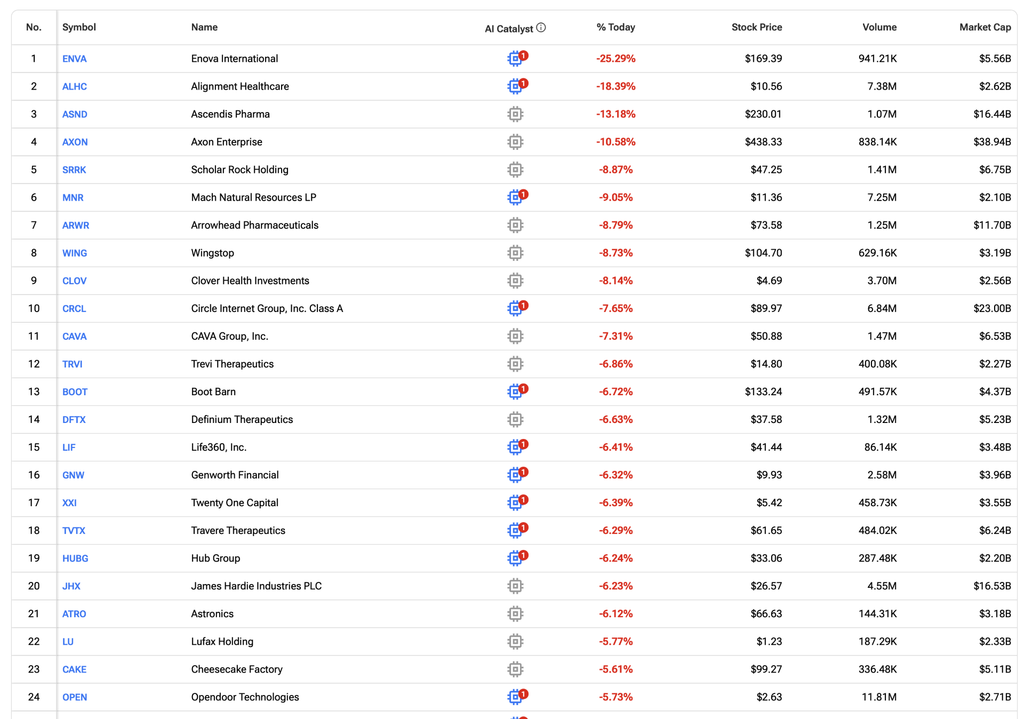
Downside
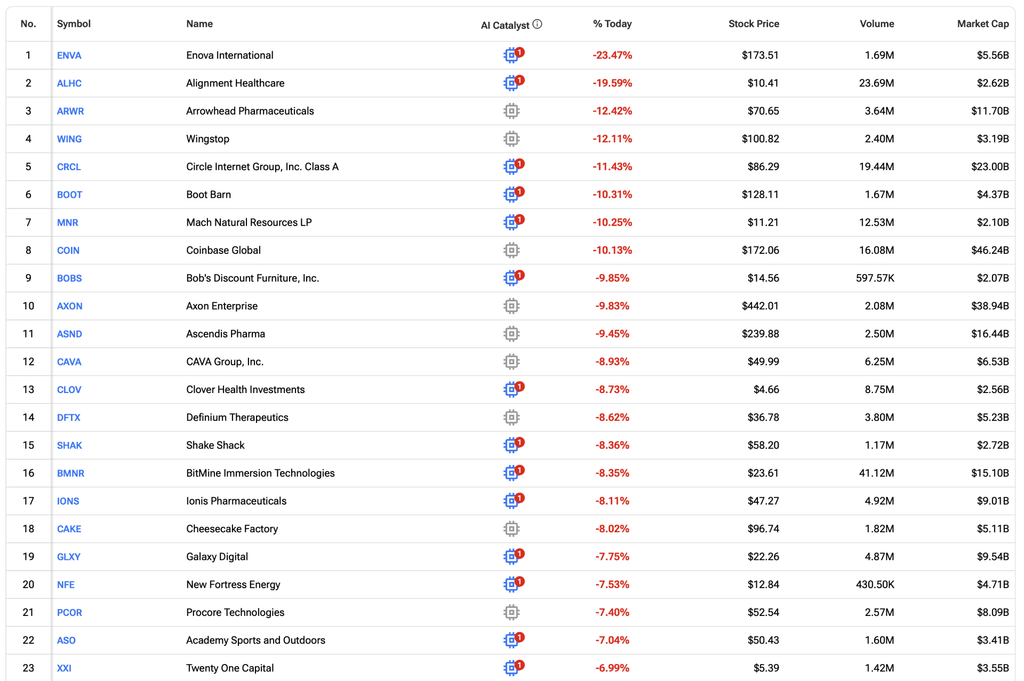
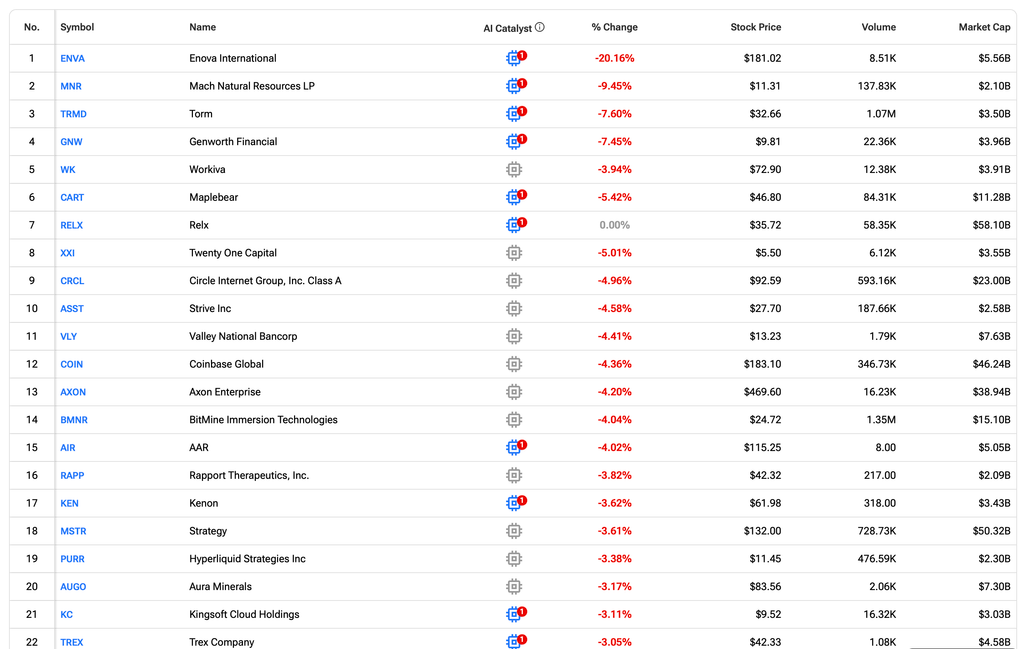
– CNTB -34% (sell-the-news reaction despite preliminary Phase 2 asthma data showing a meaningful reduction in treatment failure)
– FTFT -22% (reverses Monday’s speculative surge with no fresh company catalyst identified)
– ENVA -17% (withdraws regulatory applications for its proposed acquisition of Grasshopper Bancorp)
– PLAY -13% (Q2 sales and profit missed expectations as comps declined and adjusted EBITDA contracted sharply)
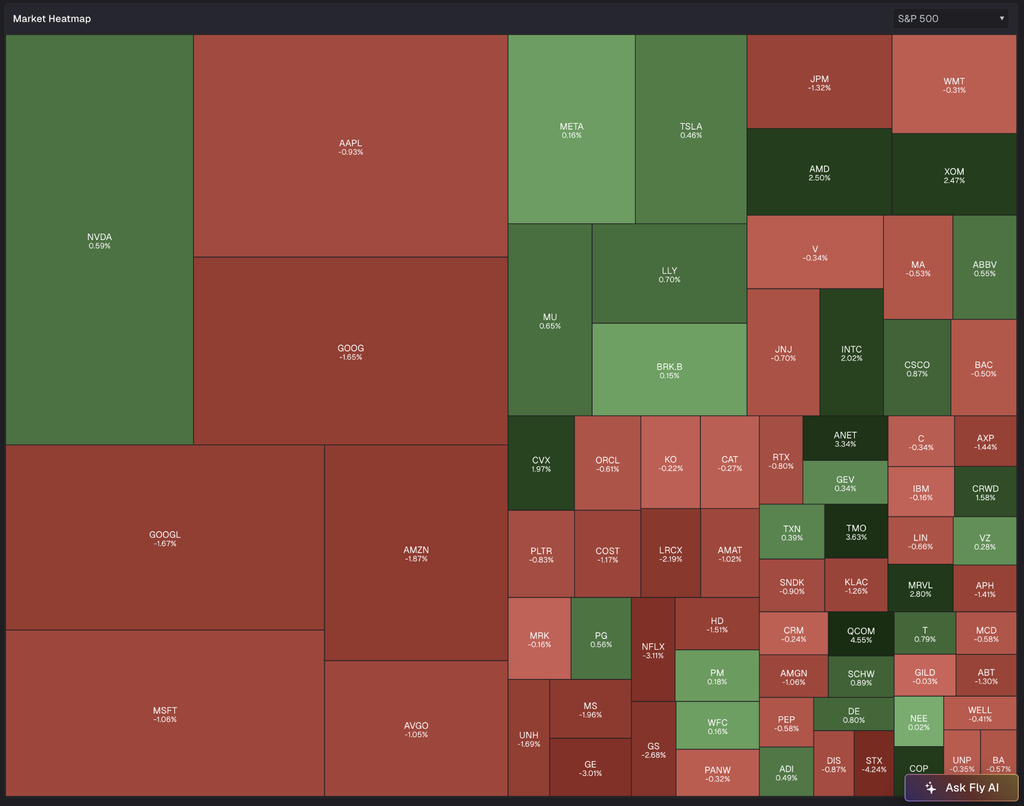
– NOW -2.7%, CRWD -2.0%, CRM -1.8%, PANW -1.7% (software and cybersecurity names give back part of Monday’s sharp rally as Treasury yields climb above 5%)
95% of retail traders and investors shouldn't short stocks:
1. risk/reward is asymmetric – you can lose an infinite amount in shorts but make only 100% in shorts (bankruptcy!) 2. there is a gravitational pull for stocks to rise over time 3. requires risk management/discipline as… https://t.co/e78ak6bBb4
Bond positioning has sunk to the 5th percentile. If history rhymes, yields are near a short-term peak. "When all experts agree, something else tends to happen." – Bob Farrell. h.t @ISABELNET_SApic.twitter.com/UlBmAgRkCi
Yields on 10-year Treasuries are about the highest relative to a similar measure on the S&P 500 since 2000. That's still not enough to materially attract multi-asset investors away from stocks. (1/2) pic.twitter.com/TVo4vIV86p
I am adding to GLD under $391 and moving to a large-sized position.
The predictable price pressure on precious metals from higher rates and the fear of a Fed rate increase tomorrow has likely been or is close to being discounted.
I like this entry point… and the risk/reward.
However, like every commodity, gold will remain volatile (both on the downside and upside).
Yields on 10-year Treasuries are about the highest relative to a similar measure on the S&P 500 since 2000. That's still not enough to materially attract multi-asset investors away from stocks. (1/2)
Bond positioning has sunk to the 5th percentile. If history rhymes, yields are near a short-term peak.
"When all experts agree, something else tends to happen." - Bob Farrell.
h.t @ISABELNET_SA
95% of retail traders and investors shouldn't short stocks:
1. risk/reward is asymmetric - you can lose an infinite amount in shorts but make only 100% in shorts (bankruptcy!)
2. there is a gravitational pull for stocks to rise over time
3. requires risk management/discipline asShow more
Jeremy Robson 🏍️🐶
@JemRobson01
Timing short positions is a mightmare, so I wish you luck. Don't disagree with anything in the post.
Quote of the year — and maybe the decade:
“It’s certainly some crazy 4d chess to say there’s whatever a 10% chance of annhilating humanity. But by the way, um, how much allocation would you like in our IPO?”
[h/t @dee_bosa]Show more