You Can Either Anticipate the Markets or React to Them. Here's My Pick
No one can predict the future with any consistency, but here's what traders can do to get in the best position to win.
You've reached your free article limit
You've read 0 of 1 free Pro articles.
There are two basic approaches to market timing: anticipatory and reactive.
Anticipatory traders look at overall market conditions, consider the charts, fundamentals, and other things, and then make a prediction about what the market will do next. They create a thesis and then buy and hope it works. Currently, there are quite a few bulls that believe that positive seasonality will occur and the market will enjoy a sizable rally to end the year. Most of what we see in the financial media are those sorts of market predictions.
The other approach to market timing is reactive. Rather than predict what might happen, the reactive trader focuses on the price action and then makes moves as it develops. These traders don't have a strong market bias and will focus on how the market reacts to news flow rather than form opinions about the news. To the reactive trader, it is possible that there will be a strong end-of-the-year rally based on seasonality, but they want to see some actual price action to confirm it rather than just hope that it happens.
I have a strong preference for the reactive approach to market timing. I've never seen any proof that people can anticipate what will happen in the market with any great degree of accuracy. Just look at the ups and downs in the markets since Covid hit in early 2020. No one has been able to predict all the twists and turns. Some folks get lucky and make good calls, but that is more luck than skill.
Since I don't believe anyone has the ability to accurately forecast what the market will do, I have to look to the price action. Price action reflects how people are investing. When big, well-connected institutions are buying or selling, we see that reflected in the charts and in the price action.
How do we use a reactive approach to time a market bottom? In the course of a downtrend, bounces and random action will cause some people to believe that the worst is over, but how do we determine if it is just noise or something more significant?
William J. O'Neill of Investors Business Daily developed a reactive approach called follow-through days. The goal isn't to try to identify the exact market low. The goal is to identify that there was a low, and now there is ongoing buying interest that will produce a sustained uptrend.
Many investors spend a great amount of energy trying to pinpoint the exact moment that a stock has hit bottom. It is appealing to be the hero who nails the exact bottom tick, but it is a highly unproductive action. When you play this game, you constantly are too early because that is the only way to call the low exactly.
The reactive trader doesn't worry about exact lows. They want to see confirmation of a change in trend that will allow them to be more aggressive. The focus is on catching trends rather than exact lows.
The way the IBD approach works is as follows. A day one is identified within a downtrend on which there is a strong rally. There will be lots of these jumps in any sustained downtrend, but the focus is on an upside follow-through day. A follow-through day is defined as a gain of 1.7% or more four or more days after day one. This is proof that there is real buying development that will be sustained.
A good example occurred back in March, and that led to a sustained rally that lasted several months. There was also a follow-through day in August after a brief pullback that abruptly ended in just a matter of days. Currently, the market is still waiting for a good follow-through day.
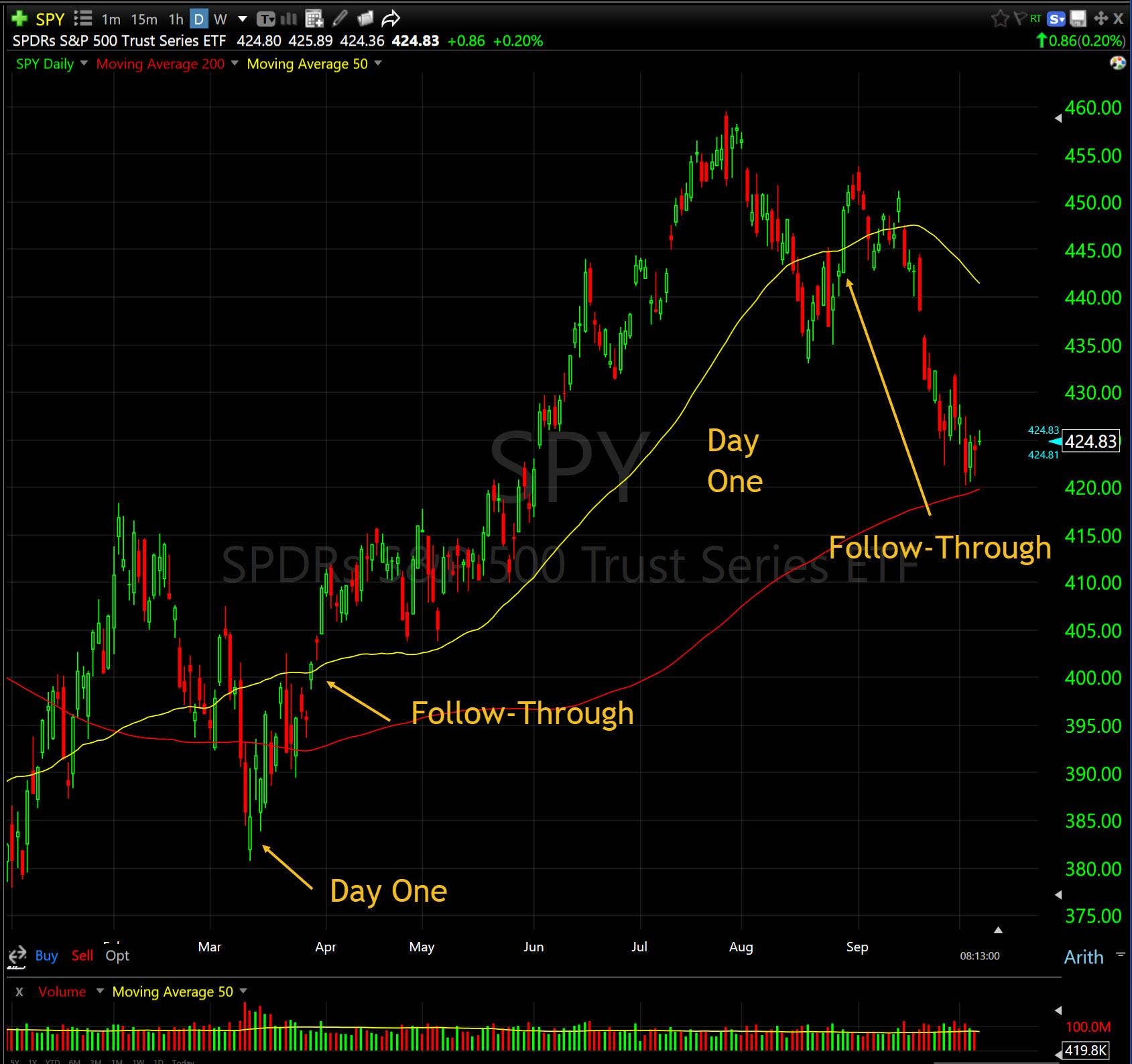
The important issue here is that reactive trading is looking for price action to confirm a new trend. The important issue isn't the exact low. When you stop focusing on precise timing and focus on trends instead, you can be much more patient and will reduce risk if you keep stops tight and manage positions tighter.
The current market is still in the process of trying to find a low and produce follow-through. It will eventually happen, but our chances of catching a sustained move are much better if we wait for proof.
At the time of publication, DePorre had no position in any security mentioned.