Little-Known AI Beneficiary Hits a 'Turning Point' and Blows Wall Street Away
After an 'amazing' move by this next-in-line beneficiary of the generative artificial intelligence revolution, here's how to get involved.
You've reached your free article limit
You've read 0 of 1 free Pro articles.
Holy Moly. Did you see that?
Mid-cap technology stock Credo Technology Group Holding CRDO released its fiscal second-quarter financial results on Monday evening and shazam! Did they ever just blow Wall Street away.
For the three-month period ended November 2, Credo posted adjusted EPS of $0.07 (GAAP loss per share: $0.03) on revenue of $72.034 million. These top and adjusted bottom-line numbers both bested the Street's expectations, while that revenue print was good enough for year-over-year growth of 63.6%. The company also issued some impressive forward-looking guidance.
Who the Heck Is Credo Technology?
Credo is a Cayman Islands-headquartered tech holding company focused on the delivery of high-speed solutions to break bandwidth barriers on wired connections within the data infrastructure market. The company provides connectivity at high-speed that delivers increased power efficiency as data rates and corresponding bandwidth requirements increase exponentially. These solutions are optimized for optical and electrical ethernet applications.
The feeling Tuesday morning is that Credo is a next-in-line beneficiary of the generative artificial intelligence revolution as the entire advent of this next-level technology has exacerbated the expected rate of growth in the market for active electrical cables as demand for an increased attach rate per XPU and higher speeds ramps higher. Credo has existing relationships with both Microsoft MSFT, and Amazon AMZN as well as other hyperscalers.
What the CEO Said
President and CEO Bill Brennan commented in the press release... "For the past few quarters, we have anticipated an inflection point in our revenues during the second half of fiscal 2025. I am pleased to share that this turning point has arrived, and we are experiencing even greater demand than initially projected, driven by AI deployments and deepening customer relationships.”
Operations
As mentioned above, revenue generation increased 63.6% to $72.034 million. Within that number, product sales grew 88.2% to $64.443 million, while engineering services grew 90.3% to $4.632 million and IP Licensing increased dropped 60% to $2.959 million. Total cost of this revenue printed at $26.522 million (+48%), leaving gross profit of $45.512 million (+74.3%) on a gross margin of 63.2%, up from 59.3%.
GAAP operating expenses increased 54.1% to $53.919 million, leaving a GAAP operating loss of $8.407 million, down slightly from loss of $8.875 million from a year ago. Once adjusted, operating income/loss improved from $-731 million to $+8.256 million. Adjusted operating margin improved from -1.7% to +11.5%.
After accounting for other income and losses, interest and taxes, GAAP net loss attributable to shareholders printed at $4.225 million, versus a loss of $6.623 million, which works out to -$0.03 per share, an improvement from -$0.04 for the year-ago period. After the adjustment, net income improved from $1.163 million to $12.255 million, or from $0.01 per share to $0.07. The primary adjustment made was for $16.663 million in share-based compensation expense.
Guidance
For the current quarter, Credo expects to generate revenue of $115 million to $125 million, which is well above the $85 million to $90 million that Wall Street was looking for and would compare to a year-ago comp of $53.1 million. The company also sees a GAAP gross margin of 60.6% to 62.6% and an adjusted gross margin of 61% to 63%.
Lastly, Credo expects GAAP operating expenses to reach $58.6 million to $60.6 million that when adjusted for stock-based comp will come down to $42 million to $44M million.
Fundamentals
Credo has not yet released a statement of cash flows, but they did file an updated balance sheet. As of November 2, the company ran with a cash position of $382.9 million and inventories of $36.313 million. This puts current assets at $538.252 million.
Current liabilities add up to $49.645 million, which does include a small amount of deferred revenue, but no short-term debt. As of the end of the period, the company stood with current and quick ratios of 10.8 and 10.1, respectively. That's strong to the point of being incredible.
Total assets amount to $638.551 million. Credo makes no entry for any kind of intangible assets. We appreciate that. Total liabilities less equity comes to $70.644 million, which includes no debt of any kind.
This is one heck of a well-managed balance sheet, a true pleasure to analyze.
What Wall Street Thinks
Not a lot of sell-side analysts cover this stock, but some higher profile analysts do. Since last night, I have come across five five-star rated (by TipRanks) analysts that have opined on CRDO. One, Richard Shannon of Craig-Hallum reiterated his "Buy" rating without setting a price target. The other four all significantly increased their targets.
Vivek Arya of Bank of America upgraded the stock to "Buy" from "Underperform," which is a "sell-equivalent" making this a double upgrade. Arya took his price target from $27 to $80. Quinn Bolton of Needham, Thomas O'Malley of Barclays and James Lee of Mizuho Securities all reiterated "Buy" ratings.
Bolton raised his price target from $33 to $70, and O'Malley took his from $32 to $80. Only Lee held firm with a target of $49, which is now already way below water.
My Thoughts
Wow. Just wow.
The stock is already up more than 40% Tuesday morning. CRDO now trades at 140 times forward-looking earnings, but I don't think anyone is looking at that.
Sales are starting to grow like a weed and the balance sheet is in spectacular shape. The guidance is impressive, and several high-ranking sell-side analysts are obviously very impressed.
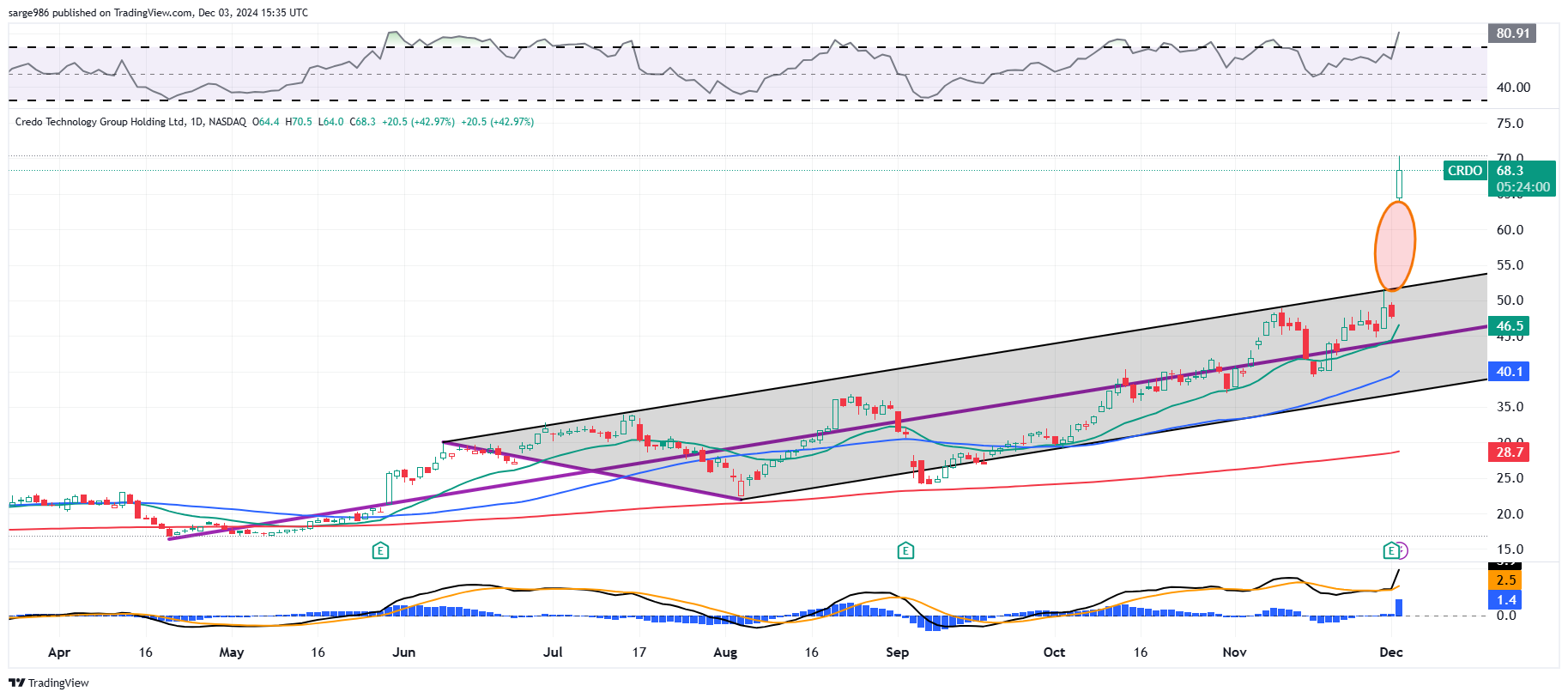
Just look at that breakout from an Andrews' Pitchfork model. Look at the gap-up opening. That's just amazing.
Today's action has pretty much blown up the stock's RSI (relative strength index) reading and daily MACD (moving average convergence/divergence) where both now look beyond extended. That doesn't mean as much as it used to.
Is this it? Does the stock come in and give potential buyers another chance? Less than 5% of the float is held in short positions, so not that much of this is a squeeze. Most of this move is genuinely organic.
Here's What an Interested Investor Could Do (in minimal lots) ...
-- Purchase one December 20 $65 put for $3.80.
-- Sell two December 20 $55 put for $0.70.
Net Debit: $2.40
Note: The trader is buying downside movement at $65 and exposing him or herself to long side exposure at $55. By selling twice as many $55 puts as $65 puts purchased, the trader is willing to get long at a discount even while accepting that this morning's move may be overdone. Should the stock just go higher from here, the trader is out the $2.40. Should the stock trade below $65, but not down to $55, the trader would need the stock to trade below $62.60 upon expiration to profit. Lastly, should the shares trade below $55 on expiration, the trader would be long the stock at a net basis of $57.40.
At the time of publication, Guilfoyle was long MSFT and AMZN equity.