How to Trade the AbbVie Price Dip Following Failed Trials
After news broke of failed late-stage clinical trials, the drug manufacturer has seen a slide in share prices.
You've reached your free article limit
You've read 0 of 1 free Pro articles.
We all know AbbVie ABBV, the creator of the "wonder-drug" Humira, the patent for which was lost by AbbVie in early 2023. This is what forced the firm to go on a "buying spree" in order to replace what would potentially be the lost free cash flow that Humira had provided. The first notable deal to fortify free cash flow was the Allergan acquisition announced in 2019 and closed in 2020. That was a $63 billion deal that brought in such therapeutics as Botox and Ubrelvy among others into the AbbVie family.
Since then, the firm has acquired ImunoGen for a little more than $10.1 billion and Cerevel Therapeutics for under $9 billion, as well as a number of much smaller deals. Long-time readers may recall that ABBV used to be a core holding in the "Sarge-folio," but it has been quite some time since I took a good look at this high-dividend payer. Now, we must ask after Monday's 12.57% beat-down, the following: "Do we buy this dip?"
So, What Happened?
Early on Monday morning, news broke that the firm's late-stage clinical trials investigating emraclidine failed to reach its primary endpoint as an oral monotherapy treatment for adults suffering from schizophrenia experiencing acute exacerbation of psychotic symptoms. The trial had failed to show a statistical significance from a placebo in producing a significant reduction in the change from baseline in the positive and negative syndrome scale total score.
Emraclidine was brought aboard as part of the Cerevel deal, and this is quite a disappointment for the firm. Bristol-Myers Squibb BMY was up 10.5% on Monday in response to the news as BMY had just received FDA approval for its schizophrenia treatment this past September. Carter Gould, a five-star-rated analyst at Barclays did lament the investment made by AbbVie in this treatment, but did reiterate his "buy" rating and $212 target price, noting that such drugs as Skyrizi (used to fight plaque psoriasis, arthritis, colitis and Crohn's disease) and Rivoq (used in the treatment of arthritis, dermatitis, colitis and Crohn's disease) could still drive earnings per share growth.
Is the Cerevel-Driven Pipeline Dead?
No, not really, or maybe not at all. Emeraldine is still in Phase 1 testing for Alzheimer's disease psychosis, where the candidate has an FDA fast-track designation. Tavapadon is an AbbVie/Cerevel candidate currently in Phase 3 testing for Parkinson's disease and CVL-871 is an AbbVie/Cerevel candidate now in Phase 2 testing for dementia-related apathy and also has fast-track status.
Earnings
AbbVie reported its third quarter number on October 30. The firm beat expectations for both top- and adjusted bottom-line performance. For the full year, AbbVie raised guidance for adjusted profitability above Wall Street's consensus. For the current quarter, that consensus is for an adjusted $2.98 on revenue of $14.8 billion, which would be good for sales growth of 3.6%.
We know that, for ABBV, it really is all about free cash flow and sustaining the shareholder payout. For that third quarter, the firm generated operating cash flow of $5.447 billion and free cash flow of $5.198 billion. The firm regularly produces multiples of billions in dollars in quarterly free cash flow. AbbVie paid the shareholders a cool $2.751 billion in cash, while refraining from repurchasing any stock for the firm's treasury. Clearly, the statement of cash flows is a work of art.
The balance sheet is less wonderful. The firm ended the period with a cash position of $7.285 billion, inventories of $4.45 billion and current assets of $27.785 billion. Current liabilities add up to $43.062 billion, including $12.57 billion in debt due to mature within 12 months. This puts the firm's current and quick ratios at 0.64 and 0.54, respectively. Obviously, I'd like to see those ratios improve sharply.
Total assets amount to $143.422 billion, but that does include $101.422 billion in goodwill and other intangibles. At 70% of total assets, this is in my humble opinion, way too large. Total liabilities less equity comes to $137.351 billion. This includes another $58.753 billion in longer-term debt.
My Thoughts
The balance sheet is fairly close to being a train wreck in my opinion. That said, the statement of cash flows is a masterpiece. The firm is paying its shareholders $6.56 per share per year to stick around. At a yield of 3.76%, that's nothing to sneeze at. The stock trades at just 15 times, so while that may look inexpensive, one has to take a discount given the imbalance of cash and free cash to debt, especially to current debt, some of which will have to be refinanced at today's prevailing interest rates. Bottom line: If all you care about is the dividend, ABBV can maintain this dividend, in my opinion. Just understand that the balance sheet is crying out for improvement.
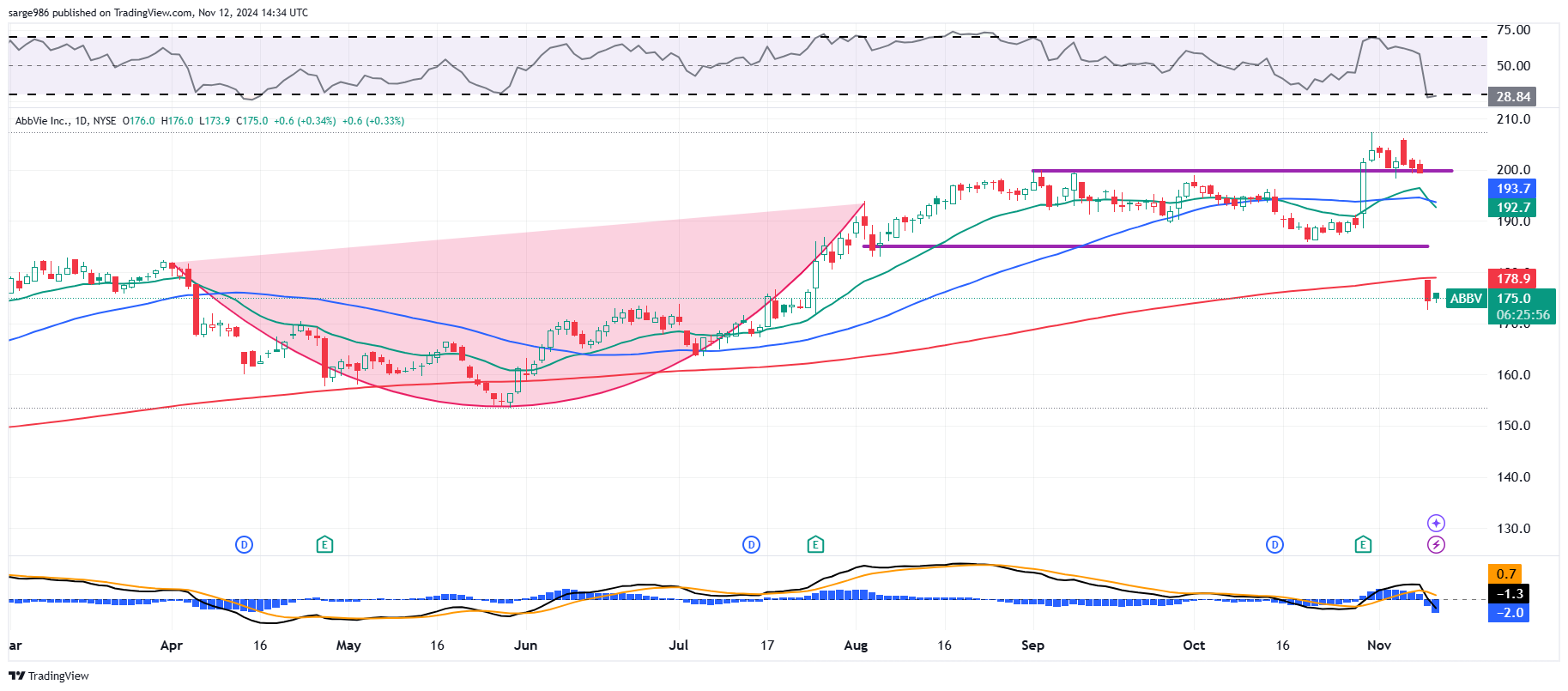
Readers will see that ABBV broke out of a sloppy-looking cup pattern that did not develop a proper handle this past summer. The stock then put together a basing period of consolidation with a $200 pivot that had been cracked to the upside on earnings ahead of Monday's severe beating. Now, the stock has lost both its 50-day SMA and 200-day SMA, forcing portfolio managers to reduce long-side exposure and giving up the 21-day EMA, which probably shook out some swing traders. Both the stock's RSI and daily MACD are now postured bearishly.
If trading the name, I would not automatically buy this dip. I would, however, be willing to take on a smallish to medium-sized long position either on a re-taking of the 200-day SMA, currently $179, or on a test of the May 2024 low down at $153. Otherwise, I watch. The dividend is solid, but it's not worth making a mistake. We have the luxury of allowing the stock to tell us if we should be long this name. The balance sheet is a problem waiting to happen in my opinion, so I would look at this more as a trader than as an investor.
At the time of publication, Guilfoyle had no positions in any securities mentioned.