Recession No More? Here Are the Signs
Treasury bonds and consumer stocks are sending the same signal.
You've reached your free article limit
You've read 0 of 1 free Pro articles.
For months, Wall Street debated the likelihood of a U.S. economic recession. The debate centered around whether Fed Chair Powell and the FOMC could engineer a soft economic landing, or if a hard landing was imminent.
Now, it seems there is an increasing possibility of no landing at all.
According to Goldman Sachs, the probability of a recession during the next 12 months fell from 20% to 15%. The investment bank lowered its estimate on October 8.
Meanwhile, the yields on U.S. Treasuries are flying. The yield on the 10-year note has jumped from 3.62% on September 16 to a three-month high of 4.27% on October 28, an increase of 65 basis points.
Higher yields are an indication that fewer interest rate cuts will be needed in the future. Rate cuts are implemented to prevent an economic slowdown, so the rising yields are an indication that the odds of a recession are diminishing.
The 10-year T-note is right up against resistance, left from July (black dotted line). Traders will be watching to see if the yield is rejected at that level, or if it can break out to fresh multi-month highs.
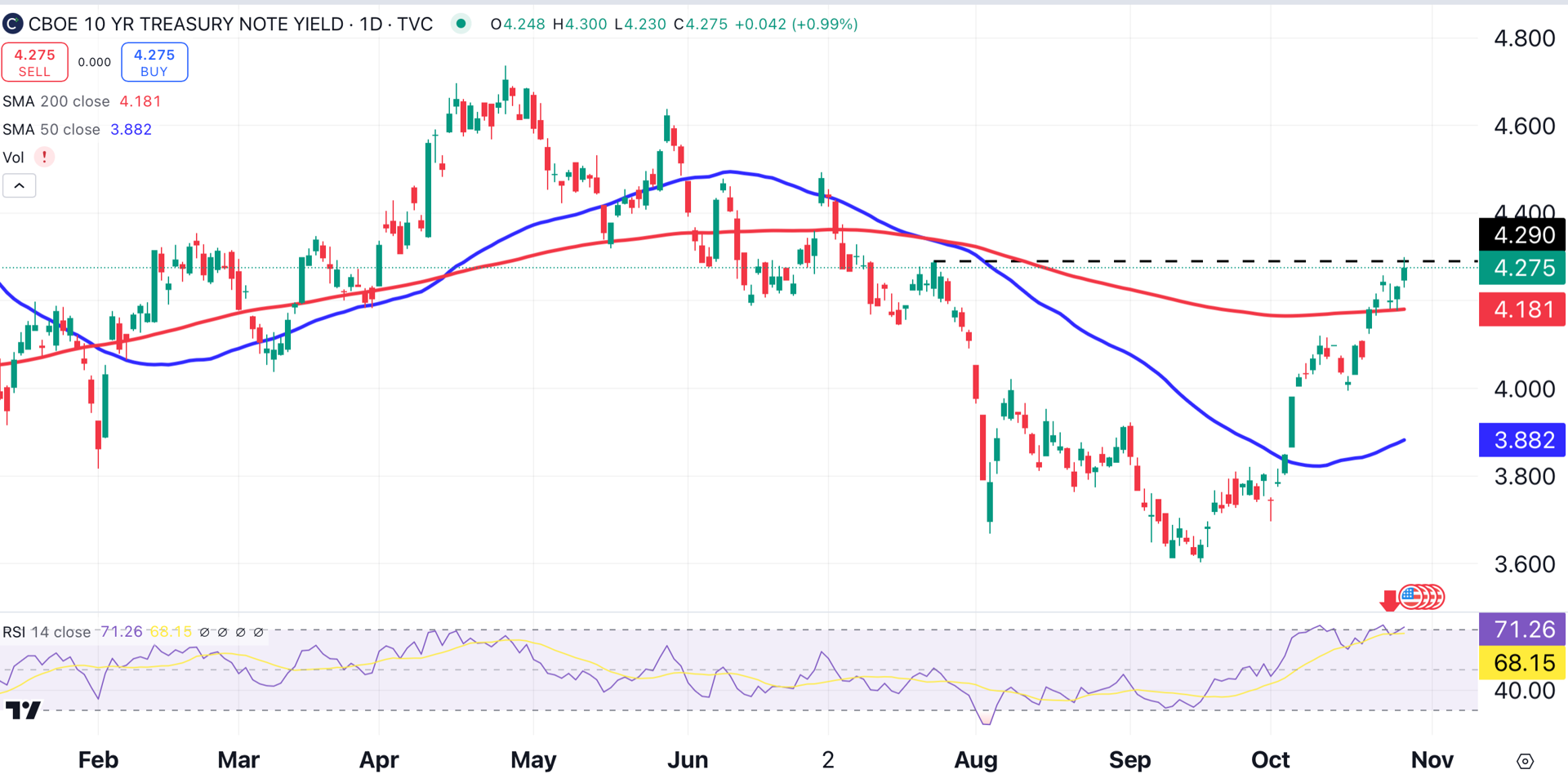
The 10-year yield’s RSI (relative strength index) has just climbed into overbought territory (red arrow) for the first time in over a year. I don't consider this a negative. In fact it could be positive, since an overbought instrument can always become more overbought.
The T-note is also trading above its 50-day (blue) and 200-day (red) moving averages, which are both rising.
The likelihood that the U.S. economy could escape recession is also demonstrated by the recent performance of consumer staples stocks. Consumer staples include items like food, toothpaste, soap, and detergent. This sector should outperform the market during a recession, because most of these products are considered necessities.
The sector, represented here by the SPDR Consumer Staple ETF XLP, reached an all-time high on September 16 (red arrow). That’s the same day that the yield on the 10-year Treasury note reached its low point for the year, and it’s not a coincidence.
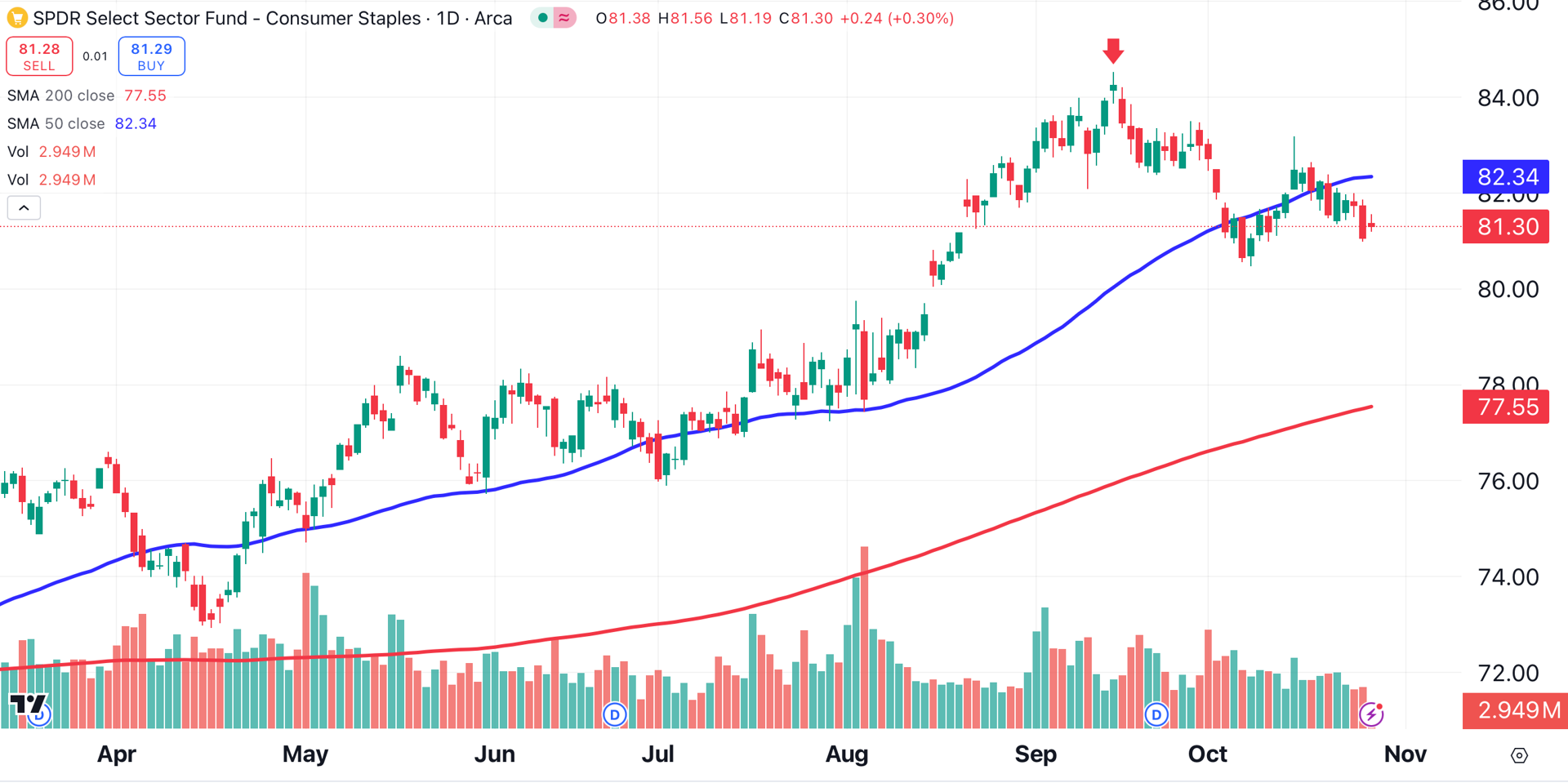
Since then, consumer staples stocks have been trending lower. Institutions likely beefed up on these stocks as a recession appeared inevitable. Now, they’re selling these same names.
On Monday, XLP closed below its 50-day moving average for the sixth consecutive session. On the same day, the 10-year yield closed above its 200-day moving average for the sixth consecutive session.
Why did events transpire in this manner? Both consumer staples stocks and Treasuries are defensive instruments. If Treasury yields are rising, that’s because institutions are selling Treasuries.
The same logic applies to the decline in consumer staples stocks. This sector started to underperform the market at the same time that Treasury yields began to rise.
Institutions hire armies of researchers. If institutions are simultaneously selling defensive positions, like Treasuries and consumer staples, those researchers have uncovered something very positive about the U.S. economy.
It’s like my mentor said: “Always assume that someone has information that you don’t have. You don't have to know what they know. You only need to know if they are buying or selling."
At the time of publication, Ponsi had no positions in any securities mentioned.