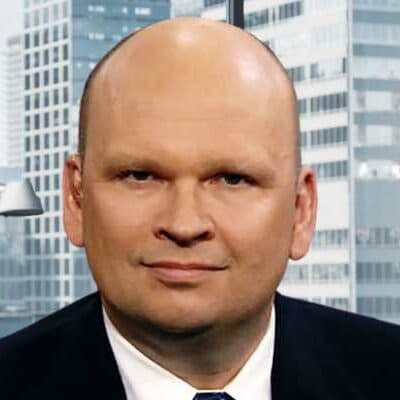
Kevin Warsh Could Change Rate Cut Stance After Joining Fed
There's good reason to dismiss the hawkish narrative surrounding President Trump's pick for Federal Reserve chair.
You've reached your free article limit
You've read 0 of 1 free Pro articles.
We discussed Kevin Warsh on Friday (along with gold, bitcoin and the flippant use of “debasement”), but I have had more time to ponder what is likely to come.
Dismissing the 'Warsh Is a Hawk' Narrative
We are looking for three rate cuts by September. Not 300 BPS, just 75 BPS. That isn’t a heavy lift.
It is easier to be hawkish when you are not the person who risks sinking the economy into a recession.
We’ve argued for ages that whoever becomes the Federal Reserve chair immediately shifts two notches more dovish. Yes, inflation is painful, but by definition, it typically takes time, and is more of a “slow bleed” that is often masked in the early stages. Recession hits pretty hard, pretty quickly.
Do you really think the Fed chair errs toward fighting inflation rather than keeping the economy running smoothly? (They got it wrong in the other direction once).
My working assumption is that it is more difficult to be the “inflation hawk” when you are going to get the primary blame for tanking the economy, when the president (and Scott Bessent and Stephen Miran — more on him in a moment) all want you to cut and when your wife’s father is a pretty large donor to the administration.
Imagine that Thanksgiving dinner conversation: “You didn’t cut, we lost the midterms because of that, please pass the gravy.”
Miran spoke on Friday, and I swear he has been reading the T-Report as he argued about the reality of the neutral rate being lower than the current Fed believes (in aggregate). There are valid arguments for cutting.
More importantly, he argued, as we have for years, that housing in CPI is lagged. It tells us things from six months to a year ago — not today. When we all know (mathematically) that the data in CPI is wrong, why do we base decisions on it? We missed “transitory” because of this and we are at risk of missing a shift in inflation again.
Reluctance to Use the Balance Sheet
This one is tricky for me as I do believe quantitative easing (QE) tends to spur inflation.
So, it is easy to see Warsh not wanting to use QE to control the yield curve. Having said that, Operation Twist is not viewed as balance sheet expansion by the Fed. Us mere mortals view Operation Twist as a form of QE because it takes a lot of duration out of the market (selling bills to buy bonds).
So, that part of my view has not been removed. Even if he cuts and the market becomes convinced that it was warranted (which I think it is), he might not have to do much to control the long-end of the curve. Will he do QE/yield curve control?
I’m less certain that is the ultimate endgame with him, but I still find it difficult to believe that we won’t take extraordinary measures to lower mortgage rates (more on that later), which are linked to the 10-year.
Coordination and Cooperation Are Coming
Another theme from last week (and prior reports) is that we should expect more coordination between the administration, the treasury and the Fed. Warsh’s choice fits that narrative well.
I think the market will come to terms with this, but I also think the “debasement” trade was so overdone, and there is more unwinding on that.
I am worried about AI and crypto, largely because I think concerns and fears about the cost of electricity are gaining traction and the market (at least in AI) remains positioned too bullishly.
With bitcoin hovering near the reported average cost of (MSTR) (just over $76,000) we might be at an inflection point. Either the ability to buy more is demonstrated and pressure is released, or concerns mount and the ongoing sell-off continues.
I think the sell-off that started on Thursday and resumed on Friday has more to do with other factors (overcrowded debasement trades, heightened geopolitical concerns and overly bullish/complacent positioning than the announcement of Warsh).