Why Are Buffett-Backed BYD Shares Up But Tesla Suffers When Slapped by EU Taxes?
In the strange world of EV imports into Europe, Tesla is a Chinese manufacturer, and Mercedes says Europe should cut, not hike, taxes on the Chinese competition.
You've reached your free article limit
You've read 0 of 1 free Pro articles.
The European Union has slapped hefty import duties on Chinese electric vehicles. It was telegraphed, but the market response has been … unusual, to say the least.
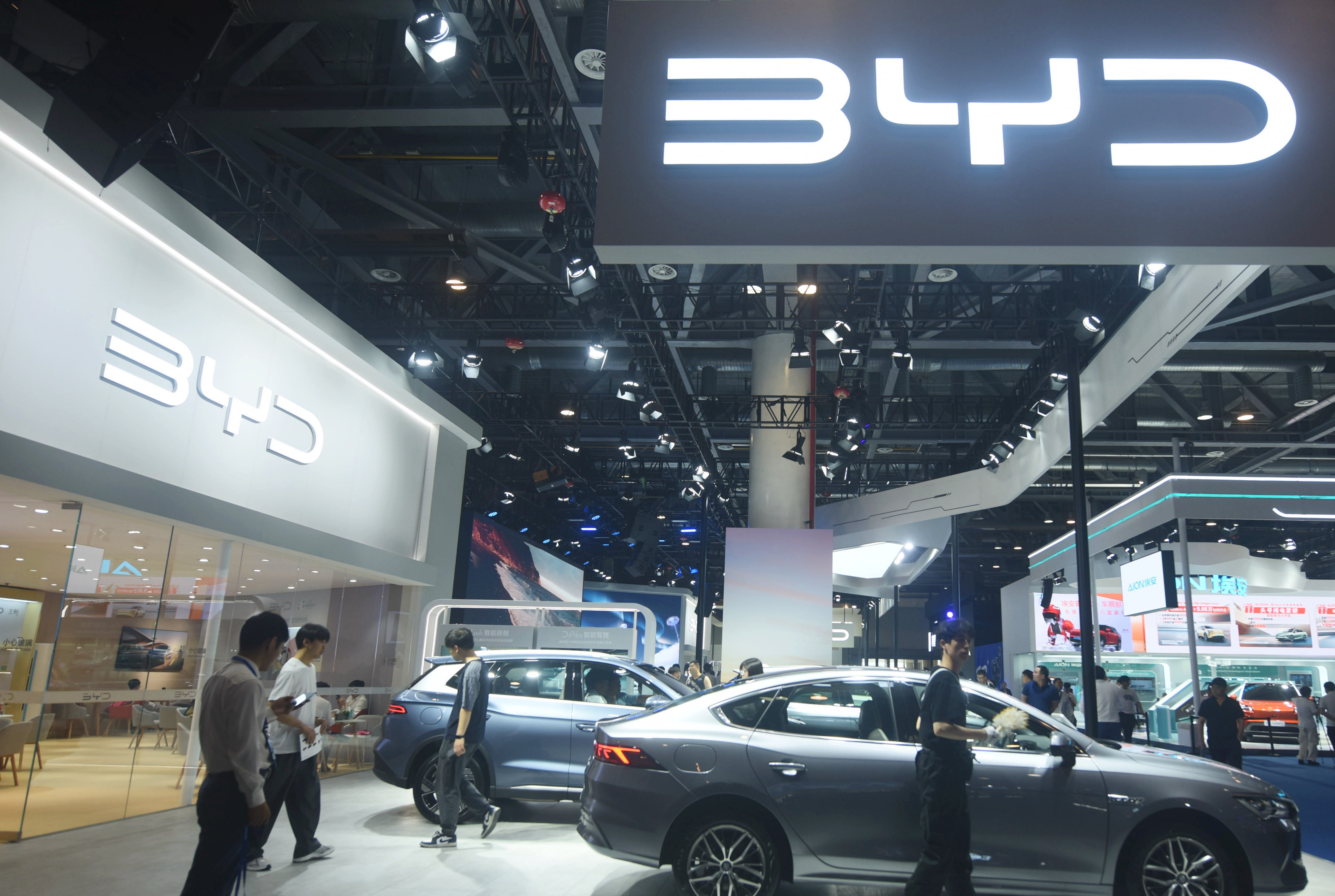
Shares in BYD BYDDY (HK:1211), the Chinese EV maker backed by Warren Buffett, have actually risen after being hit with the E.U. tariffs. The stocks of rival European automakers such as BMW BMWYY and Porsche POAHY, which will benefit from greater protection, have meanwhile fallen.
Last but not least the little-known Chinese brand Tesla TSLA will be hit by the new duties.
Say what?!
Europe, which launched a politically charged investigation into the topic last October, has decided that Chinese battery electric vehicles benefit from unfair government subsidies at home. So the European Commission is imposing an import tax of as much as 48% on Chinese battery electric vehicles.
It is the “as much as” that partly explains the share-price moves.
The European authorities sampled three Chinese EV makers. It rules that the import duty on BYD cars will be 17.4%, while on Geely Automobile GELYF (HK:0175) vehicles it will be 20%. SAIC Motors (SH:600104) will pay the full 38.1%. All three cooperated and provided data to the European authorities.
If other Chinese car companies have cooperated with the investigation, they’ll be subject to an average duty of 21%. And all Chinese EV makers who didn’t cooperate with the European investigation will pay the 38.1% extra freight.
There was already an existing 10% import duty on all EVs imported into the European Union. So the maximum new import charge, to be taken by the customs of the individual nations, will be 48.1%.
In an ironic twist, Tesla is actually affected since it is making cars for sale in Europe at its Shanghai factory. So it’s technically a “Chinese” EV producer, in terms of import taxes, although it has requested and been granted “individual consideration” to pay a special rate. That’s yet to be declared.
European car companies can even fall under a similar situation, making cars in China to send back “home.” BMW and Renault RNLSY make EVs at their Chinese joint ventures, for instance, then ship them back to Europe for sale.
It is the European “Chinese” manufacturers that would be hurt the most by higher E.U. duties, according to some fascinating analysis by the Rhodium Group. A Volkswagen ID.4 made in China sells for 49.4% more in Europe than when sold locally in China. But a BYD Seal U sells for 92.9% more, virtually double, meaning BYD makes €14,300 on an E.U. sale vs. only €1,300 on the same model sold in China. So BYD can still absorb the higher duties and make more with a European sale than one at home.
Duties in the 15% to 30% range would “wipe out the business model for foreign players like BMW or Tesla, which are using China as a base for exporting to Europe,” Rhodium said prior to the tariff announcement. BMW already makes only 9% more on a sale in Europe of a Chinese-made iX3 SUV, for instance.
The new duties will go into effect from July 4 unless discussions with the Chinese authorities lead to “an effective solution.” The sampled companies also have the chance to respond.
Since BYD would “benefit” from the lowest extra tax, its shares have been on the rise. They’re up 4.2% in Hong Kong trade since Wednesday’s close. That leaves them sitting on a 9.6% advance so far this year.
The company doesn’t have any component of state ownership. That’s unlike SAIC, which is listed in Shanghai but is 63% owned by a government holding company. Its shares fell on Wednesday but have since recovered, up 1.3% since last week’s close.
BYD has an added attraction in that it is building a production base within the European Union, in Hungary. The company said in January that it will make both full EVs and plug-in hybrids at the plant, which is due to begin operations in three years. It has even hinted at starting a second assembly plant in Europe in 2025.
BYD says its plan is to secure 5% of the European market for EVs by 2026. It ultimately intends to build itself into one of the top 5 car companies in Europe. And it has stolen a lead on the competition, one they will no doubt now scramble to follow.
The U.S.-listed Chinese EV makers have suffered, since they face the higher freight. Nio NIO is down 8.3% in Hong Kong since Tuesday’s close, XPeng XPEV is 7.9% lower, and Li Auto LI (which so far hasn’t demonstrated European aspirations) is down 3.0%.
I should note I own small stakes in Xpeng and Li Auto as well as BYD, but have sold out of Nio. Their stock price oscillates wildly and I’m considering selling the other stakes to reinvest the proceeds all in BYD.
Xpeng management has said the E.U. probe could steer it toward production in Europe. SAIC Motor, which to confuse matters owns the British brand MG Motor, has a parts center for MG in Amsterdam, and plans a second facility in France.
Geely is working with a Polish state-backed company to build an EV plant there. But the plans were paused since they were approved in 2022 under a previous Polish administration. It’s not clear how or if they’ll proceed.
Tesla stock is up 7.0% since Tuesday’s U.S. close, before the E.U. move, but I’m sure investors are far more focused on Elon Musk and his pay packet than anything else. The shares have suffered this year, of course, down 26.6% despite this week’s action.
The E.U. decision was pushed back until after European Parliament elections that saw a distinct shift toward conservative, protectionist and anti-immigration politics. So the new taxes fit the pattern.
They are not, however, as punitive as increased duties in the United States. U.S. trade tariffs rose from 25% to 100%, effective this year. The move is part of a raft of tariff changes that also increase the duty on semiconductors, solar panels and a smattering of other goods, as I explained when they were announced.
While the actions from the Biden administration are anticipatory, seeking to ward off a flood of cheap Chinese EVs, shipments into Europe are already significant. They have ballooned from US$1.6 billion in 2020 to US$11.5 billion in 2023, with cars from China accounting for 37% of EVs shipped into Europe.
But this is a two-way street. Another way that the situation differs is that China is a major destination for European car companies, too. German companies in particular both make cars in China and ship significant amounts into the country.
China can, of course, retaliate. It may do so in a way that hurts European car companies but is also targeting certain symbolic goods such as brandy, having launched its own anti-dumping probe on the spirit in January. Dairy products and aircraft parts are also in the crosshairs. That could help drive a rift between French and German companies in particular, and the national governments that champion their cause.
The markets clearly think the European brands will suffer. Mercedes-Benz DMLRY shares are down 3.3% since the Chinese EV decision, BMW is off 3.7% and Porsche shares are down 4.5%. They all ship their expensive high-end European-made cars into China. Even the Swedish manufacturer Volvo VLVLY, which is now majority owned by Geely back in China, is off 2.5%. Volkswagen, with a Chinese j.v., is down 5.8%.
Perhaps that’s why the boss of Mercedes-Benz called on the European Commission to cut rather than raise import duties on Chinese EVs. Mercedes CEO Ola Källenius in March stated that protectionism is “going the wrong way,” the FT, and that increased competition from China will ultimately force European car companies to produce better vehicles in the long run.
“Don’t raise tariffs,” he told the Financial Times. “I’m a contrarian, I think the other way around. Take the tariffs that we have and reduce them.” To see Chinese companies importing into Europe is a “natural progression” of competition, and “needs to be met with better product, better technology, more agility,” he explained. “That is the market economy. Let competition play out.”
At the time of publication, McMillan had positions in Xpeng, Li Auto and BYD.