Is It Finally Time for Small-Cap Stocks to Take the Lead?
Small-caps have lagged for so long that many have given up on the asset class — but not famed investor Stanley Druckenmiller.
You've reached your free article limit
You've read 0 of 1 free Pro articles.
On Wednesday, I discussed the Cheap Fake Bull Market, which has been running for a while now. It has been an increasingly lopsided market that has been distorted by a small group of big-cap names for a while. Eventually, this dynamic will change, and the most logical resolution is that the lagging stocks will finally start to perform better.
It has been a nuclear winter for small-caps for over two years now. They have done nothing and have consistently lagged the Nasdaq 100 QQQ for so long that many investors have given up on the asset class. It has been a very tough period for traders like me that focus on small-cap stock picking.
This is what the iShares Russell 2000 ETF IWM chart looks like. After the Covid panic and recovery in 2020 and 2021, there was a frenzy in smaller stocks as meme stock trading and short squeezes took hold. This coincided with the SPAC frenzy and eventually led to a top in late 2021. Small-caps have consistently underperformed since then and have been in a choppy trading range for the last two years.
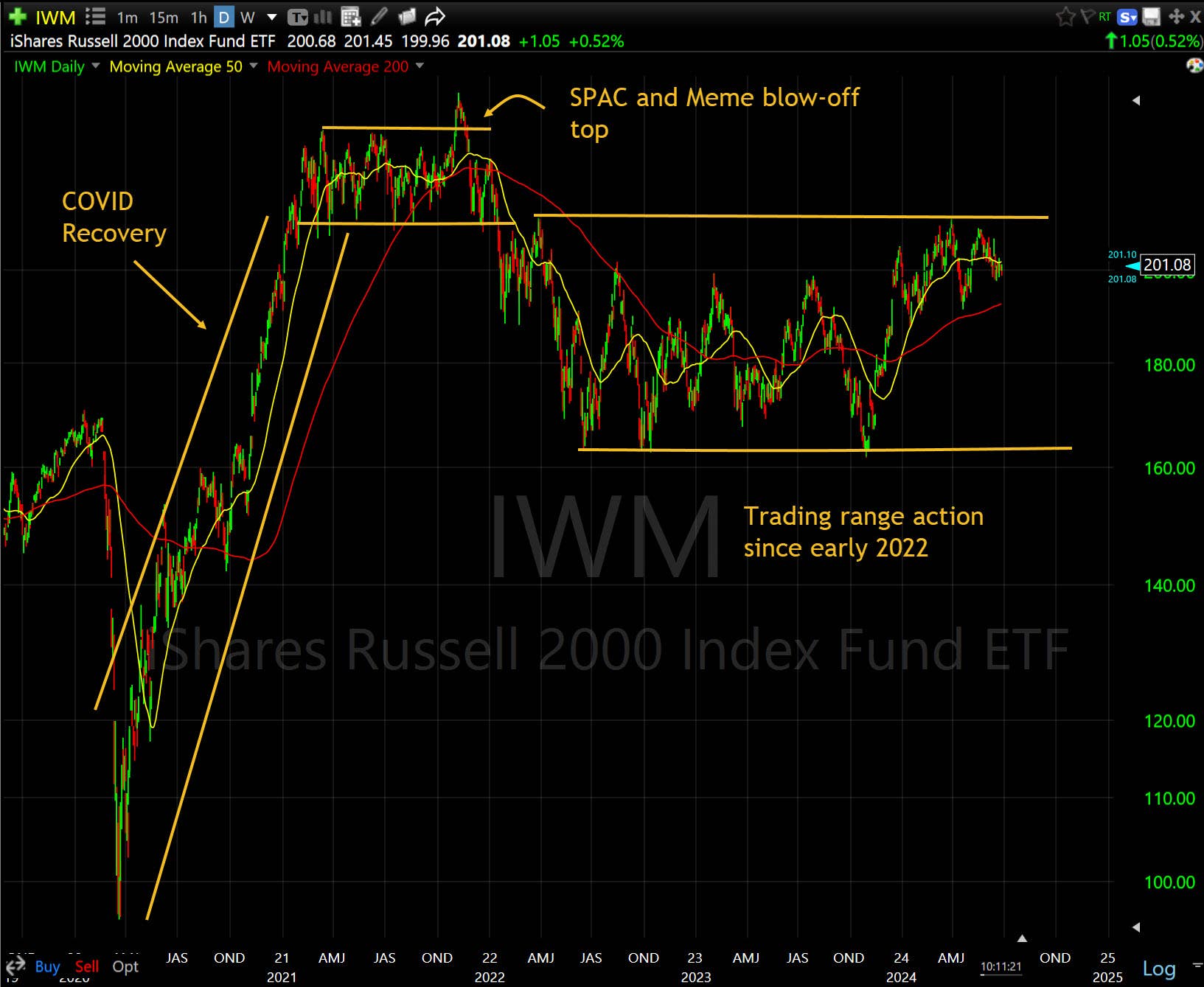
One reason that some strategists are starting to believe that small stocks may finally start to exhibit relative strength is because the Fed is moving closer to cutting interest rates. Smaller-cap companies tend to carry more debt and have more capital needs than big-caps, so they will benefit from lower rates. In addition, the cyclical nature of the market suggests that it may be time for small-caps to "revert to the mean" and play some catch-up.
At the end of March, famed investor Stanley Druckenmiller, who recently made a killing on his investment in Nvidia NVDA, reported that his fund had bought call options on 3,157,900 shares of the iShares Russell 2000 Index IWM worth around $664 million. This was his biggest position in March. We don’t know exactly what is currently going on with this position, but it is obviously a timing bet on the recovery of smaller stocks.
As a trader, I have always preferred smaller stocks for two reasons. The first is that they are not followed as closely by analysts and are often priced inefficiently. Good stock pickers can find great opportunities that the market has not yet identified.
The second reason is that small-caps carry more risk, and they also offer much more potential rewards. For example, Hut 8 HUT, which I mentioned the other day, is up 70% in about 12 trading sessions. Big-cap stocks simply do not make moves of that magnitude so quickly.
The Russell small-cap indexes will be rebalanced at the close on Friday, which will be a good time to start looking for the next crop of winners. I’m hopeful that Druckenmiller is right and the long drought in the group is about to end. There is nothing more profitable for aggressive traders than small-cap rallies.
More Trading Basics
- The Most Important Thing I've Learned in 25 Years of Trading
- Day Trading Is Very Difficult: Here Are 6 Tips for Long-Term Success
- Everything You Ever Wanted to Know About the CNN Fear & Greed Index
At the time of publication, Rev Shark was long HUT.